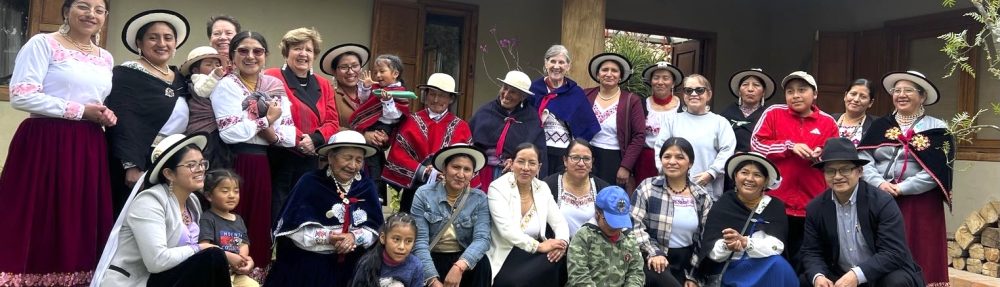
Dear Friends, As we celebrate our scholarship program’s 21st anniversary, I want to thank each of you for your generous support over the years. With your help, thirty-five Cañari women have become university graduates and professionals. Twelve are currently studying, six have earned master’s degrees or the equivalent—including one Fulbright scholar—and another has earned a PhD. To make it easier to follow the stories of so many scholarship women, I’ve grouped them by graduation year: the “earlies” (2006–2012), some of whom now have daughters of their own attending university; the “middles” (2014–2020), now mid-career professionals; and the “presentes and newbies” (2021–2026), our current scholars, recent graduates, and three newly enrolled young women (two in medicine, one in economics). So, here we go! We’ll start with our Doctor of Veterinary Medicine…  Juana Alvarez (UCuenca, 2015; PhD, UNAM, Mexico, 2025) shared a video made by her company, GenoMar, in Guayaquil. In it, she explains her work as a research scientist in marine genomics, focusing on shrimp, a major Ecuadorian export. “I’m working with a team of geneticists to improve survival rates and harvest weights through science-based decisions in the lab and in small- and large-scale industrial farming trials.” This past July, Juana presented a research paper in Madison, Wisconsin at the 13th World Congress on Genetics Applied to Livestock Production.She writes: “It was the only paper accepted from Ecuador, out of 900 proposals submitted worldwide.”
 Mariana Solano, with a master’s in Sustainability and Development (UAzuay 2025) works with SENDAS – as a technical specialist on the project, “Rural and Indigenous Women and Young People Addressing Climate Change. One of her activities is
 I Am Territory, a video series highlighting the roles and contributions of rural women. One of those featured is another of our graduates, Nancy Bermejo (URiobamba, 2010), who created the community association Sumak Makina to promote traditional agriculture and grains such as amaranth and quinoa.
 Paiwa Acero, a more recent graduate (UCuenca, 2021), completed her two-year Fulbright master’s program in civil engineering at the University of Illinois Chicago in 2025. Over the past year, she worked with a team in Cuenca designing drainage systems for underserved areas of Guayaquil. “These systems are part of a long-term plan to be implemented over the next 30 years,” she writes. She has co-authored her first academic article, based on her master’s thesis: “Challenges Impacting Alaska’s Critical Infrastructure Systems.”
 Mariana Acero Chuma graduated in nutrition in 2014 and, after years as a nutritionist at a regional hospital, now serves as a lead promoter with the Cañar Provincial Directorate of Health. “I work in the promotion of sexual and reproductive health, the prevention of gender violence, and the strengthening of mental health, food, and nutrition. We also work on intercultural health, coordinating actions with midwives and men and women of ancestral medicine.” Other “middle” graduates have become leaders in Cañar and their communities. Here are a few of our heroines: Margarita, supervisor of the regional 911 services; Pacha, our favorite dentist; Carmen, who created Kinti Wasi, a program in her village offering cultural exchange with U.S. students; Marta, transitioning from years in nursing to traditional medicine; Aracely and María Teresa, ecotourism graduates who manage neighboring hostels near the Ingapirca archaeological site; and Mari and Verónica, professionals in accounting and management with the municipality of Cañar.


 Recent graduates (2022–2026) include Sara, Nube, and Nataly in economics, all three working with savings and loan cooperatives; Verónica in nutrition (currently pursuing her master’s degree), Tannya, in education (sciences and math), and Elsa in environmental engineering.
 Our Cañar committee/board now has eight members: five graduates, a treasurer, one male partner (our expert in meeting protocols), and me. As of 2024, we are an Ecuadorian NGO, registered under the rather long name Programa de Becas Universitarias Para Mujeres Cañaris Ana Margarita Gasteazoro. (Ana would be so proud.)

 We meet every couple of months to check in on our scholars, review applications, keep our finances in order, and … share a kukayo or potluck meal. These usually feature recently harvested potatoes, corn, beans, homemade cheese, broccoli from my garden, and occasional bits of chicken or cuy (guinea pig).
 Oh, and I see two future candidates playing in the patio while their mothers are at the meeting. To end on a personal note, I’m happy to report that Michael and I are heading to Ecuador on November 1 for our 22nd year of living six months a year in Cañar. If you’re subscribed to my Cañar Chronicles, you’ll soon be hearing from me. If you’d like to subscribe for free, go here: https://judyblankenship.substack.com/
Thank you again for being part of this remarkable story. Your generosity has helped make these women’s achievements possible. Please stay in touch, and know that your support of our program means so much to our scholarship women, their families, and their communities. With gratitude, Judy B
CWEF is an official 501(c) 3 nonprofit, which means your contributions are tax deductible and every dollar goes directly to the women. Checks can be made to CWEF and sent to Charlotte Rubin, 2147 NW Irving St., Portland, OR 97210. Or you can contribute through PayPal with the secure “DONATE” button above. Thank you, Judy

Thank you for being such an inspiration!