Dear Friends: We are into week three of a national lockdown in Ecuador, with obligatory masks, barricaded streets, and a curfew from 2:00 PM to 5:00 AM. That allows us to move about (on foot) in the mornings for groceries and other necessities.  One of us goes out about once a week for shopping in town where only small stories, bakeries and banks are open. Soon after 2:00 I hear sirens go off for about ten minutes. It sounds to me that the police are circulating into neighborhoods and comunas with sirens blaring, but none has passed by on our road. But the other day when I was out in the front garden, I saw a man running down the road about 2:30 and I remembered that on government order we can be fined for breaking the curfew at $100 (first time), second time basic salary, and so on. (Though I wonder if it is being enforced in Cañar.)
 The photo above is part of the agricultural cycle we’re watching from our living room windows – accelerated, I think, by the many country neighbors stuck at home during the quarantine. These images also help explain why we are literally surrounded by farm produce that gets sold on the streets and small stores through this crisis. So…on Day One we saw cows gleaning the cornfield after a harvest.
On Day Two, we saw the fires burning what was left on the field. On Day Three, plowing the field with yoked oxen.  We took a walk that day and saw these bulls at rest (it was lunch hour), but you get a good picture of the hand-hewn wooden yoke, with the long neck of the plow tied between the bulls. On a later walk we stood and watched a farmer and his helpers try to tie a yoke onto a fiesty bull, who obviously knew what it meant a hard work day ahead- a difficult and dangerous job for the farmer.
Day Four, we watched the family planting and fertilizing with bags of guano. Now we’re set for the cycle begin again. It’s comforting to see how much agricultural activity still exists around us, after years of massive out-migration, urbanization, and low-income production. Here is a field of potatoes in bloom just below our house.
On another theme: I got an email last week from the director of the Fulbright Commission in Quito with instructions on how to leave the country on April 7 on a charter flight for the U.S. (No commercial flights can leave or enter Ecuador.) Fulbright and Peace Corps students and volunteers have already been evacuated, and I guess the offer was extended to me as an ex-Fulbrighter, or maybe just as an American. In any case, it was a crazy scary scenario: (1) make a reservation on the flight to Miami with the U.S. Embassy; (2) then we qualify for a safe conduct pass on a special bus from Cuenca to Guayaquil (the epicenter of the Covid-19 outbreak). (3) Once in Guayaquil, the message read, the plane might be delayed, so be prepared to wait it out in a hotel. (The flight is with Eastern Airlines – didn’t they go bankrupt about 20 years ago? Yes, but someone bought them and they now do charters out of Miami. No mention of cost of flight.)
I emailed back: Thank you very much, but NO WAY are we leaving Cañar. It seems to us the safest place we can be these days, and probably for the next few months…
Although I continued to believe Ecuador’s numbers were low, I read the news today (April 4) and see that the both the case numbers and death rates are high (3.4%). Ecuador reports 3465 confirmed cases, 172 deaths. Nearly 50% of our cases are in Guayaquil, the coastal city of 2.3 million that is hot, low, humid, with with much poverty and lack of basic services. The images I see today that have been shown around the world are appalling: cadavers left in the streets or wrapped in plastic in family homes, caskets or bodies left on the curb, even DYI cremations, as hospitals, morgues and funeral homes are overwhelmed. Guayaquil is our New York – people are fleeing for the mountains, avoiding roadblocks by taking back roads and “goat paths” as someone described it. Our first case in Cañar was someone who had visited Guayaquil, and today we are at 5 cases.
And that is why, in part, indigenous communities, or comunas, around Cañar are setting up their own roadblocks. Below our house we came across this chain, resting on the road, but obviously it is ready to be raised to prevent cars from coming in.
Michael wants me to mention his new theory: that dogs, realizing people are disappearing from the streets, are reclaiming their territory. “The dogs on my way into town are more aggressive” he said the other day. “They never barked before; now they do. One even ran out into the street and lunged.” He is convinced Cañar dogs have been waiting for this moment. Most run free anyway, but they usually have a healthy respect for pedestrians. No more. Here we found them on our walk – having an organizing meeting, with minimal social distancing. (See the little gray mutt under the chin of the dog on the right?)
But our favorite dog from next door, Gordo, would never bark or lunge or join that group of ruffians. He guards our house, keeps other dogs away, and loves Michael for the morsels thrown his way every now and then. All it takes is a whistle and Gordo comes running. 
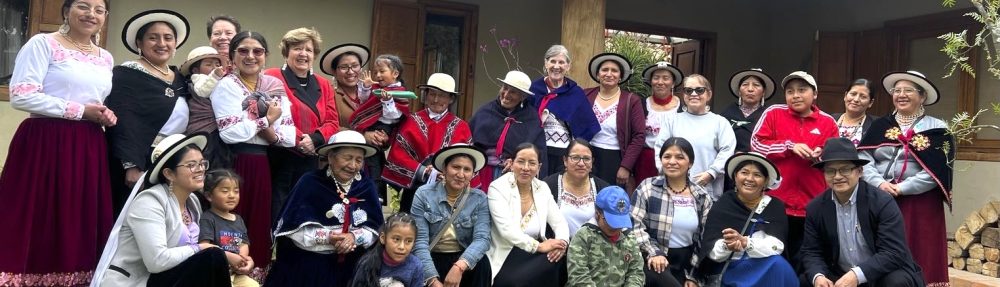
To finish this update: my thought are with our scholarship graduates who are working in front-line health care through the crisis: four nurses, one physician, one dentist, one medical laboratory technician and at least one current student who is set to work in a hospital as a nutritionist. Here are photos of a few – we hope they all stay safe.


The Cañar Book Club
As I’m constantly reminded, books are even more important during our home confinement. I’ve been downloading lists of “must-reads,” reserving e-books from my local library and looking with alarm at the few unread books I brought from Portland in that lifetime ago. Our Cañar Book Club members are doing the same – and I’m happy to pass on these recommendations
Joanne in Mexico:- Gods of the Upper Air by Charles King: “fascinating look at race, culture and the history of anthropology – very readable.” And A Woman of No Importance:The Untold Story of the American SkypWho Helped Win WWII by Sonia Purnell, “a biography that reads like a spy novel.”
From Joan in Leige, Belgium: “Just listened to audio book of The Milkman by Anna Burns and it was great.”
From Nancy in Portland: Half Broke Horses, by Jeannette Walls, author of the Glass Castle. “This one is billed as a “true life novel” — the story of her grandmother, who led an adventurous life in New Mexico, Arizona and Chicago. It’s peppered with actual photos of the grandma and family, and she’s framed the narrative around authenticated family stories, but wrote it in the 1st person of the grandmother, so she’s created a lot to fill in where the record doesn’t. A competently written page turner.”
Lisa in Savannah: “I am reading Vera by Stacy Schiff (author of my favorite – Cleopatra). “It is a biography of Vladimir Nabokov’s wife. I loved Cleopatra so much that I just read it again recently. Still mind-boggling exciting the 2nd time!”
Pat in Bend, Oregon: “In my book club we were reading, just before the outbreak, The Great Influenza by John M Barry, a history of the 1918 pandemic. I don’t recommend reading this now, but it made me acutely aware of what can happen. I do recommend two beautiful books that sweep you away into nature: 1) Of Wolves and Men by Barry Lopez an 2) Edge of Awe, a collection of writing about the desert that includes William Kittredge and Ursula Le Guin.”
Laura in up-state New York: The Overstory by Richard powers and Underland by Robert Macfarlane.
Irene in Salem: The Wright Brothers by David McCullough. “I found it a terrific read and well written.”
That’s it for now, dear friends. I need to send this off, so will wait until next time for my own recommendations. Stay well, stay safe, stay in place, and stay in touch. Here’s where we’ll be for the unknown future (photo by our goddaughter, Paiwa, who is with us for the duration.)


