Settling In

panoramaIt’s two weeks now since we arrived in Cañar and, along with our various systems – we are settling in. We had no water for the first 24 hours, and then only dribbles in the days that followed. Michael lay awake at night refiguring his plumbing systems. Last year, after a new city sewer/water main came down our street and we hooked up, Michael disconnected our big water storage tank, thinking we’d have city water 24 hours a day. Ha! There was also a pesky leaking pipe under the tile floor in the laundry room, connecting the tank. He fixed the pipe but left the pump disconnected. Last July it was easier to leave it all behind, foolishly assuming we’d have a constant source of water this year. M in bodga

Michael grumbles and predicts the worst possible scenarios – “We may never have running water again!” – but he’s a puzzle guy and can’t resist an interesting problem like this. He searched his bodega for parts, made lists and went into town, lie awake at night or dreamed Rube Goldberg schemes, and cursed as he struggled with the big tank in the pump room, or sprawed on the floor in the laundry room, wet with spray.P1110697

Five days later, after he’d fixed some related electrical problems and we had our first hot showers, Michael’s mood changed for the better and he announced that we are now ready for guests.

* * * *3 mujeres

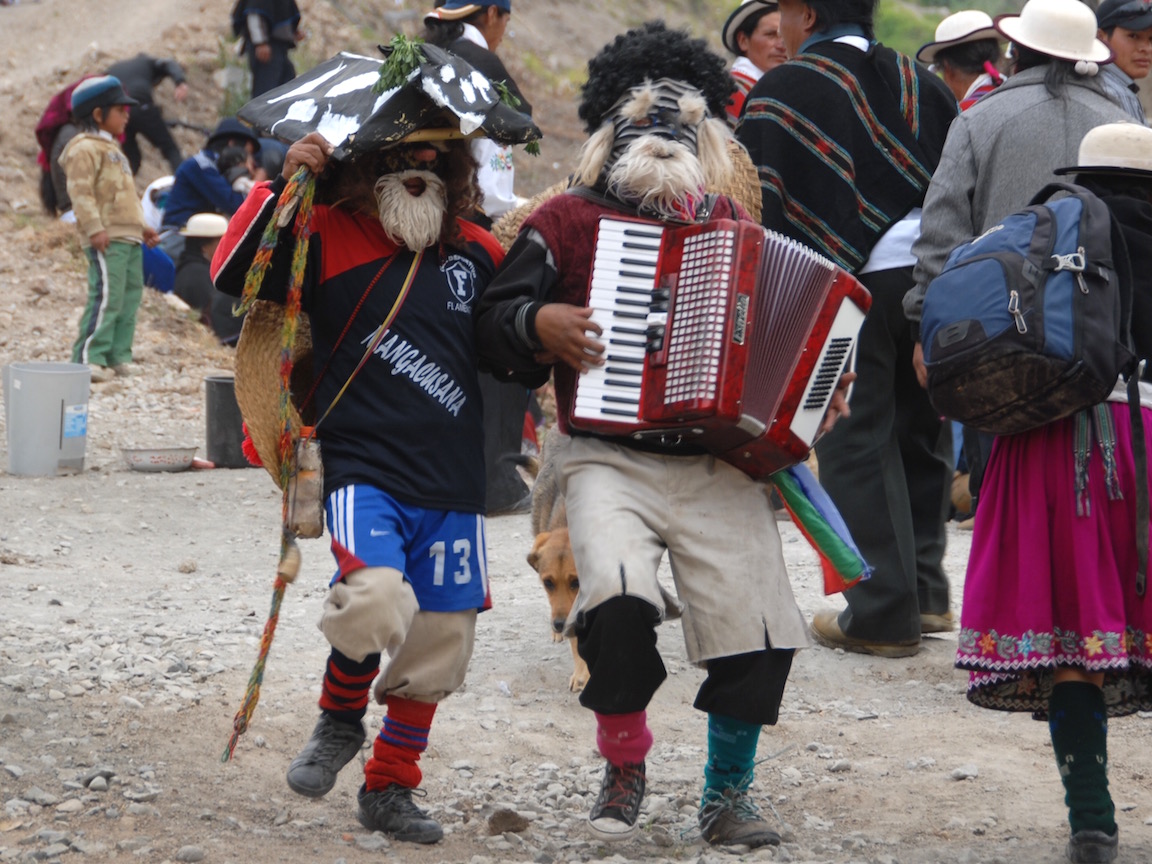
Meanwhile, I went to work. The Fiesta de San Antonio always comes middle of January, before I’m well acclimated, and the eight-day fiesta – most of it at 11,000 feet – is rigorous to say the least. I usually photograph one or two days. This year I worked one day, on Saturday, when the community gathered at the church for a blessing of their tiny saint (about 8 inches tall) followed by a procession through the town and into the country to the house of the prioste, this year’s host of the saint. There, while the saint rested in his special room with candles and incense…

San Antonio w candlesoutside there was dancing of the vacas locas, music by different groups, and the crazy antics of clowns called rukuyayas

2 efigiesvaca loca kid  rukuyaya rukyaya dancing.

Finally, around 4:00, the host community served a meal to about 300 people. Incredible. A pampamesa, or “table in the field”  is just that: for a communal work day, fiestas, even funerals, women bring warm food wrapped in baskets or shawls on their backs, and at the appropriate moment, they sprinkle it along white cloths laid on the ground. Usually a mix of small bits of chicken or roasted pork, but mostly potatoes, corn, beans – the basics of the Andean diet. People sit alongside or stand behind if it’s a large crowd, and slowly eat bits and pieces until full. It’s a wonderful way to serve a big crowd, without utensils or dishes. Here you see only mote, boiled corn, while we wait for the good stuff.pamomesa

This year I had the pleasure of working with a partner – Allison Adrian, an ethnomusicologist from Minneapolis who has come for six months with a sabbatical and Fulbright to research Cañari and Saragureño music. During the long day, she recorded in audio and video, and I with photos. I can see we are going to work beautifully together. Welcome, Allison!Judy _ Allison

___________________________________________________________________________

Finally:  announcing the CANAR BOOK CLUB

Scholarship program progeny in Judy's book cornerI’ve been a big reader since childhood, but I’ve never been in a book club. I asked to join one once, but the group was already well established and the members felt they couldn’t integrate another person. I understood. So I’m going to create my own Canãr Book Club, and I invite you to join. I’ll report on what I’m reading and you tell me what you are reading, what you recommend, what you think. I’ll put this at the end of every Chronicle so those who are not so interested can leave off!

At the moment, I’m in book two of the “Neapolitan Novels” by Elena Ferrante: The Story of a New Name.  I started and finished the first one in October on a lightening trip to Ecuador, when I had many flights and many hours of reading. The second book is going slower, and with only 30 minutes or so of reading at bedtime and early morning, I find I’m growing impatient with the pace and obsessive, almost suffocating, details. This morning I picked up Dear Life, Alice Munro’s last book, and it was like a breath of fresh air to read one of her short stories. I remember discovering Munro when I lived in Toronto, and thinking, “How does she do it?” It looks so easy. Inspired, I tried a story of my own. Hmm, silly thought, not so easy, trying to copy a genius.

Stay in touch!
 

Cañar Redux, 2016

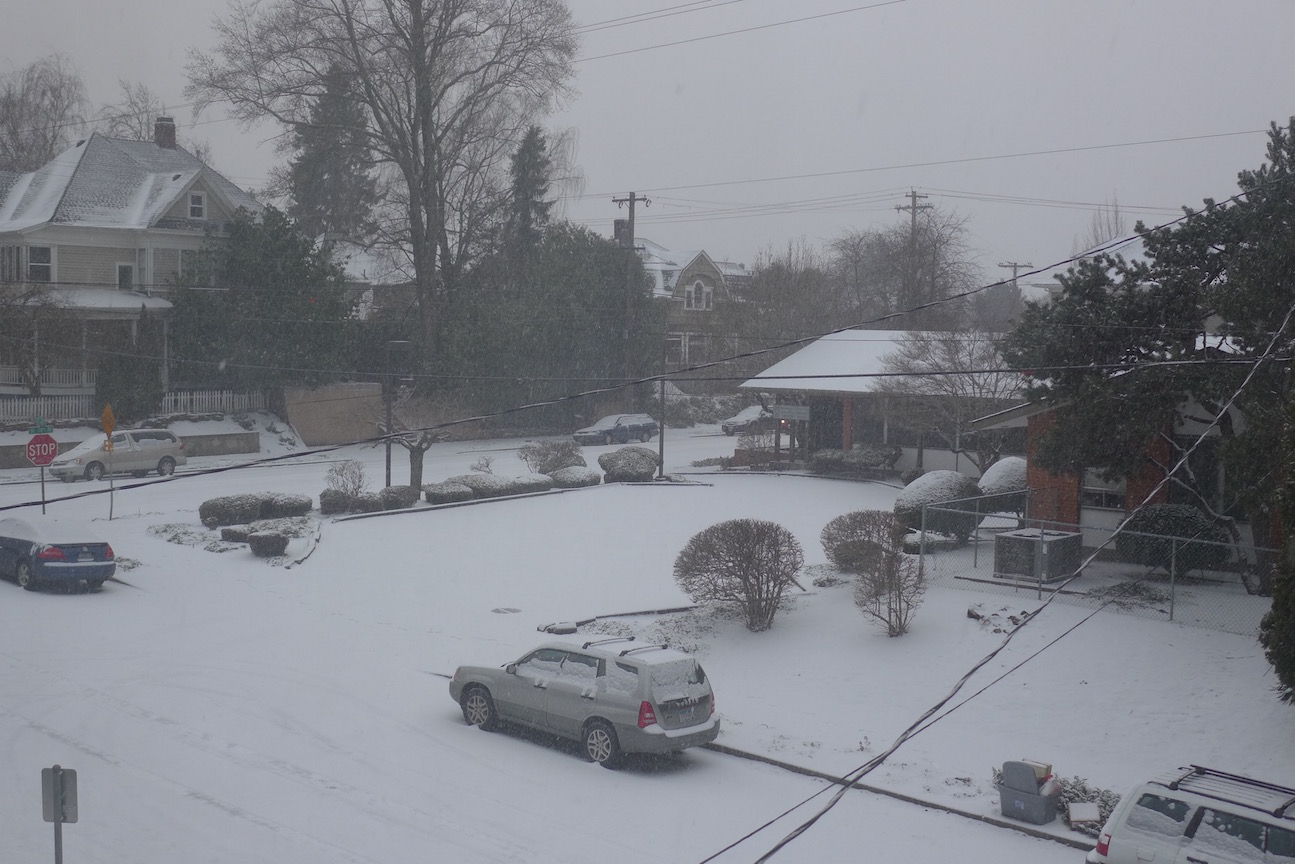
Dear Friends:  Here’s the view out our bedroom window on January 3, the day before our flight to Ecuador. (This is a color photo, by the way)view window

By January 4, the first snowstorm of the season had turned into a treacherous ice storm. We decided to spend the night in an airport hotel so we’d be sure to catch our 6:00 AM flight. No taxis available, not even Uber, so a friend drove us, slipping and sliding, to the Holiday Inn, where we spent a brief night. Next morning, our flight to Los Angeles was cancelled – no apology, explanation or friendly reroute. Once we reached Dallas on an alternative flight, our plane to Miami had already boarded and we had to sprint about 20 gates to make it as the doors were closing. In Miami, Cuban sandwiches and beers and a Cuban coffee restored us before a delayed flight to Guayaquil, where we arrived at 2:30 AM. With our bags! As we headed for customs, I looked with pity at the large crowd around the “lost luggage” window. 

Enough of this January travel chaos! Two years ago, we were stuck in an east-coast storm that caused all our flights through DC and NYC to be delayed or cancelled. After an expensive night in a crummy motel near JFK, we arrived a day late. We’ve decided that next year we leave in November.

After a few hours of sleep in Hostal Tangara, at 85 degrees, with noisy air conditioner off and chirping crickets in the room, we woke to this:

arch guacamayasP1110640  P1110637

(OK, the macaws were on the wall of our room, painted by Lucia, the hostel owner.)

After breakfast and naps, we ventured out into the hot humid air for our ritual crab soup, crab ceviche, patacones and ice-cold beers in an open-air restaurant on the Malecon Salado, the seawater canal near our hostel. This has been our routine for years, and the place always reminds me of my mother, who came to visit when she was 87 and loved it. She bought a CD from the guy who was fake-playing his panpipe. crab cevichewaterworks

January 6:  After another night in the hostel to recover, things move more smoothly. A good driver with a vehicle with seatbelts that work gets us to our gate in Cañar in a mere three hours. The house looks much as when we left it in July. This is the dry season, so the yard is scruffy, and inside the house is dusty and cob-webby, but this climate – dry and cool year-round – is kind to a house like ours, made of wood and mud and straw. house first vewInside, the macho aloe lords it over the patio, bigger than ever, and I complain to Michael, as always, that it needs to be taken down to size. As always, he resists. And by the swallow-like birds that flit in and out (through an open space between glass and tile roofs), and seem to feel right at home, I suspect there is a nest or two hidden there.patio first vew

We follow all our usual arrival rituals, including the uncovering of San Antonio, the patron saint of Cañar who keeps watch over the house.  uncovering st anotnio san antonio alone

And then, Michael’s first fire, first beer and his favorite Oscar Peterson on the CD player.  Ahhh, we are at home in Cañar.M. first fire2

The Pope, the Shaman, the Taxi Driver & U.S. Customs Agents

on the road to Guayaquil

on the road to Guayaquil

Well, I can’t resist one last Cañar Chronicle, given the prefect storm that accompanied our leaving Cañar last week. How could we have known when we made our reservations six months ago that El Papa would be flying into Ecuador the next day? That there would be no buses through Cañar because all were going straight to Guayaquil for the Pope’s mass, where a million people were expected? That protesters against President Correa would take advantage of the turmoil and close some roads around us the day before we were to travel? El Papa 2Making this trip more complicated (and interesting), Mama Michi was traveling with us to visit her daughter in the U.S. Fortunately, the day before our flight, and seeing trouble coming, we had hired Jacinto, our friend/taxi driver, to take us to Guayaquil. We agreed to leave Cañar at 3:00 for a flight on American at 11:00 PM.

As Jacinto tied Mama Michi’s two enormous bags on top of his car, I asked her why she was taking so much luggage for only a month’s visit. “It’s food,” she whispered. “I’m worried about the food there.” She was also, of course, taking typical Cañari fare as gifts for her family. I asked her to name what was in the bags: five cuyes (guinea pigs), cleaned and ready for cooking, and one already cooked; one rabbit cleaned and ready to cook; five bottles of Zhumir, the cane liquor so important at any ritual event; a bag of fresh shelly beans, another of peas and one of choclos (fresh field corn in husks) – all harvested from Mama Michi’s fields in the days before the trip; a bag of dried corn to make mote, an essential filler at every meal; and a pound of máchica, dried ground barley added to milk or other liquid for a drink that everyone loves; PLUS a big box full of tamales and chiviles (another type of tamale). Everything for the Andean diet except potatoes.mama michi now

After Jacinto picked up his wife – an unexpected fourth passenger – and stopped at the local roadside shrine to collect holy water, which he sprinkled on the car, on Michael in the front seat, and a few last drops on we three women crowded in the back, we were off…in plenty of time, so we accepted Jacinto’s invitation to stop at his “coast house” for beers. Every Cañarejo seems to want a warm place on the coastal plane, 9,000 feet below, where they can grow bananas and other sub-tropical crops not possible in Cañar. And have flowers galore. Here is Mama Michi posing with a “bear’s paw ” bush at Jacinto’s casita. She uses plants in her curaciones, so she was fascinated with the the flora. (A bundle of dried flowers and plants in one of her bags would figure in our near future.)

I should stop here and explain that Mama Michi (Mercedes Chuma) is one of our oldest friends in Cañar. I met her in 1991, on my very first trip to the (then) village for a meeting on a research project. I was a volunteer, ready to teach two young Cañari men photography and sound recording, and one of those young men was Mama Michi’s son, Jose Miguel. At a time of great distrust of outsiders, she welcomed me and found me amusing. She was an early and one of my best portrait subjects. Back then she was a community leader and a tired mother of 6 children with a sick husband, Serafin. After her husband died, Mama Michi became a curadera, a healer, or – as her passport says – shamán. She said she always knew she had the talent but her husband prevented her from practicing. Since then she has built an impressive business that has lifted her family well out of poverty. Mama Michi, however, did not have the advantage of an education beyond grade 3, and for that reason she needs to travel with someone – she cannot read nor write. Here she is in her first portrait, circa 1993.

Mama Michi Chuma

After the stop at Jacinto’s, it was a straight shot to the airport, except for a traffic police stop for no other reason than our out-of-province license plates and pure corrupt shakedown. We passengers watched in the rearview mirrors much arm-waving and angry gestures as the officers’ demand was negotiated down from $125, to $75, to $50, to $25. “Que disgracia! Que disgracia!” sweet, honest, religious Jacinto kept saying as he got back in the car. What a disgrace.MM & Michael in airport

me Mercedes in airportOnce at the airport we had plenty of time to relax and run into friends. Now that the US Consulate has begun to give out visas to Cañarejos, after years of refusing just about everyone, there’s lots of traffic visiting family, mostly in New York and New Jersey. Waiting, we ran into Mercedes Guamán, one of our first scholarship graduates and now a busy attorney and alternate member of the national congress.

At check-in, Mama Michi’s bags were overweight, and as I had a nearly empty suitcase I stuffed several unidentified packages from her bags into mine. “Bad idea, very bad idea,” Michael kept murmuring. But I forgot to ask MM about her carry-on, and that caused the first contretemps as we went through security. What are these? “Bottles of agua florida for my for my ceremonies,” she said. (Basically cologne with magic powers for “limpiezas, buena suerte, y protección.”) 

agua florida label agua florida

You can’t take those.  What’s this? “Olive oil, used for massages,” she said. Can’t take that, or that big tube of hand cream. And what is this? “My tupo, to hold my cape.” (A tupo is an essential part of every Cañari woman’s clothing – a sort of medallion with a small skewer about 4 inches long.) The security folks gathered around to test the point with their fingers, and shook their heads. I could see it was a beautiful silver tupo, maybe her mother’s, but in any case a treasured item. “You can’t take that,” I said. “It’s part of her heritage, her identity.” Without a word, one of the security women quietly stuck the tupo into a pocket of Mama Michi’s purse.

the long long hallway

OK. I think I’ll skip the drama of passing through Immigration in Miami at 4:30 AM, when Mama Michi was lost for an hour and a half in the visa-holders’ line and no one could let us go back to look for her once we had passed through the US citizens’ line. After a tearful reunion we grabbed our bags and rushed to customs, fearing we would miss our flight to Chicago. (Meanwhile I’d transferred her goods from my bags to hers.) There, Mama Michi’s luggage was opened by an agent to reveal all the glory of her hard work and planning and preparing and packing. Polite young agents who spoke Spanish gathered around and began to look for insects in her beans and corn and peas. “Yes, there’s a laper-something,” (Latin name) said one young agent, carefully peeling back the husks of an ear of corn with vinyl gloves. A young woman came over with a small vial to collect a nearly microscopic bug. “Can’t take the corn, sorry” he said in Spanish, very polite.  Oops, what’s that worm we see in the beans?  Sorry can’t take those. Nor the peas. What else do you have?

With that Mama Michi began the litany of goods: surprisingly, raw guinea pig was OK, but not beef or pork (she had none). Bottles of Zhumir, no problem. Dried corn and barley, fine. The bundle of dried flowers and herbs, OK. And the large box of cooked tamales and chiviles – looks good! YOU MAY GO.

By the time we were done, we had missed our flight to Chicago. That meant lining up to be re-routed with hundreds of other international travelers who had missed their connections. But again, very nice American Airlines helpers who spoke Spanish, all interested in Mama Michi, and in keeping us together for the remainder of the trip. “What tribe are you from?” asked someone along the way?  “Is she from Peru?” asked another. “May I speak to her?”

It was barely 9:00 when we were liberated into the Miami airport, exhausted, with two long flights still ahead, but we’d got to Guayaquil despite the Pope’s visit, survived Immigration and US Customs, and could begin to recover with coffee, breakfast, and a bit of rest.

P1100582