 Dear Friends: The truth is I rarely think about our life in Cañar while we’re in Portland. Then, as we get closer to leaving, I’m preoccupied with renting the house, remembering and organizing what we’re to bring (two 8″ chimney brushes; exhibit materials for the Costa Rica trip, airpods for Paiwa), and preparing for travel. (At least no Covid restrictions this time.) On December 1 we’re off, with excess baggage ($168), four busy airports (bad food $$$), and three cramped flights (no food). Twenty-four hours later we land in Guayaquil, where the temperature is 82 F. We check into our usual silly Wyndham Garden hotel with endless Christmas carols in the lobby, two big beds, hot showers, cold beers. Ahhhhh. Sheer luxury to relax with nothing to do but relax after the past busy weeks.


Tulio, the man at the hotel who helped us with our bags, turns out to drive a taxi on off-hours, so even before we’ve settled into our room we’ve arranged a ride to Cañar the next day. He’ll take us after he finishes his shift at 3:00. We have a late lunch called a Tex-Mex bowl in the hotel’s dreary dining room, long rests with skipped dinner, and good sleeps. Next day for lunch we try the Magnolia Room on the 8th floor. World Cup games blasting everywhere, of course; I was briefly hopeful for Costa Rica. Terrible lunch, but I hardly noticed so distracted was I by the view outside and the decor inside. As long as Michael has a beer and his KenKen puzzles (printed out in Portland), he notices nothing but the tasteless fried seafood. 
 The next day, with Tulio in his taxi, we take a familiar route out of chaotic Guayaquil, across the long coastal plain through the scrappy towns of Troncal and El Triumfo, with mile after mile of fruit stands on the side of the road. “Mango season,” Tulio says tersely. I’m grateful he’s a driver who doesn’t chatter; I like to read, Michael does his puzzles. Suddenly the road climbs and we begin the long ascent into the mountains. Distant clouds obscure the view, then clear to a blue sky, then lower to the ground for 50 feet visibility. Then repeat. We climb to up over 12,000 feet into the sierra of the Andes.
  As we reach the highest point, I avert my eyes from the bright red “love motel” that some idiot built here a couple of years ago, the sole eyesore in this magnificent landscape (also the turn off to Sangay National Park.) Past that, approaching four hours, I watch for signs of the inter-Andean valley where our town lies (big red dot on the map). Although the map barely captures what I’m describing, you can see the lighter areas where the Andes bifucate to create highland valleys.
  As we descend, I shoot a bunch of photos from the car on my phone. And there it is – the neighboring town of Tambo, looking celestial in the afternoon light. Only now do I start thinking about our life in Cañar – how will we find the house and garden? Will I remember people’s names? How are the scholarship women doing? I dig out my keys for the gate as we pull onto our road. We unload the bags, invite Tulio in for a beer (declined; he’s going straight back to Guayaquil), but we show him around the house. It’s dark from the closed shutters, furniture is covered with sheets, with a thick coating of dust everywhere, but otherwise pretty much as we left it six months ago. It’s too late for a fire, so Michael puts together a quick dinner with the groceries he bought in Guayaquil while I find a lamp, tablecloth and napkins to set us up in my office. Not only do we have a first dinner “in style” but the Internet is working so we watch the new Netflix film, Lady Chatterley’s Lover. Talk about culture shock!
  The next day we open the shutters and take stock. The layer of thick dust everywhere comes from constant traffic these past eight months on our dirt road due to a construction/sewer detour that brings everything from buses to cattle trucks by our house.
 In the patio, we find two little fuzzballs hidden deep in the macho aloe. We see nests nearly every year, but this is the first time we’ve seen nestlings. In the following days we hear them chirping, and get occasionally sightings of them and their mother as she flies in under the roof to feed them. Then one day they are gone, flown away. For my birding friend, Annie Tucker: these are rufous-collared sparrows, (Zonotrichia capensis). “Widespread, common and familiar in shrubby and grassy areas throughout highlands, often around houses. Distinctive, with rufous collar, puffy-crested look. Streaky juveniles are often seen.” (The Birds of Ecuador Field Guide.)
 Next day is Sunday, market day, and Michael has a yen for hornado or roasted pig. We trudge into town, stopping to catch our breath along the way, and greet acquaintances in the streets. “How do we know them?” we murmur to one another as we walk on. “What is his/her name?” But many know Michael by name – “Miquito” the taxi drivers yell as they drive by. And in the market, the pineapple man from the coast greets him with Señor Miko and the perfect fruit to eat today.
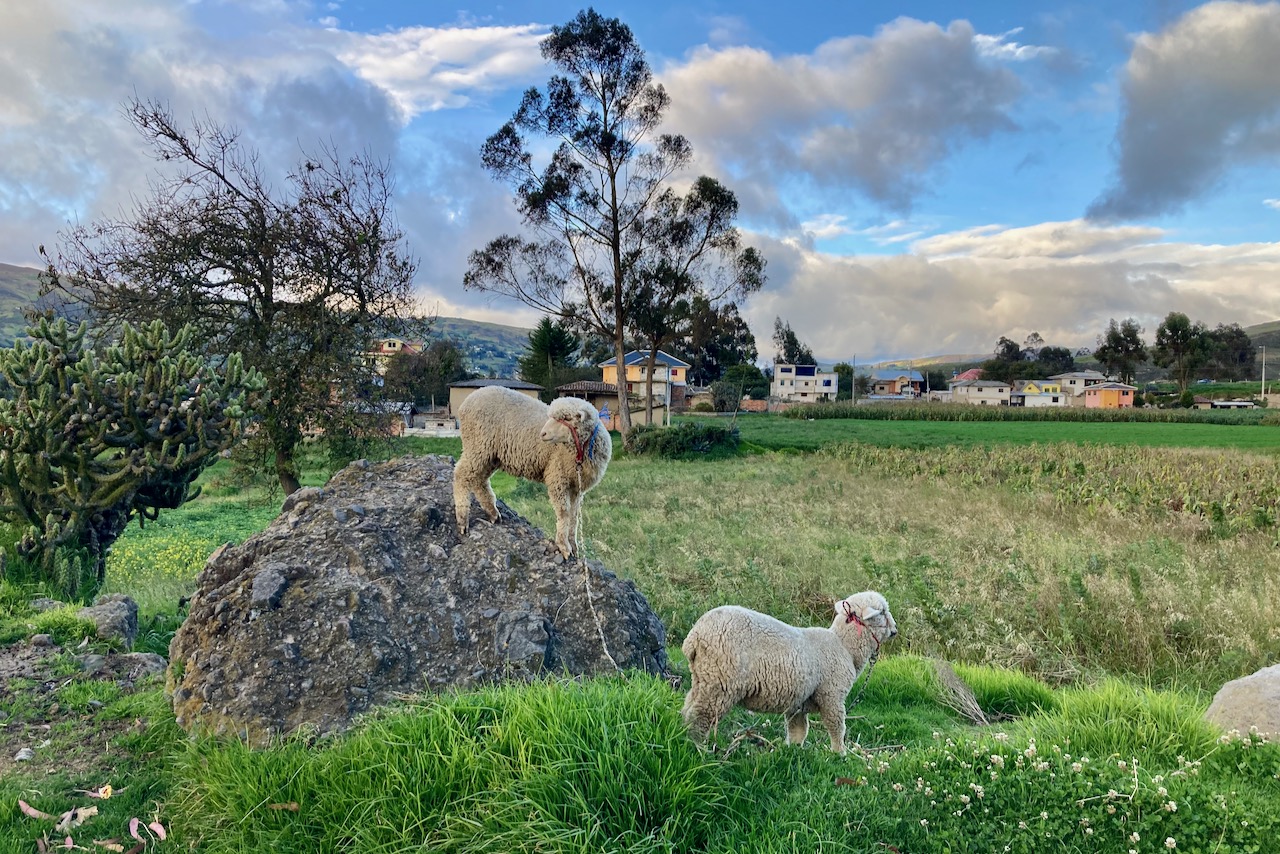
 In the days that follow, we each make forays into town for groceries and supplies and to check out the state of this place, where dogs run free (I counted seven in front of our house one day)…
Road/sewer construction never stops, which to go into town means running a guantlet of open sewer access inlets, fresh concrete (with dog prints), fresh asphalt (black footprints), and entire streets shut off with hoardings.
But that’s all part of life in Cañar, this homely town working to bring itself into the 21th century with potable water and sewer systems, paved roads (not ours), rabies vaccines for dogs, pink Himalayan salt found in our tiny MegaMarket (!), and nice people everywhere. We are happy to be back.
Cañar Book Club

Oh, how I’ve missed the Cañar Book Club, and I’m so depending on you, dear readers, to bring me out of my literary doldrums. I’m overwhelmed by all the “best of 2022 books” flooding my in-box, and although I’ve put several on hold in my library, when they come I’ll probably have no memory of why I got interested. I will mention one book I read in transit: The Wall, by Marlen Haushofer, and again, no memory why I choose this book. Published in 1963 it was recently reissued, so I might have read this review. But I was fascinated by the story of a women who finds herself cut off from the rest of humanity by a transparent wall, and has to create new skills to survive, accompanied by a dog, cow and cat. For some reason, I really enjoyed the repetitive mundane details of her life.
As for the books I’ve brought, it was a mixed bag (so to speak) of a couple of books I’d ordered (About Grace, Anthony Doerr, Butcher’s Crossing, John Williams), some taken from my shelves (Greene, Bryson, McPhee, Kidder), two that I’ve published this year (Ana Magarita’s story, Tell Mother I’m in Paradise), and another in Norwegian by my good friend Liv that I’ll be editing in the English edition (more on that next time). A paltry pile, so I’m depending on Kindle books from my Portland library to keep me happy these six months. And I’d also love to hear your recommendations for the next Cañar Book Club meeting in the new year, January 2023.
Until then, please stay in touch. I love hearing from you.




 …
…

