2019 Cañari Women’s Scholarship Foundation Update

Featured

I begin this year’s update with exciting news related to Ana Margarita Gasteazoro, the original inspiration for our scholarship program. Ana was a Salvadoran friend from my Costa Rica days, a political refugee after years of resistance and imprisonment during the El Salvador civil war (1979-92/75,000 lives lost). During the late 80’s and early 90’s, with friend/colleague Andrew Wilson, we recorded, transcribed and edited Ana’s oral history. But before we could make a book together – our original plan – Ana died of breast cancer, at age 41, in 1993. Just before, she had visited Michael and me in Cuenca, Ecuador, and we had a chance to spend a night in Cañar. On hearing the news of Ana’s death, I established a women’s education fund (that later became Cañari Women’s Education Foundation). A born teacher, feminist and organizer, Ana fervently believed that women’s education was one of the most important tools for social justice and political progress in Latin America.

Twenty-six years later, we not only have thirty-four university graduates and current scholars, but we have a book! In October I was in El Salvador for the launch of Tell Mother I’m in Paradise: Memoir of a Political Prisoner, based on Ana’s oral history. Many dedicated volunteers helped bring this Spanish edition to life: from translators, transcribers, editors and artists to the director of MUPI, Museum of the Word and Image, in San Salvador, publisher of the book. The banner/poster pictured above was presented various times during the visit to El Salvador, along with the story of Ana’s scholarship. I heard so many of her family, friends, and others who had known her, say – “Ana lives again!” And that is never more true than in our Cañari women’s scholarship program. Stay tuned for an English edition that we hope will be published in a year or two.

Book presentation at MUPI in San Salvador, October 8, 2019

Our early graduates are now mid-career (a term their modesty would never allow), but I thought it would be fun to do some updates – where are they now? – along with before/after photos.


Alexandra Mariana Solano (2006/Cuenca/Agronomy) is the new director of CENAGRAP, the potable water organization that serves rural regions of highland Cañar. Here she signs a convenio with city officials. Alexandra is also midway into a new master’s program at University of Azuay in Cuenca: “Climate Change, Sustainability and Development.” (Our program provides $3000 over two years for master’s degrees for our graduates.

Mercedes Guamán (2006/Cuenca/Law) represented Ecuador at the United Nations Permanent Forum on Indigenous Issues in 2019, as she had in 2018. She is president of her local community of Quilloac and, as a lawyer, serves a wide contingent of Quichua-speaking clients. She is also our first graduate to receive an honorary degree in jurisprudence for her service to the community and social justice.

Pacha Pichisaca (2011/Cuenca/Medicine) has just finished an advanced diploma in dentistry. Pacha has established her own clinic in Cañar and told me recently that she has added a “second chair” (e.g., business is good). She too serves her neighbors and others as one of the only Quichua-speaking women dentists in Cañar.

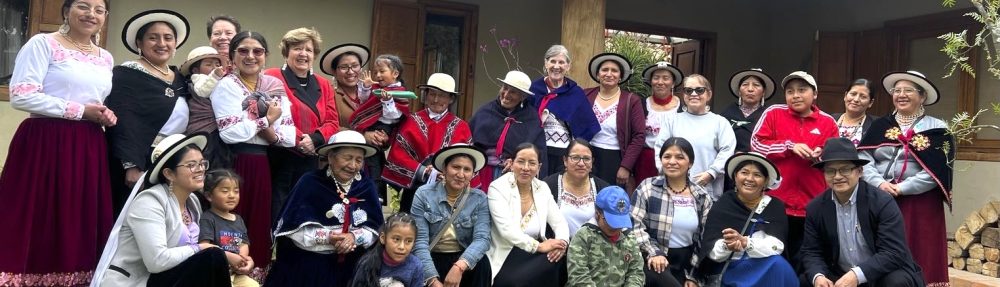
Juana Chuma (2015/Cuenca/Veterinary Medicine), finished her master’s at UNAM in Mexico in 2019, and is charging ahead for a PhD in the same program. Although CWEF is not able to support doctoral studies, we are so proud that Juana will be our first graduate to get a doctorate. Juana appears in the photo above with her fellow graduates (first row, far right, white blouse). And on the right, her proud parents in Cañar. Juana has several younger sisters yet to be sent to university, but in order to serve a wider population of young Cañari women, CWEF has a policy of one scholarship per family.


In January we had two special visitors to Cañar from Oregon, representing the Bend Giving Circle, a group of six women (now eight!) who have chosen CWEF for monthly support. We had a great gathering of the scholarship women, past and present, and families to meet Helen and Laurel. Maria Esthela, our board treasurer, made red bead necklaces for the group and I recently received this photo taken at their October meeting, showing off their Cañari jewelry. We are so grateful to them – as well as to all of you – for sustained interest and support.

So – a quick recap: the Cañari Women’s Education Foundation has 21 graduates, 13 current scholars, and an amazing board in Cañar that we couldn’t do without, but that could manage very well without me. We meet two or three times a year to look over applications, assess where each woman is in her studies, and decide how many spaces we have to fill. We keep the current group at about 12, which makes the accounting and monthly payments easy to handle. We pay stipends in cash so as to have personal contact with each scholar on a regular basis. Charlotte Rubin, our treasurer in Portland, keeps track of contributions and manages the banking. Michael and I have willed our Cañar house and property to the program – a long time off, we hope – in a move that will help insure long-term sustainability.

The Cañari Women’s Education Foundation is an official 501(c)3 nonprofit, which means your contributions are tax deductible. We have zero administrative costs other than a yearly mailing, so every dollar goes to the women’s education. Please make checks to CWEF and send to Charlotte Rubin, 2147 NW Irving St., Portland, OR 97210 (some of you will receive this letter by snail mail with return envelopes), or you can contribute through PayPal with the secure “DONATE” button below.

Last note: We are returning to Ecuador on December 16 and the regular Cañar Chronicles will begin in January, along with the Cañar Book Club. I have missed you all, and we will have so much book news to share!

“Indigenous Ecuadorians Too Strong to be Ignored After Deal to End Protests”

Featured

Dear Friends: We are not returning to Cañar until December, but I wanted to post blogs on current events: the recent protests in Ecuador (and resolution – with headline from The Guardian, October 16), and my recent trip to El Salvador for the launch of a book that was inspired by Ana Margarita Gasteazoro, for whom the Cañari Women’s Scholarship Program is named. So…first the protests and the resolution, in an online article published by my good friend Alan Adams, a Peace Corps volunteer in Ecuador in the 1960’s who has rekindled his Canari friendships in retirement, working with Mushuk Yuyay, a local community development organization and reconnecting with those local indigenous leaders he knew back then. Thanks to Alan, and thanks to his editor at https://www.esperanzaproject.com for allowing me to reprint the article. (I have edited lightly and added a few extra photos from various sources). Next chronicle about El Salvador coming soon…

UPDATE, October 12: At publication time, the Cañari caravan was in Quito joining the throng of demonstrators in a victory celebration. The Moreno government agreed to rescind the austerity decree and has promised to rewrite it with input from the people. Nicolás Pichazaca of Mushuk Yuyay wrote me: “Our work and strategy have not been in vain, not only for the Indigenous people, but for all Ecuadorians. It is one more story.”

Superheroes don’t wear capes. They wear ponchos and sombreros.” The phrase is often repeated in the Andean highlands. And now as they see their lands and their culture under increasing threat, the Indigenous people of Ecuador are employing that phrase once again, as they go out into the streets in the face of danger, as they have many times during their history.

High in the Andes of southern Ecuador live the Cañari people, who have been struggling for their freedom and for Sumak Kawsay, a good life, for thousands of years. Their present challenge comes at the hands of the President of the Republic who made a pact with the International Monetary Fund and expects the poor of Ecuador to pay. When Lenín Moreno Garcés took office, the Cañari people were cautious, hopeful, and patient because he promised to break with the extractive policies of his predecessor, Rafael Correa. He humbled himself before Indigenous people in a solemn ceremony where he accepted the blessing of the many nations that comprise the State of Ecuador.

Lenin Moreno becomes president, February 2017, Reuters.

Slowly it became obvious that the winds in Quito had shifted, as the President began to move in a different direction. I often describe Lenín Moreno in Shakespeare’s words, “Commanded always by the greater gust…” The greater gust these days was coming from the IMF, which demanded austerity, and Moreno decided to find cash by removing fuel price subsidies that have been in place since 1970. Fuel prices shot up by a dollar a gallon, enough to wipe out the budgets of most small businesses as well as of most families. In addition to the gas prices going up, the IMF is requesting an increase in fees for all government services and for utilities, a new value-added tax, a consumption tax, and an increase in the ceiling on interest rates so that banks can charge whatever interest rates they want.

Immediately, the Cañari people responded with peaceful, but vocal, demonstrations throughout their communities. They joined in support of labor unions and other groups, but mostly in collaboration with other indigenous communities and organizations of Ecuador. They blocked roads and joined the general strike. They requested dialogue with the government. Violence began to erupt in the protests — which some, in civilian as well as governmental sectors, suspect was being incited by infiltrators paid by Correa. President Moreno declared a State of Emergency to quell the violence, which only increased the people’s determination to find a solution that would benefit all and lead toward a more secure future for the country. 

President Moreno responded that the austerity policies would not be changed. He said that the demonstrations did not originate with the people but were encouraged by the former president of Ecuador, Rafael Correa, working with President Maduro of Venezuela. The statement only fanned the flames of resistance. However, there is evidence that Correa and other actors are taking advantage of the situation to sow doubt and suspicion. The Indigenous organizations need to weave through this confusion cautiously to keep the issues in focus.

Disrespect is not new for the Cañari people. After centuries of being used as beasts of burden, as the Cañari poet José Buñay put it years ago, they are determined not to go back to the abuses of the hacienda days. Last week, as the protests continued to escalate and began to grow violent, Moreno took his government from the capital of Quito to the coastal city of Guayaquil. When the demonstrators set out to meet him there, the mayor of that city stated bluntly that “Indians” are not welcome in her city. They should go back to the páramos, the high mountain grasslands. 

Mayor of Guayaquil Cynthia Viteri in her signature white shirt. Photo El Universo

But Cañaris will not be humiliated. Indigenous people don’t take abuse lightly. A movement was launched to withhold  food from the highland farms to Guayaquil. Several Indigenous people posted photos of their páramo homes with pride. They also posted the reminder that Indigenous peoples can be found in the universities, the professions, government offices, elected positions, and everywhere in Ecuadorian society. They even live in Guayaquil.

The declarations that I read over and over again from Cañari friends are not simply that the price of gas should go down, but that neoliberal policies must end. The IMF must go. What they are demanding is a complex set of changes, each affecting the other, that cannot be oversimplified. There is no simple fix. They are proposing a comprehensive solution on the other side of the insults and accusations that will insure that a way toward a peaceful and lasting social and economic system can be secured. This solution will be sought by large numbers of determined and united people.

Faced with this necessity, the people of the Cañari communities, both those in Ecuador and those who have emigrated, decided to add their voices. Truckloads of people departed. They made laughing videos of people climbing aboard moving overcrowded vehicles. Wave after wave of men, women, and children declared their determination to protect their rights as Ecuadorian citizens.

The last trucks to departed Cañari on Saturday morning. It was not lost on anyone that this was Columbus Day, the day set aside to commemorate the beginning of the struggle that they have been involved in for over 500 years. They drove slowly over roads that had been blocked and made contacts with others along the way. On Saturday evening, the caravan announced that they had Puruhua People in their company now. They are the Indigenous Nation to the north of the Kañari in the province of Chimborazo. On Sunday they set off again in trucks, cars, buses, and on foot on a cold and cloudy day.

Photo by Kusikayo Naula, Zhud.

The plan was to arrive in Quito in time to lend force to the words of the leaders in a meeting with the President, to show the strength of a united people and to prove that hardship and danger will not deter them. We remember, too, that over the recent Ecuadorian history, Indigenous demonstrations have led to changes of government and policy changes. What sets this demonstration apart is its spontaneity and comprehensiveness.  The people responded immediately to a threat with thought and care to find a solution consistent with their goals. To get elected, President Moreno said and did some things he seems to have forgotten, but the people didn’t forget.

This is but one more chapter in the history of the people who developed their science and art over the millennia, resisted the Inca, survived the haciendas, rebuilt their lives through the Agrarian Reform, ended the agro-chemical-based Green Revolution, confronted (and continue to confront) climate change, and now are dedicated to help redesign the social and economic institutions of Ecuador. The significance of this continuing struggle cannot be overemphasized.

ALAN ADAMS

Back to Cañar 2019

Hello Friends: 

Three days, delayed flights, missed connections, two hotel nights, $12 food vouchers for 24 hours in Miami airport, a taxi from Guayaquil and we are finally here in Cañar, on January 5. Below is Michael blowing his $12 voucher on a Cuban sandwich and guava cheese pastry in Miami Airport at La Carreta, one of our favorite layover stops.

If I count right, this is our 25th year of knowing this chilly, homely, lovely place; our fourteenth year living here half-years, and twelve years in our house. Which, amazingly, stays safe and sound for the time we’re gone. Perhaps because this guy was guarding it?

At least he was on duty the day we arrived, cropping and fertilizing the grass. It’s obvious from the droppings all around the house that our compadres José Maria and Narcisa and family and animals have been an effective security presence around the property during the eight months we have been gone. Inside, some dust and spiderwebs but otherwise dry and ready to settle in. It takes a couple of days (with altitude headaches, me) to open the shutters, uncover the furniture, unpack the sheets, towels, pillows and such, before the house begins to look like home. We uncover San Antonio in his nicho and take a look at the plants

Michael finally agrees that we have to do something about the massive macho aloe that is taking over the interior garden; in a couple of years it will reach the glass ceiling. From the time we moved in I have tended my (low) side of the patio, and Michael his. Many of the flowers I planted early on died during our times away (although volunteer geraniums are thriving along with a variety of sedums). But slowly, M. has invaded my side by planting cacti and jade and that big spiky blue-green creature a friend gave us years ago that keeps producing hijuelos. We’ll wait to see how things get resolved on the pruning issue.

Staying with the patio, a few days after we arrived I was crossing it to the living room with a large 3T hard drive in my hands, when my foot slipped off the brick edge and I went flying. Trying to hang onto the hard drive, I landed nose-first in the garden (hard drive went flying anyway), exactly between a rock and an watering spigot. Either would have done terrible damage, though my face still left a clear impression in the ground. We had no ice yet, but Michael had frozen two pork chops, so those went onto my nose in the first few minutes. After that, things got very ugly with purplish black eye and cheek and scrapes and scratches (no photo please!). During this past week I’ve had to explain over and over why my face is such a mess. Today I’m entering the bluish-green stage with patches of white skin showing through. (In photo below: I landed just to the right of the rock you see at knee-height.)

On to Michael – who is delighted with the result of his hip replacement in September, which means he can climb the hill into town without pain for his daily shopping. At home: cooking, chopping wood, building the fire, cleaning the chimney, hauling the propane tanks that give us the luxury of hot water. He’s so happy to be back in the land where a pound of large shrimp at the Sunday market costs $5.00. He’s in the kitchen now, cooking them along with camote (sweet potato) for a Peruvian-style ceviche tonight.

This is a short chronicle because I want to get it out before a busy week begins. But I must end by thanking all of you who contributed to the Cañari Women’s Scholarship Program these past couple of months. (Thank-you letters will be going out soon.) Gracias to our faithful contributors, we had a successful fundraising campaign to continuing support eleven women in universities full-time, two doing their masters, and various applicants waiting in line. Next Sunday will be our first meeting, with special visitors from the Women’s Circle of Giving in Bend, Oregon.

Cañar Book Club 2019

Finally, I’m anxious to hear what you all are reading and what books you have on your lists for 2019. For my report, I can say that the three-day trip to get here seriously cut into my stash of books. I finished The Gunrunner’s Daughter by Neil Gordon (fascinating, complex, still haven’t figured out all the twists and turns), The Rules Don’t Apply memoir by Ariel Levy, a New Yorker writer who must be one of the world’s most neurotic but charming journalists. Imagine Me Gone by Adam Haslett (hmm, no comment; found in a sidewalk library in Portland), and I’ve begun A Place in the Country by W. G. Sebald (a favorite writer but I believe these linked essays were pulled together and translated after his death and I’m not yet engaged), and a book by Paulette Giles, whom I knew as a writer in Canada but turns out she’s an American now living on a ranch near San Antonio, Texas. In News of the World she has written a lovely account set in post-Civil War Texas of an itinerant older man who makes his living riding from town to town to read newspapers aloud to live audiences, and the 10-year old Kiowa captive girl he agrees to return to her family. Reading, I cannot help but think of my mother, a great reader, who would have loved this book. Tomorrow will be her 99th birthday, and I dedicate this meeting of the Cañar Book Club to her memory. I miss her every day.

Please leave a reply here or email at: judyblanken@gmail.com. I do love hearing from you.