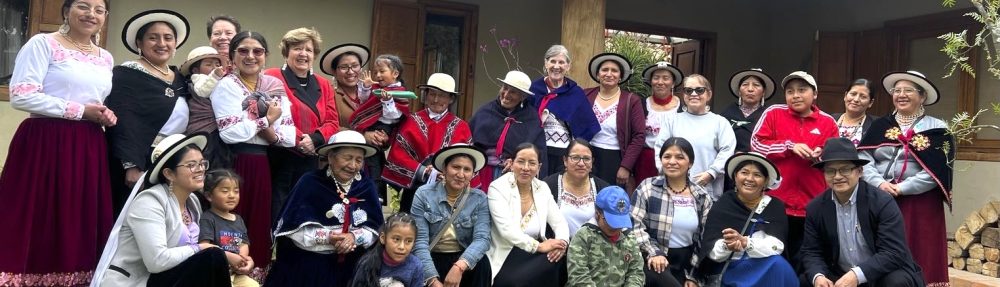
Here comes 2022 with the años viejos

Featured

Dear Friends:  Well, since it’s still barely the first week of 2022 I can say – best wishes to you all for the new year, and please let it be better than 2021!

Looking back this past month, the holiday season in Cañar is always mixed for us, without family, visitors from far away or Portland friends. Christmas and New Year’s here are all about family gatherings, and it’s rare to include outsiders. However, we had just enough special visitors and events to make us feel loved. Here’s a lunch with our favorite architect, Lourdes Abad (red necklace), and her sister Ana.

I debated whether to take part part in my first crowd event on December 31 (called Año Viejo, or Old Year), but it was a beautiful day and I knew the hours-long, outdoor procession would be in constant motion. In the Cañari world, this day is all about music, dance, masks, disguises and irreverent fun. So early afternoon I tried out my persona/mask – I think it’s Ugly Betty? – packed camera, water, sunscreen, and joined several hundred comuneros at the highest village of Junducuchu at about 11,000 feet,-truly up in the clouds.There, with a 10-piece band leading, and dancing women and girls called damas, we began winding down the steep mountain. I in heavy boots, concentrating hard not to slip on the loose gravel or tip over the edge where the roadway collapsed, hanging onto tree branches and an occasional fellow walker… …while the women and girls stepped alongside me in their little wedgies sandals and plastic slippers without a pause. We stopped in several other comunas on the way down the mountain where the band played, the damas danced, and others joined in, many in funny masks and disguises.Men dressed as women is the favorite (no Cañari woman would ever make such a gesture).

Along the way I saw various life-sized rag dolls propped up at the entrance to villages, called monigotes, with names tacked on representing known figures, to be burned at midnight in a symbolic gesture of “regeneration” (though history says these were often effigies of hacienda overseers or other hated authority figures). Past years Michael and I have stayed up late enough to burn Trump, but this year I bought two masks to add to my collection and I don’t want to burn any of them: the devil signifying the pandemic, and a Dr. Fauci representing medical heroes.

By the time we got to the next-to-last village it was nearly 6:00 PM, the temperature was dropping, I was tired and Michael was at home by the fire with dinner on the stove. I nodded goodbye to the last monigotes and started on down the mountain.

I’d like to give a last credit to the great mask makers of Cuenca, the Alejandro Flores family who have been hand-crafting these papier maché masks for seventy years. Made with scrap paper from schools and other sources, glue and paint, they show up in the markets in Cañar the week between Christmas and New Year’s, costing about $2 each. Pictured below is Susana Flores, one of Alejandro’s ten children, four of which have stayed in the business.

Cañar Book Club

Our Cañar Book Club members have awaken after their holiday stupor and are reading books like crazy. From my Wine and Whine girlfriends in Portland: The Master and the Emissary. “Iain McGilchrist presents a fascinating exploration of the differences between the brain’s left and right hemispheres, and how those differences have affected society, history, and culture.” Cloud Cuckoo Land. “Already in 100 pages; Anthony Doerr is certainly a master of simple writing that makes for page-turning.” Two memoirs of special interest according to reviews: Home in the World by Amartya Sen and Sentence by Daniel Genis.

From Bibi in California: Mothering Sunday, Graham Swift; Moonglow, Michael Chabon  and  Rescue, Anita Shreve. “All of them are intriguing stories well told. The kind that makes you sad when they’re over. But my favorite book of the year: Garlic, Garlic, Garlic, by Linda & Fred Griffith. Even if you are not a gardener or cook, it is a wonderfully informative and entertaining book.”

Bruce in Portland gets the prize for most complicated title:  “I’m reading The Standardization of the Demoralization Procedures by Jennifer Hofmann. It’s about a career Stasi officer in East Germany around 1989. So far, it’s a pretty good read. Very tight prose.”

Pat in Bend, Oregon: I am in the midst of The Old Ways: A Journey on Foot  by Robert Macfarlane, and it’s great. I picked it up after reading Mountains of the Mind by him, a geological and psychological  history of mountains and mountain climbing. Braiding Sweetgrass by Robin Wall Kimmerer, Native American botanist and teacher of environmental biology, weaves science with indigenous wisdom and teaches us how to listen to plants. I wonder what your aloe has to say? Louise Penney recently co-authored a political thriller with Hilary Clinton called State of Terror that has details only an insider could know, and has cameos by Penney’s characters from her mysteries. Loved it! (Daphne from Edmonton, Alberta seconded this opinion.)

Alan the “The Avid Indoorsman” in New Jersey seems to be reading a book a day: Of Women of Salt, Gabriela Garcia. “It is beautifully written brutally honest and hard to put down. The story is brilliantly woven together and ends with unexpected hope.” Word By Word: The Secret Life of Dictionaries, Kory Stamper. “Finally, a book that tells the truth about our language. Here is why the rule against final prepositions is preposterous. Its bent and worn pages are a testament to how thoroughly I studied this tome.” Lies My Teacher Told Me: Everything Your American History Textbook Got Wrong, James Loewen, “…about how we remember and avoid the facts.”

Claire in London (with with a leek and lentil gratin in the oven, reminding me we need to start again with our recipes – Claire?). The Plot by Jean Hanff Korelitz. “Great fun, well structured with lots of twists and turns and very entertaining.” Love After Love by Ingrid Persaud. “If you don’t mind getting into the patois (it’s set in Trinidad) it’s a wonderful story of love and loss through food and friendship. I couldn’t put it down.”

Song of Achilles by Madeline Miller. “It takes a few pages to get into it but I was soon gripped. Beautiful writing and so evocative.”   For those, like me, who LOVED  A Gentleman in Moscow, the new Amor Towles, The Lincoln Highway, might well be a disappointment.  Multiple characters, none of them that believable or interesting and a story that seems to be taking ages to get going. However, I see from Twitter reviews that people who didn’t take to Gentleman rather like this one!  I adored All the Light One Can Not See by Anthony Doer and was initially dubious about his latest – Cloud Cuckoo Land. But I kept going and it grew on me, though I still had reservations about some elements (and mostly skipped those elements). Next I might try The Promise by Damon Galgut which won the Booker last year.

Ed on Vashon Island noted my interest in walking books and sent this recommendation: The Salt Path: A Memoir by Raynor Winn, who with her husband walked 600 miles of coastal paths in southwest Britain when they found themselves homeless and broke. I read it earlier this year and loved the story.

I’ll finish with a couple from my own very eclectic reading list. Friend Liv in Oslo recommended Trieste: A Novel by Dasa Drndic that I have just begun to read and had a hard time grasping the jumble of facts/figures/time periods. But I’m just getting into “this many-layered novel of WWII combines fiction with a collage of facts to explore the fate of Italian Jews under Nazi occupation, through the intimate story of a mother’s search for her son.” For some reason I brought Old Filth by Jane Gardam with me to Cañar, and for some reason I loved reading about the last days of an elderly lawyer called affectionately by the acronym FILTH: Failed in London Try Hong Kong. First of a trilogy that I’m hooked on. I’m also meandering along with The Old Ways by Robert Macfarlane, but yearning for a really great novel or thriller. I’ve already ordered several from the fantastic recommendations above.

That’s it, dear friends. Please stay in touch and write me with all your news and book recommendations at: judyblanken@gmail.com


Settling into our 16th half-year in Cañar

Featured

Dear Friends:   Brrrr, it’s a foggy chilly day as I begin this – the inside temperature is 13C (55 degreesF). Although we yearly head south, no one can accuse us of being wimpy snowbirds on this, our 16th half-year in cold Cañar. We count on a little sun in the mornings to warm the glass-covered atrium and make the day comfortable. Not today. Michael wants to hold off to 4:00 PM before making a fire (he claims our woodpile is critically low), but once he has his KenKen puzzles, a beer and the fire, all is well in our little corner of the Andes.

We arrived a little over a week ago in Guayaquil, with a hard landing after a full day of travel from Portland. Turns out the Ecuadorian government changed the entry requirements for travelers the day before, so there was no way to know that we had to have a Covid test within 24 hours of travel. Nor did the hundreds of other travelers stuck in the airport with us at 2:00 AM. We finally emerged at 4:00 AM, after a quick and painful screw-up-the-nose antegen test. I laud Ecuador for being careful about the new variant, but it was unconscionable not to let us know what was going on, as we stood waiting 30 minutes in the jetway, then in a corridor, then another corridor, the in two waiting rooms. Finally, we were called to an improvised clinical setting and asked for our Covid exam results. Whaaaat? I’ve made a sort of cartoon of our travel day, with a nod to Roz Chast of the New Yorker. I hope you’ll be able to make sense of it.

After recovering in a Guayaquil hotel for a day and a night, we made the familiar drive to Cañar, leaving the hot and humid coast to zigzag up through the clouds to over 10,000 feet. Looking down on Cañar from the highest point, I thought back to my first writings about this place –  that I’d first called a village, then a town, and now I have to say it is a small city. A scrappy, homely and cold small city, where we are still the only extranjeros who choose to live here. (Though who wouldn’t want to live here with a view like this?)

This high and dry climate is kind to our house, however. Other than dust and spiderwebs, it looks exactly as we left it six months ago. In fact it’s pretty much in the same shape as when we moved in, in 2007. Our compadres Jose María and Narcisa have left an offering on our kitchen table of a big basket of dried beans (enough for a few years) and a bowl of mazorkas, dried corn in various colors. These are from the harvest of our back field, where they follow the custom of being partidarios – planting land not your own and sharing the harvests. Over the years we’ve learned to acquiesce to the custom of receiving our symbolic “share,” even though we can never use the amount they give us.

The interior garden requires little care, with it’s succulents, cacti, aloe, geraniums, ferns and orchids. While we’re gone, Andean sparrows take up residence and build their nests in the monster Aloe, and I can peer in and see at least two nests. They appear empty of eggs, but the mamas still make regular visits during the day through the six-inch gap between the steel/glass structure and tile roof, circling the space, hopping around the patio and sometimes checking out our rooms.

The yard is another story – the compadres‘ sheep and the neighbors’ chickens have pretty well decimated the flower gardens and much else. Last year I wrote about my Sisyphean garden: no matter how much love I pour into it while we’re here – planting, pruning, mowing –  it goes back to square one when we go away for a few months. Then, this time, after a few days of rain, just as I think the front lawn might recover, here comes Chirote in his heavy truck with a load of wood for Michael. Thirty-six vigas, or square wooden beams, some from old torn-down houses. Perfect heavy wood and truck tires to gouge out the grass.And because Chirote’s an old friend, Michael invites him in for a beer by the fire, where I can’t resist making a portrait of old friends.

And because it happens that the next day, when Mike finds his old chainsaw sputtering, he has a perfect excuse to make the trip to Cuenca to drop it off for repairs, and buy a new one. Although he will deny this, nothing makes him happier than to have a new toy – I mean tool.

(I want to stop here to say how much I love hearing from you all, and and ask that you respond to my Cañar Chronicles with my email judyblanken@gmail.com: Something is screwy with my MailChimp account and I know it’s been impossible to use the reply.)

That brings us to the moment we’ve all been waiting for…..

The Cañar Book Club

Dear Members – it’s been way too long, I agree, and I know it will be hard to make up for lost time trying to remember all we’ve read in the past few months. Speaking of memory – here and gone –  I opened the book I brought for the long travel day, A Constellation of Vital Phenomena, by Anthony Marra, and within a few pages I realized I’d already read it. But I could remember almost nothing, so I kept reading through the week, and the next, and found it (again) to be a beautiful, moving, reading experience of a story that takes place in Chechnya – a place I knew nothing about. I’ll let the New York Times Book Review say it all: “Extraordinary…A 21st Century War and Peace.” It’s currently #1 on my list.

Otherwise, given that an extra bag now costs $65 on American Airlines, I brought way fewer books this time. Here they are, looking rather pathetic on their own nearly-empty shelf on my bed-side bookshelf. They are:

Little Failure, Gary Shteyngart memoir (after enjyoing reading his articles in the “New Yorker,” humorous but serious writing. (Just finished – loved it!)

Oh William, Elizabeth Strout – a gift from a reading friend. I love Strout and am holding back on reading it so I can keep anticipating it, like a delicious meal.

Meaning a Life: An Autobiography, Mary Oppen (after references read in Maggie Nelson book The Argonauts, which I found riveting. I felt the same about Nelson’s The Red Parts: Autobiography of a Trial, but she lost me with her most recent On Freedom.

The Book of Aron, Jim Shepard, because my serious reading friend Bruce said that he is one of the best authors he knows. Shepard also shows up on lots of best-of lists, but I don’t think I’ve read anything by him.

The Piano Tuner, Daniel Mason, because I read a later book by him, The Winter Soldier. Like “A Constellation…,”  it captures previous centuries and worlds I don’t know – Siberian Russia and Burma.

Old Filth, Jane Gardam, I don’t remember, but I think it was mentioned in a book I recently read and loved –To the River: A Journey Beneath the Surface by Olivia Laing, about walking the length of the River Ouse from source to sea. The river where Virginia Woolf died, Laing muses on that history and much else that’s taken place over the centuries along her walk.  A slow meander to savor. And that led me to this strange title. Old Filth?  Will report in next book club.

The Old Ways: A Journey on Foot, Robert MacFarlane – because I love books about walking. Part of a trio of books about landscape and how we live in it. “…Macfarlane sets off to follow the ancient routes that crisscross both the landscape of the British Isles and its waters and territories beyond. The result is an immersive, enthralling exploration of the voices that haunt old paths and the stories our tracks tell.”

Landmarks, Robert MacFarlane (same author), also walking, this one about terms that comes about from particular landscapes. Each section starts with a glossary of words you’ve never heard before, such as rife: small river flowing across the coastal plain, or  sike, small stream, often flowing through marshy ground.  “Landmarks is a celebration and defense of such language.”

And just so I don’t get nervous about running out of books, I loaded a few on my iPad. I must confess I have no idea when, where or why I ordered these titles.

Earth Beings: Ecologies of Practice Across Andean Worlds, Marisol de la Cadena

Bring Me Back, B.A. Paris. A novel, but I know nothing else

Still Life, Louise Penny. A mystery, because I read one of hers before and like it. Not my usual fare.

PLEASE SEND YOUR READS AND RECOMMENDATIONS FOR NEXT CANAR BOOK CLUB, IN JANUARY 2022!


2021 Cañari Women’s Scholarship Program Update

Featured

Dear Friends: I’m very happy to be back in touch. Michael and I made a short trip to Cañar in the spring, when we found the Covid lockdown in Ecuador still in effect and cases rising, though nothing like previous levels. Masks were required throughout the country and public transportation was back but varied according to infection levels. Vaccinations were just starting in Cañar for the elderly and are now available to everyone, including children. Otherwise, in Cañar, at least, daily life felt “regular” – a favorite expression said with dead-pan tonality. Twice-weekly markets had started up and the town streets were alive with traffic and shoppers. Since then, according to a recent post from the World Bank, “after a vaccination campaign earlier this year, Ecuador went from being one of the countries hardest hit by the pandemic to becoming an example for the world. This success story would have been impossible without the massive turnout of the population.” (Note: World Bank provided most of the funds for vaccines.)

Two posters for rural areas of Cañar. Text on the left: visits door-to-door to give vaccines to all persons from five years old. Second right indicates same information for local health clinic.

Last year I started this letter by saying that despite the pandemic our program was alive and well. I think this year I have to say that while still alive – we are limping. When the lockdown hit Ecuador in March 2020, our women were scattered across the country, some as far away as the northwest coast and in the Amazon, and they came home to face the challenge of continuing classes without Internet. Everyone had cell phones, however, and so at the outset the women “attended” classes and submitted their work on their mobiles. Imagine how hard that was! Our local committee quickly decided to continue paying full scholarships ($150-$160/month) to help families buy access to Internet and support additional children at home. Today, 18 months later, university classes are still virtual. One woman suspended her medical studies after struggling all year.

However, our 2021 numbers provide a positive overall picture: we have 25 graduates, four with master’s degrees, and one PhD student. Michael and I are headed to Ecuador on December 1 to begin the sixteenth year of our life in Cañar, so during the next six months I will send more up-to-date news of the scholarship program on this blog. Meanwhile, I’ve checked in with some of our graduates (mostly via Facebook) to see what they are up to.

Carmen Loja, (Economics, 2011), worked with several financial cooperatives before realizing her dream of building a community-based tourism program, Kinti Wasi, in her home community of Suscal. Along with her cousin and another partner, Carmen hosts groups such as this one of US-based Amigos de Las Americas: https://bit.ly/3BYzCNa) where “high school and gap-year students experience the Andean worldview in agroecology, gastronomy, architecture, ancestral medicine and spirituality.” And I see by the website that Kinti Wasi is an Amigos partner for 2022. Congratulations Carmen!  (She also welcomes individuals and small groups if any of you are contemplating a trip to Ecuador.)Margarita and Mercedes Guamán (with younger sister and brother), are both graduates of our program, and their subsequent careers reflect the employment situation in Ecuador. Margarita (l), now married with two children, works with the 911 call center in Cuenca, not what she was expecting when she graduated with a degree in natural resources in 2011. Her younger sister Mercedes (in cap & gown), also married with two children, graduated as a CPA in 2018 and has worked steadily as an accountant for local organizations. Without exception, our scholarship women choose careers aimed at jobs. Among our graduates we have several accountants, nurses and nutritionists, along with an MD, veterinarian, dentist, lab clinician, psychologist, agronomist, gastronomist, lawyer, business and communication specialists, but not one in the humanities. I’m sad about this, but the public university system in Ecuador is geared towards technology and science, and our scholarship women are geared towards professional jobs.

Juana Chuma is the only one of our women pursuing a PhD (so far). As a graduate in veterinary medicine from University of Cuenca (2015), she received our master’s support of $3000, but beyond that she has won scholarships and awards at UNAM in Mexico, including a training trip to Chile and a semester at University of Georgia in the US (delayed due to Covid but on track for 2022.)

The pandemic has meant good news for those already working in public health, as the Ecuadorian government has offered them full-time, permanent jobs in hospitals and community clinics. To be permanently nombrado in your workplace in Ecuador is something like tenure – you can stay for life. This is good for job security but not so good for new graduates trying to break into their respective fields. However, the world always needs doctors, nurses and nutritionists, especially those who are bilingual Quichua/Spanish as are all of these below.

Physician Luisa Duchi works in a community health clinic serving rural areas where many elderly speak only Quichua. Married with two children, she is from the Cañari village of Sisidhuayco

Mary Zhinin is a nurse in a provincial hospital in Ambato, in central Ecuador, where her husband also works. They have two children and are from the Cañari village of Quilloac.

Nutritionist/dietician Mariana Acero works in our provincial hospital in the city of Azogues, an hour from Cañar, which allows her to live at home in Correucu with her mother, the famous curandera Mama Michi Chuma.

Here is what graduation looked like in 2021: after five years in a very tough civil engineering program at University of Cuenca, Paiwa Acero sat in front of a laptop screen in my office in full graduation regalia (rented the day before), with script in hand, four people in attendance, and a Zoom program full of glitches. But that night her proud mother, Maria Esthela, organized an elaborate fiesta to celebrate with friends and family. Congratulations Paiwa!

Great thanks to the Circle of Giving in Bend, Oregon who for the past five years have supported women in a new two-year distance program called “Integrated Childhood Development” to train preschool teachers. It’s a government-created course to offer post-secondary education to those who can’t afford to attend university or have other barriers such as caring for young children or elderly parents.The “Circle” of eight women commit to a set amount each year to pay stipends to women who need assistance with childcare, transportation or meals, or to help the program outfit teaching laboratories at the facility. In May this year I was a surprise recipient of gratitude (to the Circle) when the program included me on a wonderful rainy “solidarity” day in the mountains, including a trout lunch

The Cañari Women’s Education Foundation (CWEF) is managed in Cañar by a local board of program graduates + me and the treasurer). Under normal circumstances, we meet two or three times a year to look over applications, review each scholar’s progress and decide how many spaces can be filled. Before Covid we also had a yearly meeting of all scholars, past and present; something we hope to do again in 2022. We keep the current group at about twelve, making it easy to manage monthly payments and monitor progress. Charlotte Rubin, our treasurer in Portland, keeps track of contributions and handles the banking here. We have no administrative costs.

CWEF is an official 501(c) 3 nonprofit, which means your contributions are tax deductible, and every dollar goes directly to the women. Please make your checks to CWEF and return in the enclosed envelope. We’ll send everyone thank you letters with IRS receipts. You can also donate through PayPal with this DONATE button at the end.

Please stay safe, stay in touch, and profound thanks for your continuing support.  Judy B.