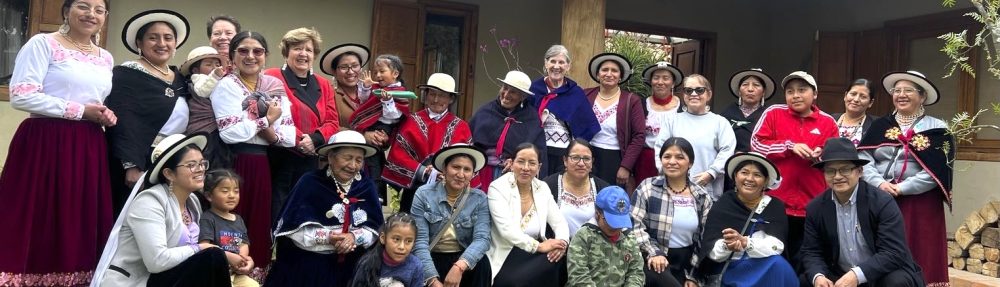
Lives of Cañari girls and women

Dear Friends: While I was in Mexico last month, several of you sent me the link to the tragic story in the New York Times of the 12-year old Cañari girl, Noemi Álvarez Quillay, who hung herself in a children’s shelter in Juarez, Mexico, after being caught trying to migrate to the U.S. (www.nytimes.com/2014/04/20/nyregion/a-12-year-olds-trek-of-despair-ends-in-a-noose-at-the-border.html) Her parents, undocumented immigrants living in the Bronx, migrated north when Noemi was a three, leaving her to be raised by her maternal grandparents, along with four young cousins left by other family members. A few months ago, Noemi’s parents arranged with “coyotes” to bring their daughter to the U.S, paying from 15-20 thousand dollars. These arrangements were made from New York through a vast human smuggling network that begins in the village where Noemi lived and extends through Central America, Mexico and the border city of Juarez where she died. Little is known about how she traveled – some deals involve flights to Mexico from Ecuador with false papers; others begin in Guayaquil on rickety fishing boats that arrive 5-8-days later off the coast of Guatemala, and migrants go overland from there, traveling by bus, truck and on foot through Central America and Mexico.

noemi

Noemi had been sent once before, a year ago, and – as she wrote in a school report – a school report! – she was detained in Nicaragua for two months before being sent back. She was only 11 then. Although I know many migration stories, I simply cannot imagine this girl – or my 11-year- old grandson, Cosmo, for that matter – leaving home alone on a dangerous journey, with strangers, detained for two months in a strange country, and sent back home.
From this creased photo published in the Times, I’d guess Noemi was seven or eight when it was taken, as a school ID photo. The article included a quote by her grandmother when Noemi’s mother told her she was sending for her daughter: “I said to her, ‘Why take her away? She’s studying here, she’s doing well.’ But my daughter says education in Ecuador is no good and it’s better for her to study there. And she took my Noemi away, only for this to happen.”

One month and 4000 miles later, Noemi was picked up in Juarez and taken to the shelter, Casa de la Esperanza and interrogated by a prosecutor, who was probably going after the coyote (in whose truck she was found). Noemi was reported to be terrified and crying inconsolably for a few days before she locked herself in the bathroom and hung herself with the shower curtain. An autopsy report showed she had not been sexually abused – an all too common crime against migrants that thankfully she was spared.

I suspected when I first read the article, and confirmed once home in Cañar, that Noemi was from a village I know well, not far from where I live (I don’t know the family, though their name is a common one). This past week I visited the country school where Noemi might have been an 8th grade student next year. I went to talk to the junior and senior girls about our scholarship program that sends low-income Cañari girls to university. “Ninety percent of our students are affected by migration,” Principal María Juana Alulema told me beforehand. “One or both parents are gone, and they are left in the care of grandparents, aunts and uncles, or others. As our students get close to graduation, all they can think about is migrating north. They do not concentrate on their studies.”

Below: Sisíd bilingual secondary school (Spanish/Quichua), for 9th -12th grades.school sisidPrincipal María Juana Alulema and the senior girls.girls sisidStill, in my talk with the girls I tried to present an option to migration – showing them photos of our present scholarship women and graduates, saying they were also poor and from similar communities, describing their determination and difficulties in getting through university, some while marrying and having children. I listed their professions: Pacha, dentist; María Esthela, Transito and Marta, nurses; Mercedes, lawyer; Carmen, economist; Juana, veterinarian; Luisa, physician.becarias 2013I also mentioned to these high school girls what they already know well: their jobs in the U.S. would most likely be limited to hair or nail salons (like Noemi’s mother), cleaning hotel rooms, working in restaurant kitchens, stitching clothing, and so on. Migrating, in almost every case, means the end of educations.

It was hard to read their responses (as you can see from the photo). But I gave the girls application forms and invited them to come see me and learn more. And I’ll go again next year, and the next, until we have a scholarship woman from this village.

In the week after Noemi’s death, 370 foreign child migrants were detained across Mexico, according to the national immigration agency. Nearly half were traveling alone. From the article: The number of unaccompanied minors caught entering the United States…is expected to reach 60,000 in the 12 months ending Sept. 30, an increase from 6,560 in 2011. 

But to return the the theme of education, I’d like to end with the story of another Noemi, the daughter of one of our scholarship graduates – Pacha Pichisaca, now a dentist with her own practice in Cañar. In the photo below, Noemi is the little girl on far right, looking straight at the camera, playing with other “scholarship kids” in the patio while their parents met in my studio. (“Keep ’em out of the fountain,” I can hear Michael saying. Impossible!)kids in patioNoemi is six or seven now. Her parents came from poor indigenous families that chose not to emigrate. Her father, Juan Carlos, a professional musician and teacher, and her mother Pacha married during high school and lost their first baby. But they persisted in getting through university, taking 5 or 6 years and having Noemi along the way. She is a bright healthy kid who loves school and her ballet lessons, living in a close family and village milieu with cousins, aunts and uncles, and grandparents, far from the hard reality of the Cañari diaspora in Queens, Newark, Minneapolis of the Bronx. With two professional parents, there is no question this Noemi will go to university, and she surely won’t need one of our scholarships. In only one or two generations, with educational opportunities, the lives of Cañari girls and women can be turned around.

I only wish the other Noemi had been given that chance.


Home again

viewAh, why do we ever leave here? we asked ourselves with a collective sigh on arriving home last Thursday. Michael built a fire and we had drinks and he made dinner and we went to sleep early in our own comfy bed, with good reading lights and surrounded by silence. “Let’s never travel again, OK?” I recall one of us saying.

We both feel our Mexico trip was not a success, and coming home we were reminded of Thomas Moore’s aphorism on travel (which I just found and gender-edited a bit). “We travel the world over in search of what we need, and return home to find it.” Take climate and congestion: Mérida, our first stop in the Yucatán, was way too hot – 100+ degrees every day (40 C), and terribly crowded with tourists. While here in Cañar we have a perfect climate with average high of 65F (18C), and no sightseers to speak of. Our second destination, Campeche, on the Gulf of Mexico, was a mite less hot, and not so crowded, but a fierce wind nearly blew us off our feet. San Cristobal, our last destination in the mountains of Chiapas, has a delightful climate, but we made the mistake of landing smack in the middle of Mexico’s biggest holiday of the year: two weeks around Easter. All children are out of school and, as in Ecuador, everyone wants to be somewhere else: the beach, the mountains, the city, the country. During our ten-day visit in San Cristobal, half of Mexico seemed to be there. All hotel prices go up, restaurants are overcrowded, streets are packed, and there’s a general air of making the most of the exodus, both among the travelers (lots of partying) and the businesses of the host city.congestionBy the way, that red/white building close on the right is a Burger King, which brings me to Michael’s recurring lament, “Where’s the old Mexico?” (It was partly his nostalgia that took us on this adventure.) The face of globalization is everywhere: Pizza Hut, KFC, Holiday Inn, Ramada, McDonald’s, often disguised within old buildings. And these were only what we saw walking the city streets. In our daily searches for small things – water, toothpaste, or yogurt – an OXXO store sat at every corner and, we soon realized, is a ubiquitous presence in Mexican cities and towns. Something like the 7-Eleven, but Mexican-owned, with 11,000 stores across Latin America. Michael yearned for the small mom-and-pop shops he remembers, but the closest we came was the orange juice and other street vendors. (Again, of course, we were not hanging out in the barrios, where I’m sure small business must still exist. But OXXO (no kisses & hugs there) has certainly taken a chunk from them.)vendor orangevendor tacosFood: When we think of Mexican food, I suspect we are remembering meals from many years ago, with a patina of nostalgia and romance. “Remember that great huitlacoche we had in Guanajuato in 1989?” Michael asks. (“No,” I reply, “but I do remember the evening and what I was wearing,”)

“Well, this isn’t nearly as good,” he declares. He was very much enjoying the Margarita, however. (We were never disappointed with those.)M. margaritaFor me, going out to search for meals twice a day was agony: trouble making a choice (always!), servings too large, flavors not what I expected. It was almost a relief to get an intestinal infection from contaminated juice so I didn’t have to eat for a few days. (Of course, there was that 12-hour bus ride ahead that sent Michael to the pharmacy for me). Once I was eating again, I remembered that no one makes chicken soup like Mexico.chicken soupHowever, eating abroad also reminds me that Michael is about the best cook around, and we don’t have to leave home for this….. or this….shrimp  tapas

Many come to San Cristobal for the re-enactment of the Good Friday crucifixion, which took place in a plaza near our hotel, and included an elaborate procession to several churches in the historic center. I was sick that day, and between bouts of intestinal distress I went out to photograph. Worthy of Cecil B. deMille, this is religious drama at its best for which the players must prepare all year: Roman soldiers, Pilate’s court, the two thieves, and Virgin Mary and Mary Magdalene. jesus + two thievesjesus in rope behind soldier roman solider thief on the crossThat night I was able to get a few shots of the candlelight procession, which was taking Jesus from the cave to the church where he would wait to rise on Easter Sunday:procession 2 procession 3 procession 4We traveled the next day and so I missed the burning of Judas. But I had seen enough. The people of San Cristobal are rightly proud of their religious customs around Semana Santa, and I have to say the Passion of Christ, as it is called, was played out with great respect and solemnity, despite all the clicking of cell phones and cameras.

OK. Back to Cañar, where “real” life continues – such as, watching the quinoa in our back field grow to maturity. There’s nothing like the pleasures of a simple life, no?quinoa

San Cristóbal de las Casas

Riding 14 hours overnight on an uncomfortable bus from Campeche, on the Gulf of Mexico, to the highlands of Chiapas, near the Guatemalan border, reminds us what hard work traveling in Mexico can be. It also reminds us how huge this country is – maybe ten times the size of Ecuador? Below you can see our trail from Cancún to Mérida to Campeche to San Cristóbal de las Casas. Next week we must retrace our steps to catch our flight back to Ecuador.imageBut here we are, settled into San Cristóbal for ten days of Semana Santa, and the suffering has paid off.imageA beautiful colonial city (and yet another UNESCO gem), Michael and I traveled here during our Costa Rica years in the late 1980s. I remember it was very cold, there were few indigenous people in the town, and the guidebooks warned us not to photograph in their villages, where a European tourist had done so in a church and been killed. Although now chock-full of tourists from every part of the globe, including thousands of Mexicans here for Semana Santa (Easter week), San Cristóbal remains a fascinating (and complicated) place to experience indigenous Mexico. (More on that in a moment.) At 2200 meters (7260 feet), and surrounded by mountains and pine forests, the climate and scenery suit us perfectly; in fact it feels a bit like home in Cañar, except for the incredible colonial churches on every corner and the religious art filling them.imageimageimageimageimage
Home to the Mayan people for thousands of years, the Spanish conquered the region in 1528 and the native peoples, who had been part of the most brilliant civilization in pre-Hispanic America, soon suffered loss of communal lands, diseases, taxes and forced labor. Familiar story. One epidemic in 1544 killed about half the indigenous population of Chiapas.imageThe city is named for Bartolomé de Las Casas, a Dominican monk who arrived here in 1545, saw the terrible exploitation of native peoples and as bishop of Chiapas became the greatest defender the indigenous in colonial times.
Since that date the city has gone through many names changes before it settled on San Cristóbal de las Casas.

Today, the local indigenous peoples are everywhere present in the streets and ubiquitous open-air markets, dressed in their stunning hand-woven and embroidered clothing. At first, one can only stare in wonder:image
image
image
Then, I began to see young children, many under ten years, hawking trinkets and shining shoes. Everywhere. Old barefoot women carrying armloads of woven belts and shawls to sell, walking the streets all day. Legions of young women with babies on their backs, or in tow, selling embroidered blouses. On our first day here, we saw government rally to “support” 6,000 single mothers in Chiapas. This was the face of poverty like nothing we’ve seen in Ecuador.
imageimage
image
(Michael playing chess surrounded by (older) shoeshine kids.)
Hadn’t the 1994 uprising by the indigenous communities, led by Comandante Marcos and the Zapatistas (EZLN), that brought the world’s attention to the abysmal conditions in Chiapas, made a difference? In an effort to understand we saw a pretty good documentary film, “Zapatista” that showed armed indigenous farmers occupying city hall in San Cristobal (a few blocks from our hotel), and then being massacred by the army in the market in Ocosingo, a town two hours from here. By the end of the narrative (2007) we learned how contradictory the movement had been. Led by a Marxist philosophy professor from Mexico City, come to organize the peasants, the Mexican military moved in with tanks and helicopters as though at war (it was a war). Aiding by paramilitaries, many villagers were killed and eventually 21,000 were displaced from their homes. Evangelical missionaries got involved, further splintering communities that had long practiced a mix of animistic pre-Hispanic rituals and Catholicism. Government promises from three Mexican presidents came to nothing; disillusionment set in and now – 20 years later – the movement is pretty much dead (except for the Zapatista trinkets in every tourist shop.)
image
But in the end didn’t the uprising have a positive effect on conditions for Chiapas’ indigenous? We asked a woman we came across who has worked with a women’s weaving cooperative for ten years. “Somewhat,” was her answer. “There is more indigenous pride. Before, if an Indian met a townsperson on the sidewalks of San Cristobal, the Indian had to step off into the street. The situation of women is better, with the organizing of cooperatives where they are earning their own money. There are now autonomous villages where the military and outsiders can’t enter. But the conflict within and between communities has intensified and caused a massive migration to the edges of San Cristóbal. The evangelical movement, encouraged by the government in the face of the uprising, split communities, and whichever group was in the majority expelled the others.”
So, some 20 years later, most villages do not have running water or electricity, two of the original EZLN demands. The Mayans farm the least productive land, with the least amount of government services. Of the 4.8 million people of Chiapas, one quarter are indigenous, and among them speak 30 languages. Hearing vendors talking to one another always turns my head with the music.image
image
But to come back to the poverty we see around us in San Cristobal: according to our Lonely Planet guidebook, many of the men, women and children on the streets are displaced villagers, living in the “belt of misery” of poor, violence-ridden shantytowns ringed around the edges of the city. Most have been expelled from their villages as a result of political-religious conflicts – a sad conclusion to twenty years of struggle to create better and longer lives.
To finish on a sunnier note, here is Michael after a successful day of playing chess on the plaza.image