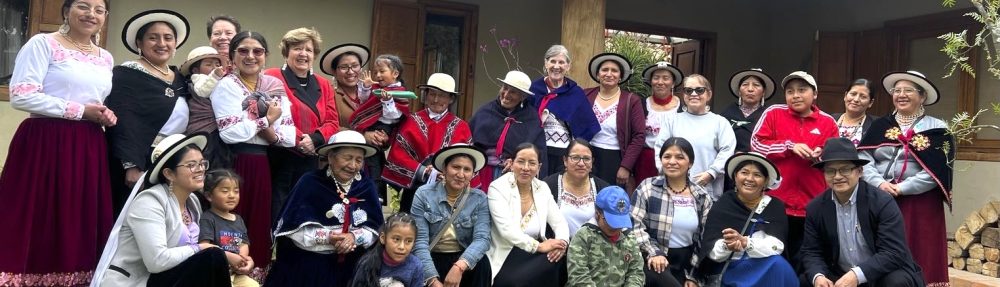
New York Times to feature our life in Cañar this week

Dear Friends:

This Thursday, June 6, the New York Times, Home/Garden section, is featuring our life in Cañar with a full-page article with photos. This has been in the works since April, when the writer and photographer visited Cañar, but I didn’t want to say anything until we had a publication date. An on-line version, with a slideshow of 23 photos, will probably go up on Wednesday night. I’ll send a link on this site as soon as I see the article.

If you’re curious to know how this has come about, I’ll be happy to tell you, as it falls under the subject of “shameless self-promotion.” When Our House in the Clouds came out in March, I sent an e-mail to a writer I’ve frequently read and liked at the Times’ Home section, mentioning the book and adding a few photos. She wrote right back saying she’d pass the message on to her editor. Within days I heard from the editor, who said they might be interested “if you haven’t already had press.” (Well, I thought, I can probably hold off all the other media clambering for interviews and coverage.) A writer, Sandy Keenan, got in touch to say she was reading the book, and might be interested to come to Cañar to do a story. Were there any hotels nearby?

Thus began a wonderful couple of weeks in April. Sandy and the photographer, Tony Cenicola, came at separate times, stayed with us as house guests, and proved themselves  true third-world troopers. Sandy’s luggage went on to Lima, Peru, and didn’t show up until five days later, mere hours before she left. Tony’s Avis rental car, along with some of his equipment in the trunk, was towed the first night from in front of his hotel in Cuenca, and impounded by the traffic police as “possibly stolen” (for no other reason than it was on the street at night). And it stayed impounded for the eight days of his stay, despite escalating calls to Avis agents, lawyers, Cuenca officials, and finally, the assistant to the mayor. No one could do anything, although a journalist friend in Cuenca valiantly took on the cause.

Tony had to rent a second car while continuing to pay for the first. He began a blog to friends called, “Daily Cup of Kafka.” Finally, a judge’s order allowed him to get his equipment (our journalist friend was key to this triumph), but the car was not liberated until seven days after he left. Tony was charged with lawyers and court fees, impoundment costs, plus the rental for both cars. (One of his parting comments to me was: “You told me not to rent a car!”)

But through it all Sandy and Tony calmly carried on with their work and enjoyed Canar, the people they met, the local sites, and Michael’s meals.  Certainly, we enjoyed them.

*  *  *  *

We are back home after a very chilly month in Spain, making Cañar feel positively tropical. (Newspaper headlines our last day: “Spain Braces for Coldest Summer in 200 Years.”) I’m hoping to write one more blog about our trip – despite the weather we enjoyed our time and learned a tremendous amount about the Basque history, culture and today’s political/economic situation.

Below: last day in Hondarribia, near the French border. Our San Nicolas hotel is with light blue trim around windows. Brrrrrr.Hondarribia


Spain – a more sombre look

Dear Friends:

Several of you have asked me about the economy of Spain, and so when I took this photo I was thinking to write something on the subject. 

The sign says: “In solidarity with the times, we have cut the price of coffee. One Euro: always, any time.” (One Euro = $ 1.40) 

Being a tourist hardly gives one a true picture of how the Spanish people are faring in these times. We know the unemployment rate is near 25% (and even higher for young folks.) We know the economy is still shrinking, though not as seriously as in Portugal. We know that Germany’s Angela Merkel has called for more belt tightening. And in Cañar, Michael and I have acquaintances and neighbors who, after years of working as legal immigrants in Spain, have come home to Ecuador to become taxi drivers or construction workers. 

In the small town Basque region where we’ve been traveling, we see things obliquely, and probably not a representative picture as northern Spain is a more prosperous region. Certainly there are empty storefronts, and paralyzed building projects, but every village is bustling with small, family-owned shops specializing in meat, cheese, fish, hardware, and lighting, and more,. Employees and customers – all seem to know one another, exchange news, and warmly greet visting tourists buying food for a picnic.


And in the surrounding cities, central markets seem always busy, the vendors knowledgable, professional, and friendly, providing excellent service. This woman had a line-up of customers, so we got to watch her at work – managing alone, keeping an eye on the line while filling orders slicing jamon, chorizo, mortadella, and cheeses, all with this great smile.  

At the market fruit stand, Michael wanted a single orange and the woman helping him asked, dead serious, if it was for juice or to eat. She tested several before she handed him one, saying, “perfect for today.”

And during the hours between work and bedtime, every bar, cafe, tavern and restaurant is full, as are the surrounding streets if the weather is nice. Customers take their wine or beer to nearby walls, benches, or stand-up tables, to watch their kids play ball or chat with friends. (Smoking is prohibited in bars and cafes, but many many Spaniards still smoke, and every establishment has an outside area for this.)   

We are also seeing, I think, an effect of the crisis in family dynamics. Daytime babysitters, it appears, are mostly grandmothers. During work hours, these gray-haired nannies are ubiquitous on the streets, deadly serious, rolling elaborate stollers with babies cozy in fancy sleeping bags, transparent rain tents and parasols, or they sit in cafes with sleeping creatures beside them. And if you meet these grannies in the streets, you’d better get out of the way, because they ALWAYS have the right of way.

From about 4:00 to 8:00, the (presumably) working parents join the action on the streets…and it is a wonderful sight to see. Every town we’ve been has great open spaces, plazas surrounded with sidewalk bars and restaurants. Babies in strollers peer around while parents have drinks at an outside table, toddlers stick together doing what the do, and older kids play soccer or race around the space in the middle, screaming with delight. Dogs are out too, in little sweaters or padded jackets in the cold weather. No traffic, so the adults are relaxed and everyone looks out for the kids, their own and others. By 8:30, it’s time for home for dinner and bedtime, and everything gets quiet…(until the adults come out again for dinner, around 10:00)


(On the other hand, I’ve heard that few young marrieds can afford to have their own places, so they continue living with one or another set of parents. Apartments are small, so maybe all this street life is to keep everyone from going crazy.)

We see much evidence of the boom years, when the EEU and Spain were spending wildly to bring the country into the 20th century: beautiful road systems, from local byways to super highways, all well marked and maintained. Attractive housing for retired people, even in smallest villages, and tourism infrastructure that would be the envy of any country. Michael and I hang around the one-two-star level of hotels and hostals (40-50 Euros) and all our accomodations have had wonderful beds, excellent plumbing, new fixtures, efficient heat, TVs and wifi. Prices and services are carefully regulated, and personal service is exceptional, everywhere.  Cities and towns are clean and green, with recycling bins around every corner, lots of sports facilities for youths, parks, plazas and pedestrianized centers, and our most recent city, Vitoria, even had a series of covered escaltors to get folks up the hills.


So Spain, at least this part of Spain, feels prosperous and lively. 

But read the national papers and you get another picture. Drastic cutbacks of public servants, bankruptcy of big companies, scandals  of corruption and graft, and always, high unemployment. 

It’s not all about food…


Dear Friends: Here we were just a few days ago…a warm day in the mountains…

…but when we read that a “severe borrosca” – cold, rain, lightening and worse – was heading our way and would last five days, we left our car in a village and took the train to this beautiful, small city of Vitoria (pop. 225,000). It’s not a place we’d planned to visit, but now, several days later, we thank the weather for bringing us here. (Pouring rain and 8 C – about 45 degrees – when we arrived; now, several days later, it is still 45 degrees, and snowing in those mountains). 

We wanted to hunker down a place with good food and drink, of course, but that leaves lots of time for other things, such as museums, maybe movies, and even some music.

Vitoria has several quirky museums, including one devoted entirely to playing cards that we are saving for last. But yesterday was a great treat: the Belles Artes Museum, once a private house, built in 1912 as a wedding present for a titled young couple… There’s Michael, lower right, wondering what it would be like to live there…

We loved the collection of Basque painting, and since I was allowed to take photos in the museum I’ll share a few of our favorites that capture Basque culture and landscape. This one reminded us of the mountainous country we’d just left and the great spirit of the Basque people (though we saw no scenes quite like this)…

And a somber one of miners ready to go down into the mine…


And finally, this one because it reminded us that things have not changed that much – our neighbors still plow this way in Cañar (you can barely see the wooden plow between the bulls).


That left the archeology museum, the arms and armor museum, and the playing card museum – the last an amazing collection by a Señor Fournier, who in the late 19th century created the playing card industry here in Vitoria that continues today.

There we learned one amazing fact that explained how Sr. Fournier became so rich: someone in the world buys a pack of Fournier playing cards every 1.5 seconds. Wealth allowed him and his heirs to become collectors, so today – May 18, International Day of Museums – we discover when we visit the arms museum that the suits of armor, crossbows, swords, knives, spears and blunderbusses, were also his obsession. All the museums here gave out free art books today – beautiful expensive books. I had to stop after three, for the weight alone.

(…no photos allowed)

The rain and cold continued, so we extended our stay in Vitoria and I snuck off on my own to visit the sacred art museum in the nearby cathedral. Forgot my camera, but this from the booklet:

Finally, we ran out of museums and found the cinemas, where tonight we saw an excellent Danish film, “The Hunt,” dubbed in Spanish, by the same director who made “Celebration” a few years ago. See it if you can.

Well, the temperature is up to 12 degrees C (54F) and we can’t linger in Vitoria any longer. Tomorrow we’ll take the train back to the little town where we left our car five days ago, hoping to find it there still with our luggage, and head towards the Rioja region, no matter the weather. We need some of that robust red wine!

Stay tuned…

 (of course we did have to eat now and then. We splurged on one great meal that finished with this – a fresh goat cheese tart with sweet ground nut paste, garnished with a little fruit, uvilla, a ground cherry that we have in Cañar   (thanks to M. For that description)