2013 Chronicle 1: Back to Cañar

Dear Friends:

Vaca loca reduced

We left Portland middle of the night on January 2 in icy cold, and arrived in the ninety-degree coastal heat and humidity of Guayaquil the next afternoon. This being the eighth year of our bifurcated life, our two-day travel routine is well established. We check into the homely Hostal Tangara near the university, drink cold beers from the hostel’s fridge, walk to the outdoor seafood restaurant for crab soup, and walk back to the hotel for a nighttime rum to congratulate ourselves on having “done it again!” – that is, arrived safely in Ecuador with a money belt full of cash, four heavy suitcases filled with electronics requested by friends here, and no trouble with customs or migración (though an agent studied our passports for an eternity) – and drift off to sleep to the hum of a noisy air conditioner.

M in tangara web

The next day at 9:00 AM a car and driver waited at the door of the hostel to bring us up through clouds to Cañar, or rather through the fog and mist, with visibility at twenty feet at times. We had hopes that the road project from Guayaquil to the highlands would be done, but no such luck. Jolting potholes, verges gone into the abyss below, trucks and buses and cars backed up for construction delays… At least we were not on a bus, remembering the six hours it took friends last year to get from Cañar to Guayaquil.

line-up on highway web

In Cañar, we find our house just as we left it, dusty inside and cobwebby, but dry and clean  – this climate is kind to houses left shuttered – and not a sign that our caretaker Jose Maria’s family had used the guest quarters and kitchen since October, when their daughter Lourdes came home from Quito after a kidney transplant (more on that story next time).

dogs + house web

Two or three dogs greeted us at the front gate, and two weeks later they are still here, sometimes with mutt friends, gamboling on the lawn, rolling in the garden, mating, coming and going like they own the place. They were possessive of their adopted territory at first, but now seem to realize we live here. We’ve no idea where they belong, but they are getting fed somewhere, and we can’t do anything to keep them out anyway.

Our interior patio garden, now in its sixth year, has grown to alarming size, at least on Michael’s side with his predatory succulents, phallic cacti, aggressive jade plants, and towering macho aloe. My side, more demure, is suffering from “inappropriate plants,” as Michael loves to call my efforts to introduce flower varieties and ferns. His first job was replacing the pump in the fountain so we now have a real gusher that can be calibrated according to our moods and visitors and time of day.

patio web

All our neighbors seem to like us now, warmly greeting us with a Feliz Año Nuevo and bienvenido when we meet them on the road. José and Rosario, who sold us their cornfield eight years ago, when Rosario agonized over losing her “children’s legacy” and blamed us (along with her husband) for tricking her, have now sold all their land around us. They welcomed us back like long lost friends. Magdalena, our neighbor on the other side and below, who accused us of encroaching on her land when we built a stone retaining wall that she wanted to prevent erosion and flooding, couldn’t have been sweeter when I ran into her with her two daughters.

We heard gossip that Mama Julia, the curandera (healer) who lived two houses down and dressed all in white, walked barefoot in the road with her followers, and built a chapel in her back yard to hold services as a sort of Pentecostal Catholic sect, is gone. “Brujeria! The bishop came and put a lock on the door,” is how someone described it. Brujeria means witchcraft, but I suspect the bishop simply told her to stop her faith healing activities, which had brought folks from far and wide and generated enough income to build this chapel, now standing half-done. “She’s gone to another village, high in the mountains,” the same informant told us. I rather miss the sounds of hymns coming over our tall hedge.

chapel web

It also harvest time, so we’re overwhelmed with sacks of potatoes and baskets of fava beans and peas. No matter how much we protest that we are only two people and cannot eat all that is given us by José Maria or the families of the scholarship women, they ignore this. I’ve learned to simply accept their largess. José Maria is a partidario and therefore feels he has an obligation to share his harvest with us, the owners of the land. We press potatoes and favas on all who visit.

In the field way below, I see our neighbors plowing with yoked bulls, a man handling the animals, a woman walking in front to guide them and make the rows straight. If the last crop was potatoes, this one will be corn, getting ready for the rains that the informal farmer’s almanac and long experience says always begin at Carnival – February 11 this year.

plowing for web

I’ll end this first chronicle with a photo I took minutes ago of the view we love so much. It’s about 5:30, the day has been beautiful, Michael has mixed his favorite cocktail (rum, mineral water, lemon), begun to build a fire, and I’m about to join him. Next time I’ll write about the Fiesta de San Antonio I photographed yesterday, when I fell in the road and got bopped on the head with a vaca loca, or crazy cow,the big puppet-like thing in the first photo of this chronicle. Until then…

late afternon view web


2012 Cañari Women’s Scholarship Foundation

Dear Friends:

Another year has gone by, and the Cañari women’s scholarship program is stronger than ever. As I reported last November, of the eight women who started five years ago, all have graduated. Four previous graduates bring our total to twelve Cañari women who have completed their university studies and become professionals, thanks to your generous help!

Graduations also mean we can offer new scholarships, and this past fall six young women began receiving support, plus one continues from last year. They are studying full time in two state universities, in veterinarian medicine, nursing, accounting, public health, medicine, forestry, and political science. Each woman receives a monthly stipend of $90 or $100, depending on her university, to help cover fees, room and board, travel and other expenses. (President Correa’s government eliminated tuition in state schools in 2012, making our dollars go further.) All must live away from home while studying, and most degree programs last five years. We also provide $500 for thesis and graduation costs, so I figure our yearly support for each woman averages about $1200, an amazingly low cost for a university education.

We have no administrative costs, other than this mailing, so every dollar goes directly to the women.Let me introduce you to some of our new scholars:

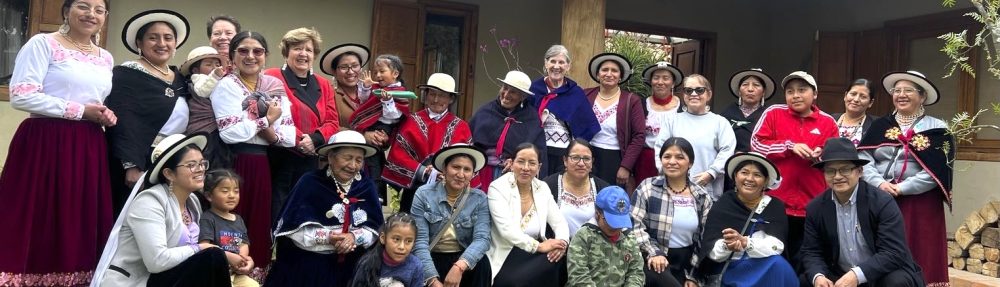
(l to r) Esthela Chuma Delgado, Vicenta Pichazaca Guamán, Mercedes Loja Lema, Transito Zhinín Pichasaca, Mariana Chuma Acero, Mecedes Guamán

Perhaps the best news is how well our graduates are faring in the real world, given a job market in Ecuador not that different than in the U.S. Carmen Loja, a graduate of University of Cuenca with a degree in business adminis-tration, is the new director of a branch of the oldest savings and loan credit cooperative in Cañar. She heard about the job on the radio, presented her carpeta (resume), was interviewed by members of the coop, competing with several others, and won the position. She now heads up the credit union in her hometown of Suscal.

María Chimbo, a graduate of University of Riobamba as a CPA, also landed a job with a credit union. You might remember she lost her husband, Juanito, in a motorcycle accident last year, and she is sole support of her son, Atik.

 Verónica Paucár, one of our earlier graduates, was hired by the local branch of the Banco de Azuay, in customer service, where she sits at a desk in the main lobby. You can imagine the thrill I get walking into town to do my errands and seeing these confident, bilingual women at their jobs, attending to clients in Quichua or Spanish.


Pacha Pichasaca, our dentist, is finishing her rural year of service and will be looking for work in the region or opening her own practice.  Obdulia Castro, with a degree in education psychology, was hired by her hometown high school as a counseler. Luz Alvarez had trouble finding work in her degree field of nutrition, so took a job at a remote school in the Amazon region, teaching science. Magdalena Guamán, in eco-tourism, was hired by the province of Chimborazo to help communities develop their tourism potential.

Our program is adapting and advancing with changing times. In 2012 the committee voted to support our graduates in master’s degree programs, beginning with the order of graduation. Three women have applied and been accepted: Mercedes Guamán in law; Verónica Paucár in business, and Alexandra Solano in education. These are low-residency programs lasting two or three years, requiring the women to travel to Cuenca or Quito once a month for weekend classes. As in the U.S., our graduates find they need more than a B.S. or B.A. to get ahead in their careers. Alexandra, for example, is teaching high school math, but with a degree in agronomy she cannot keep her job more than three years without an advanced degree in education. Mercedes found that as she competed for national positions in indigenous justice, her lack of a master’s in law kept her in second place. Veronica, although pleased with her job at the bank, wants to go further.


Another change coming in 2013: we are offering one or two scholarships to young women just out of high school. Until now we have required that applicants complete one year of university before they apply. Now, with President Correa’s education reform measure that high school graduates must take an exam to determine if they are prepared to enter university, we feel we can offer this new type of scholarship. This is an experiment that we will evaluate in 2014, along with the master’s program.

Finally, if any of you are not on my Cañar Chronicles list to receive monthly updates of our life in Ecuador, and would like to be, please send me an e-mail at: judyblanken@earthlink.net. In 2013 I’m starting a blog to make the chronicles public, so you should hear from me sometime in January. The mountain gods and satellite broadband service willing, I hope to post more than once a month. My book, Our House in the Clouds: Building a Second Life in the Andes of Ecuador is in production at University of Texas Press, and will be published in March 2013. Those receiving my chronicles will hear more about this as it gets closer.

In the meantime, a huge thanks to all of you who have supported the scholarship program over the years. Every woman knows that it is you – friends, neighbors, family, contributors, champions – who make their education possible, and each one feels a personal connection to you. They, and Michael and I, welcome you to visit Cañar, and our house in the clouds – any year between January and July.

We are proud that the Cañari Women’s Education Foundation is now an official 501 (c) 3 nonprofit, which means your contributions are tax deductible. Please make your checks to the new entity (CWEF for short), and you will receive a warm thank you letter with your IRS receipt.

Judy Blankenship, Secretary, Cañari Women’s Education Foundation, 2020 SE Ash Street, Portland, OR 97214

hello colombia – may 2012

Cañar Chronicle 5:  Colombia, May 2012

Dear Friends:

We’ve just come back from three weeks in Colombia, my first visit to our neighboring country to the north, and Michael’s first return since 1976, when he traveled as a longhaired hippy tourist. There’s a wonderful photo somewhere of him on a horse, skinny, with dreadlocks and wire-rimmed glasses. He recalls that, back then, he was stopped frequently by the police or military and asked if he was carrying drugs. When he replied, “Why on earth would I carry drugs in Colombia,” they responded. “Well then, do you want to buy some?” This time our (perceived) vises went no further than Colombian beer and famous Colombian coffee, (and maybe just a little bit of Colombia .

 It was a rigorous trip. We traveled entirely overland except for a final flight home from Quito – taking two days to travel north out of Ecuador, then making a broad loop around southern Colombia. To travel on the mountainous roads that crisscross the three Andean cordilleras – muddy, incredibly potholed, with frequent landslides and nearly impassable at times – we were crammed into every sort of vehicles for up to six hours at a time, airborne as we bumped over potholes and ditches. Drivers were good, though some little older than overly-confident teenagers, speed-loving, risk-taking, and I – who rarely get nervous on buses – had to close my eyes as we inched around landslides close to certain-death drops into a river valley abyss below, or forded a river that didn’t look like it wanted to be crossed.

Gasoline is expensive in Colombia, compared to Ecuador, and as the trip wore on we had to laugh at our descent in traveling style, from big luxury buses to decreasing-in-size mini-buses, from chiva-style rattletraps to double-cab pickups (above right, me, before six others crowded in) and, finally, standing and hanging for a short ride on the back of a jeep as it sped up the hill to a village. All that was left was to hire a ride on a horse-drawn cart or on the back of a motorcycle. Everyone from schoolgirls to grandmothers to families with babies ride small Honda bikes, and in fact in our last village we almost hired a ride on market day from a line of motorcycle taxis standing ready. When I asked the young driver if he had an extra helmet, he laughed.

Because the Andes are still a geologically active region, many of the cities we visited in Ecuador – Ambato and Ibarra – and in Colombia, have been destroyed at one time or another by earthquakes. The most recent, and devastating, was in 1983 in the colonial “white” city of Popayán, our first destination in Colombia. Many buildings, including the cathedral, were destroyed, and hundreds died. This small city has been largely rebuilt in the colonial style, and was a delightful stop for a few days. Michael found a couple of chess partners at the local university while I visited museums and churches.

From Popoyán we launched into the “great unknown” to the east – San Augustin and Tierradentro, a vast region of archeological mysteries, ancient cultures, and the headwaters of the Magdalena River, which runs the length of this beautiful country. Colombia is much larger than Ecuador – about the size of France, Spain and Portugal combined – but in many ways it resembles our corner of Ecuador. Spectacular green mountain ranges, villages tucked into river valleys or on high plateaus, and houses made of adobe. But the mountains are lower and the climate is milder – semitropical – so folks love their flowers, birds and trees. In the village of Tierradentro, where we’d gone to visit ancient underground tombs, we sat on a roadside bench one afternoon and watched two macaws making a huge racket in a nearby tree. A couple pulled up on a motorbike at the house in front of the tree and invited us to come visit their menagerie – a back yard filled with creatures running free – “Like us,” the woman, Luz Elena, said cheerfully: a miniature Doberman Pinscher, a small pig, fuzzy cuyes (guinea pigs) creeping around, and other animals along with a large cage with cockatoos and parrots. The man, Favi, said someone had brought the two macaws to them from the Amazon several months ago, and they settled right in to the little house and feeding platform in their own tree.

Interestingly, both Favi and Luz Elena are “little people,” and in only two days in this small village, we saw at least ten dwarfs, and others with dwarf-like features. One of the tomb sites we visited was named El Duende, meaning “elf,” as it had held bones of an extraordinarily small person. We could only think that since this was the most isolated place we visited, tucked in a valley between high mountains, there’ve probably been a lot of cousin marriages over the generations.

The underground tombs of Tierradentro, dating back about 2000 years, are scattered over a wide area, dug into hilltops on both side of the valley. Protected now as national park sites and watched over by friendly guards/guides, we were the only visitors. A guard unlocked wire hatches and the rest was up to us…to maneuver difficult, spiraling, stone steps down and peer into dark caverns. Scooped out of volcanic rock, and sealed for millennia from the light, most tombs were doom-shaped cavities supported with pillars decorated with geometric designs, with niches for ceramic urns with bones. Amazingly, nothing is known of the civilization that built the tombs. We had to make long walks from site to site, and all the tombs seemed the same, so after clambering down and up five or six, panting with the heat and effort, I began to ask the guards, politely I hope: “Is there anything interestingly different down there?

Our third day in Tierradentro, when I tried to visit the two museums attached to the park, a guard informed me that they were closed, “for public safety.” He said something like “guerilla action” and pointed toward the mountains to the east. I asked if the large “boom” Michael and I heard while climbing to other tombs that morning – that I thought was thunder – might, but have been a… bomba! he confirmed.

And this brings us to the part of the story that Colombian tourism officials were rather I not tell.The FARC (Revolutionary Armed Forces of Colombia), the so-called “people’s army,” has been engaged in armed conflict with the military for over thirty years. During that time, violence has come from all sides: the army, the paramilitaries, narcotraficantes and the FARC, fighting a guerrilla war mostly in remote regions.

We heard stories, including one from Pacho, our horse guide, of being “taken” by militares or paramilitares years ago and feeling lucky to have escaped with his life. “I was never anything but a guide in my entire life.” We saw manned bunkers built of sand bags right in the middle of village squares. We saw the remains of a bank, blown up and robbed by FARC eleven years ago and left pretty much untouched since then. Several times, while on buses, we were stopped by soldiers and escorted off. Men were lined up and patted down (including Michael; (see photo) and questioned, and women’s bags searched, including mine. For what? We kept asking. Drugs? Guns? No clear answer. The young soldiers were friendly, and no one objected when I took photos, but it was very reminiscent of Central America in the 1980s during the war-torn years we lived there.

Things had calmed down in last few years, and Colombia’s tourism was just beginning to rebound. Then, on the day we left, a car bomb in Bogotá targeting a right-wing ex-minister killed two people and injured many others, and the U.S. Embassy immediately issued a “terrorism” travel advisory.

Despite all this, the Colombians are wonderfully friendly people – open, curious, eager to be of help if they see you stopped in the street looking at a map, or grabbing your arm affectionately while giving directions. Indigenous people are more reserved, as in Ecuador. Curiously, we saw little evidence of indigenous, at least those easily identified by clothing or language, except for our last stop, a small village called Silvia, where the Guambianos live in hamlets outside town. Men wear bright-blue, calf-length, wrap skirts with pink fringe, fedora-style hats, ponchos and ankle boots. Women dress in variations of the same colors, also with ankle boots (though I saw a few fashion-conscious young women in running shoes). They don’t like cameras, and there were no postcards (Colombia has no national postal system!) but I grabbed a couple of photos on market day.

*  *  *  *