June 2016 Goodbye Chilly Cañar

m, m at baptism

Judy + Michael @ Lake Culebrillas

Dear Friends:  For those of you in the northern hemisphere, imagine waking up this June 24 morning and reaching to put on an undershirt, long-sleeve t-shirt, sweater #1, sweater #2, and scarf. And that’s before I get out of bed. The temperature outside is 52 F; inside about 57 F (and that’s warmer than it’s been these last two weeks). Michael has taken to starting a fire right after breakfast, and if there’s no sun that day we stay in the vicinity of the fireplace all day into night. Oh, and some days the wind blows furiously. Our lights are blinking, with frequent brown-outs, creating havoc with my work in the darkroom. Last week, my colleague Allison and I spent a long day at the Cuenca airport waiting for a flight to Quito. Three flights canceled for rain and one for crosswinds. Gave up the trip to Quito and canceled our presentation at the Fulbright Commission and my appointments related to archive. Since a plane slide off the wet runway in Cuenca April 28, a hundred flights have been canceled; Michael and I have made alternative plans for getting to Quito next week on the first leg of our trip home to Portland.TAME plane BEST

So goes life in Cañar in June.

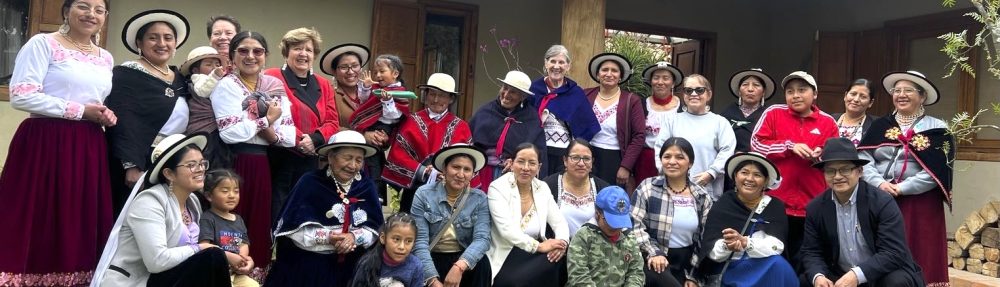
Staying with the weather…. A couple of weeks ago Michael and I spent a long day at 12,000+ feet for a baptism in a mountain lake. Culebrillas figures in the myth of origin of the Cañaris and has enormous symbolic significance. Our indigenous friends Segundo and Alexandra wanted their two children, Saiwa and Waymi, to be baptised in the lake (and later in the church in town, to cover all bases). The weather was terrible all week and we kept looking at the mountains, hoping the baptism would be canceled. But Cañaris never cancel anything for bad weather. So after an early breakfast at the parents’ house
of chicken soup…P1140591

We climbed in a mini-bus and joined a procession of cars and trucks up the mountain.P1140643Culebrillas is beautiful but famous for bad weather. Last time we were there, about two years ago, Michael jumped off this bridge, then unfinished and without steps, and wrecked his knee. So this day he was pleased to be here hiking around with a functioning knee, thanks to a series of shots.DSC_4161

DSC_4156Once there, the baptism lasted about four hours. It was miserable weather all day, my cameras fogged up, making it a most difficult photo shoot, but at the end of the day Michael and I were happy to be included in this special moment (knowing we’ll never have to do it again).DSC_4272Above: Two yachacs of the ceremony – Pablo in poncho, son of Mama Michi, and Mama Mariana, grandmother of the two children, giving him a blessing with an eagle feather. At about this point several gavilanes (hawks) circled the event, giving it nice touch.DSC_4245 *  *  *  * 

Here are some sounds we won’t be hearing for the next five months: our neighbor’s calf tied to the fence, bawling all day. The charismatic church members in the “rogue” chapel below us singing a plaintive hymn. The San Antonio mass wafting out on speakers from the “legitimate” Catholic church high on the hill above Cañar. The sound of drums of students practicing their mindless marching for the civic parade tomorrow.

P1140799P1140692

P1140700

I’ll be there too – marching with the municipal employees, teachers, students, unions, cooperatives and artisan associations. Since joining the board of the Casa de la Cultura in January, I’ve been firmly inducted into the town culture. More than I bargained for, but nonetheless I’m pleased for what it means for the archive project. Two weeks ago I prepared an exhibit of photographs made by Peace Corps volunteers in Cañar fifty years ago (1968-1970). A simple show of rich Kodachrome images tacked on boards and propped on wooden easels. People came to reminisce, point, touch, photograph with their phones, and in my mind make the exhibit a success.banner foto CCEP1140442P1140450

And with that, I want to give final and fond mention of the two wonderful colleagues I’ve worked with these past months. Ethnomusicologist Dr. Allsion Adrian came to Cuenca in January with a sabbatical, a Fulbright, three children under nine years and a supportive husband. She drove to Cañar innumerable times to make video interviews with musicians and record the fiestas – raymis – related to the agricultural cycle. We said goodbye yesterday and I will miss her tireless energy and wonderful work.allison-street copyArchivist Natalie Baur will, I hope, be a continuing presence in my Cañar life and the archive project as she begins her PhD at Florida State University, with plans to include the Archivo Cultural de Cañar as part of her thesis research. She was here for two weeks in June when she helped me with the exhibit and many technical issues related to metadata and archive work.me, natalieThat’s all, folks, for Cañar 2016. Well, at least until November, when we’ll be back and I’ll pick up again on the Cañar Chronicles. From now forward we’re changing our Ecuador schedule to November – May. Too many past travel disasters in the US in January, and too many chilly Junes in Ecuador. Until then….please stay in touch.

May 2016: Adiós Spain

P1140305

Banner hanging on a Madrid government palace demanding Spain accept more refugees.

Banner hanging on a Madrid government palace demanding Spain accept more refugees.

We are back in Guayaquil this morning, after a 14-hour flight from Madrid with a brief stopover in Quito. We ate three times,I watched four movies – a first for me – and Michael played non-stop games of electronic chess. No sleep, as we were flying w and all was daylight, but today we are awake too early, hungry at the wrong times, and will have to resist going to sleep at about 3:00 this afternoon. Today, after Michael shops at the SuperMaxi (always thinking of the next meal!), we’ll take the bus to Cañar – four hours – and our Spain vacation will be at an end. It has been a wonderful break, but my head is in Cañar already, thinking through all to be done this last month: the visit of an archivist colleague, a photo exhibit to mount in Cañar, a new project with University of Cuenca, a visit to the Fulbright Commission in Quito to present the archive project of the last two years. Michael’s heart is still in Spain, however, as he scratches out his shopping list. He reads it for me: jamón serrano, cheese, bread, fresh tomato, onion, mussels (?), special white tuna, sun-dried tomatoes, olives, pimiento (red pepper), asparagus, anchovies, water, orange, melon. These trips to Spain motivate Michael to new culinary heights previously unknown in Cañar, a great benefit to all who come around, although many of the ingredients can only be had in Cuenca or Guayaquil. Speaking of….P1140224 P1140259

Cuenca, Spain is famous today for its “hanging houses,” built on a solid rock escarpment over an incredibly steep gorge that served as a secure stronghold for the Muslim Arabs when they came in 714. P1140222Then, of course, the Christians liked the place for the same reasons when they reconquered Spain in 11th century. Since then, it’s had its ups and downs with invasions, wars, royal intrigues, the Inquisition, and the economic collapse of 2008 from which Spain is still recovering. (Our young woman taxi driver told us the unemployment rate for people her age, in Cuenca, is about 60%. She is buying her taxi and license – “the cost of an apartment, but what else can we do but invest in our own future? There are no jobs.”  We’ve heard “there are no jobs” many times before  – new university graduates back home living with their parents, unable to marry or start their independent lives.P1140228

Back to the two Cuencas: In 1557, in what is now Ecuador, a Spanish conquistador- ordered the new settlement to be called Cuenca after his hometown in Spain. Nostalgic, and struck by the beauty of the place, it’s three rivers and the barranco, where I suppose he could imagine “hanging houses” a few centuries hence, it appears to me a miniature vision. We had only two brief days in Spain’s Cuenca, but would have liked more. It’s a geographically gorgeous town, with lots of walking trails and serious hikes. An additional highlight for me was a visit to the historical archive, a modern operation in an ancient building that was the 15th-century local headquarters of the Inquisition, where they tortured “heretics, muslims and jews” to become Catholics. Some cells still remain in caves in the foundations – we were not allowed to visit – but were told you can still read a poem scratched into the wall by one unlucky prisoner, repenting and asking for mercy.P1140261 P1140265

caracolesFinally, for those who asked for more details on food, I will say only that we tried a few things we don’t usually eat in Cañar. Strolling the small town of Ubeda, we saw folks in outdoor cafes sucking on little shells served in glasses. When I asked, I was given a serving of caracoles – little snails – which I dutifully sucked but didn’t’ much like. Michael passed.

Another day, in Cuenca, we were given as an appetizer chipirones, fried baby squid in chocolate sauce. Doesn’t sound that good, but was excellent in a small amount (didn’t get a proper photo; below Internet mage of stuffed baby squid).

baby squidAnd the day before we left Madrid, we took refuge from a thunderstorm in a small place near our hotel called El Anchovito and ended up with a lunch of  barnacles, percebes in Spanish. We’d had them once before, in Galicia. These were tasty, and although the waitress said they’d come fresh from Galicia, they didn’t squirt quite as much (I remember we were given bibs in Galicia) and M. says were not as good. But still a treat. When you first see these little elephant feet you can’t imagine how or why or what, but once you manage to get the “top” off, you suck out a little morsel that tastes purely of the sea

P1140312P1140308

Though there’s so much more – I wanted to write about visiting Federico Lorca’s birthplace near Granada; the audiobook Spain in our Hearts, that we listened to while traveling, about the Americans who fought in the Spanish Civil War (1936-1939); and the great exhibit on art and artists during and after that terrible time that we saw in Madrid, that has to be it for Spain, 2016. (Though I’ll try for a special entry on books and travel, a funny and frustrating and woeful tale.)

But now it’s the next day, we are back in Cañar, and as I write this I see the silhouette of a hummingbird on the bedroom curtains, fluttering around the fuschia and calling me back to this world.

Spain, May 2016: Sevilla

alcazar wall & cathedral towerAs we leave Sevilla on the bus for our next destination, I read the tourist brochures and study the map and make a list of all the important sites we did not visit. This is an essential part of the Backside Guide to Spain – marking the famous sites you don’t see and dividing them into those you regret and those you don’t. (Maybe our tagline should be The Backside of Spain Means No Regrets?)crowds alcazar 2In our case, among the famous sites we did not (see the inside of) in Sevilla was the Alcázar (long lines and large tour groups waiting hours in the hot sun; and we’d already seen the Alhambra); the Cathedral and Giraldo Tower (ditto, plus it’s so huge we couldn’t find the main door – so I made a drawing instead).P1140034

Our grand problem with Sevilla was never getting our bearings. In five days, every time we left or returned to our hotel in the labyrinthian streets of the old quarter, we had to consult the map, and we still got lost. (The image below captures perfectly our confusion.) Or rather maps, plural, as Michael and I each had our favorites, which we guarded jealously and argued over endlessly, Michael complaining bitterly that none were oriented to North. By the last days he was carrying his compass (we still argued). We were not alone – comically, the streets in the old town were full of tourists like us with heads down over maps, gesturing and arguing and walking off in different directions. Sevilla 2

One night we got so helplessly lost that even the maps didn’t help – plus the minuscule type was impossible to read in the dim light. It was after midnight, but we’d been to the opera and were in excellent spirits, so we argued just a little as we spun around in the Plaza de Museo, and then asked for help. A passing señor pulled out his phone and quickly showed us our mistake and how to retrace our steps. (BTW: I will never come to Spain again without a smart phone.)

P1140018P1140015 (1)P1140022 (1)

Seville is so full of old art and architecture that no matter where we went in our head-spinning wanderings we were surrounded by ancient history. First came the Romans (we saw Roman ruins and mosaics circa 200 BC, discovered by an underground parking construction project in 1990); then the Visigoths invaded from Germany (we never found their style). Christians took over in the first century, but then the Moors invaded from northern Africa in the 7th century and settled in for several centuries to build marvels, still in evidence because when the Christians came back with a vengeance in the 10th century (the re-conquest) they converted the mosques and palaces and towers into churches and palaces. This preserved Moorish art and architecture and the juxtaposition of the two culture has been the most interesting part of our trip.

P1140058 (1)P1140037 (1)

So what else did we enjoy of the backside of Sevilla? For me, the highlight was visiting the Archivo General de Indias, right between the Alcazar and Cathedral but with very few visitors. I’d heard about it before we came – it’s where all the documents of the conquest of South America are kept – but I’d been told that to gain access I would need special documents, authentication, recommendations and so on. So my only hope was to simply see the place.

archive building

me archiveThe first day we waltzed right into the old archive, housed in one of those Spanish palaces, built by Queen Isabela for the merchants to keep all the records of the plundering of the New World, and saw a great exhibit, La Frigata de la Mercedes, about a Spanish Armada ship loaded with gold and silver coming from South America and sunk by the British in 1804 as it approached Cadiz, Spain. Two hundred years later, American treasure hunters found the ruins, hauled a half million silver and gold coins and other treasure back to Florida. Spain brought a lawsuit that went all the way to the Supreme Court and was settled in its favor. Spain hauled everything back here (my guess is not everything, given the American guys got there first) and the Archivo de Indias exhibited the story in all its splendor, including a mirrored room with the gold and silver coin.silver:gold coinWhen I asked about the present-day archive, I was told to come back the next day to another building around the corner with (1) identification (2) a graphic pencil and (3) A4 sheets of plain white paper, folded in half. That was all I could take into the archive. Thrilled, I showed up as instructed and was vetted, photographed, given and ID and password and shown by a very patient archivist how to use the digital archive.

museo ciencia 1

The Museum of Science was another off-the-tourist-trail find. It was in the Peru Pavillion from the 1929 Expo, Spain’s extravagant effort to join the 20th century, filled with stone alpacas and mosaics of Inca designs. The entire building was covered in black netting, giving it a macabre feeling, countered by ecstatic school kids screaming with delight at the exhibit of “Excreta y pedos” (shit and farts). Although M. enjoyed that one too, we were there to see Inventos de Leonardo Da Vinci, twelve genius designs realized in wooden models, including the bicycle, helicopter, flying machine (with nod to the Wright Brothers, centuries ahead),  parachute, military tank with spiky wheels and iron balls on chains that whirl around to take off heads, paddlewheel boat, and a prototype of the portable Bailey Bridge, which we’ve seen used in emergencies several times in Latin America.Da Vinci bicycleEvery government building in Sevilla seems to be in a 15th-18th-century palacio, hospital, convent, tower or pavilion, with the exception of the bus station, where we approached from the back side yesterday to buy our tickets for our next trip. And this morning, having a quick coffee in the station, we saw a news crawl on the TV saying Bernie Sanders won in Oregon. Hurrah! This will give our eventual winner, Hillary, something to chew on as she polishes her platform.back side bus station

A last word for two friends we were delighted to meet up with in Sevilla: Pedro Cantaro and Javier Andrade. Both first known four years ago in Cañar, where we crossed paths one day when I was documenting the opening of a community tourism project, and they were working on a book of photographs, Los Ecuatorianos. At lunch near our hotel, Pedro introduced us to some of the best food we’ve had in our four days of wandering the streets of Sevilla, and that evening Michael and I passed by the gallery where Pedro and Javier were teaching a photography class and they gave me a copy of their book. I hope we meet again one day.lunch 1