Settling In

panoramaIt’s two weeks now since we arrived in Cañar and, along with our various systems – we are settling in. We had no water for the first 24 hours, and then only dribbles in the days that followed. Michael lay awake at night refiguring his plumbing systems. Last year, after a new city sewer/water main came down our street and we hooked up, Michael disconnected our big water storage tank, thinking we’d have city water 24 hours a day. Ha! There was also a pesky leaking pipe under the tile floor in the laundry room, connecting the tank. He fixed the pipe but left the pump disconnected. Last July it was easier to leave it all behind, foolishly assuming we’d have a constant source of water this year. M in bodga

Michael grumbles and predicts the worst possible scenarios – “We may never have running water again!” – but he’s a puzzle guy and can’t resist an interesting problem like this. He searched his bodega for parts, made lists and went into town, lie awake at night or dreamed Rube Goldberg schemes, and cursed as he struggled with the big tank in the pump room, or sprawed on the floor in the laundry room, wet with spray.P1110697

Five days later, after he’d fixed some related electrical problems and we had our first hot showers, Michael’s mood changed for the better and he announced that we are now ready for guests.

* * * *3 mujeres

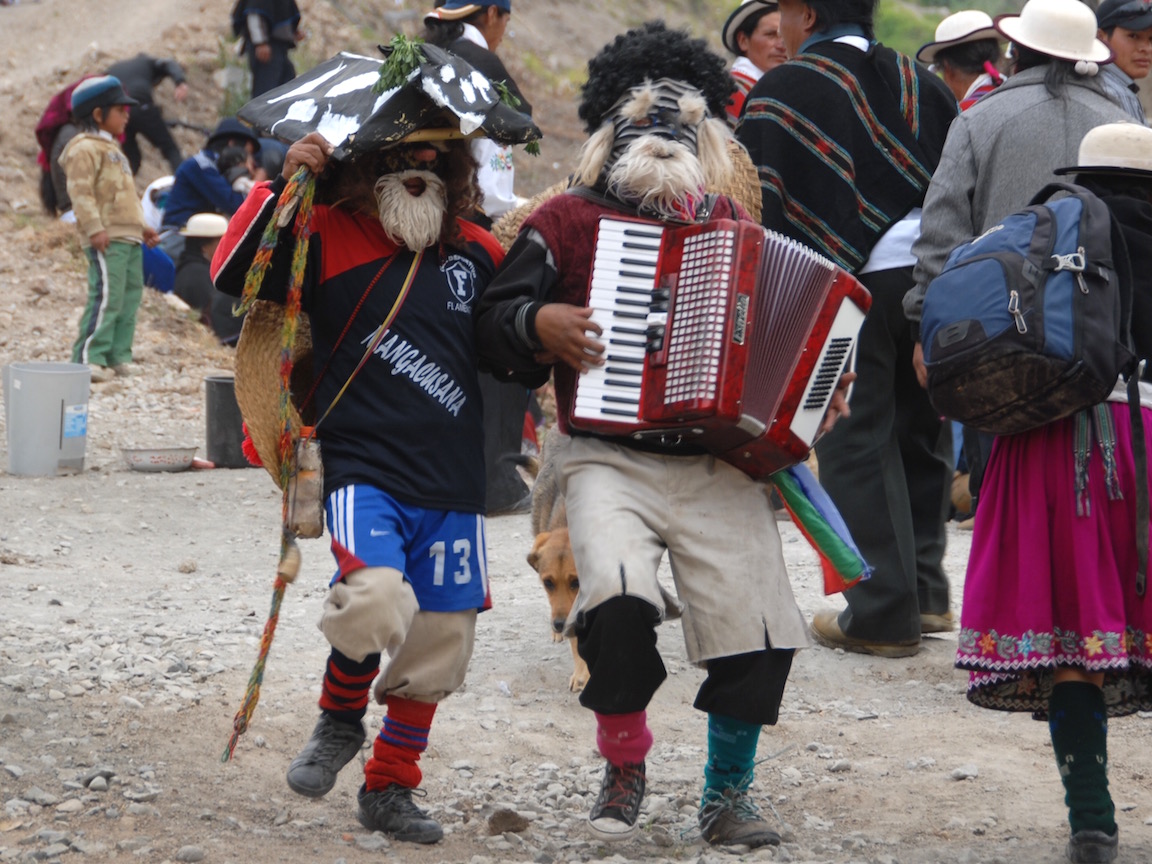
Meanwhile, I went to work. The Fiesta de San Antonio always comes middle of January, before I’m well acclimated, and the eight-day fiesta – most of it at 11,000 feet – is rigorous to say the least. I usually photograph one or two days. This year I worked one day, on Saturday, when the community gathered at the church for a blessing of their tiny saint (about 8 inches tall) followed by a procession through the town and into the country to the house of the prioste, this year’s host of the saint. There, while the saint rested in his special room with candles and incense…

San Antonio w candlesoutside there was dancing of the vacas locas, music by different groups, and the crazy antics of clowns called rukuyayas

2 efigiesvaca loca kid  rukuyaya rukyaya dancing.

Finally, around 4:00, the host community served a meal to about 300 people. Incredible. A pampamesa, or “table in the field”  is just that: for a communal work day, fiestas, even funerals, women bring warm food wrapped in baskets or shawls on their backs, and at the appropriate moment, they sprinkle it along white cloths laid on the ground. Usually a mix of small bits of chicken or roasted pork, but mostly potatoes, corn, beans – the basics of the Andean diet. People sit alongside or stand behind if it’s a large crowd, and slowly eat bits and pieces until full. It’s a wonderful way to serve a big crowd, without utensils or dishes. Here you see only mote, boiled corn, while we wait for the good stuff.pamomesa

This year I had the pleasure of working with a partner – Allison Adrian, an ethnomusicologist from Minneapolis who has come for six months with a sabbatical and Fulbright to research Cañari and Saragureño music. During the long day, she recorded in audio and video, and I with photos. I can see we are going to work beautifully together. Welcome, Allison!Judy _ Allison

___________________________________________________________________________

Finally:  announcing the CANAR BOOK CLUB

Scholarship program progeny in Judy's book cornerI’ve been a big reader since childhood, but I’ve never been in a book club. I asked to join one once, but the group was already well established and the members felt they couldn’t integrate another person. I understood. So I’m going to create my own Canãr Book Club, and I invite you to join. I’ll report on what I’m reading and you tell me what you are reading, what you recommend, what you think. I’ll put this at the end of every Chronicle so those who are not so interested can leave off!

At the moment, I’m in book two of the “Neapolitan Novels” by Elena Ferrante: The Story of a New Name.  I started and finished the first one in October on a lightening trip to Ecuador, when I had many flights and many hours of reading. The second book is going slower, and with only 30 minutes or so of reading at bedtime and early morning, I find I’m growing impatient with the pace and obsessive, almost suffocating, details. This morning I picked up Dear Life, Alice Munro’s last book, and it was like a breath of fresh air to read one of her short stories. I remember discovering Munro when I lived in Toronto, and thinking, “How does she do it?” It looks so easy. Inspired, I tried a story of my own. Hmm, silly thought, not so easy, trying to copy a genius.

Stay in touch!
 

Cañar Redux, 2016

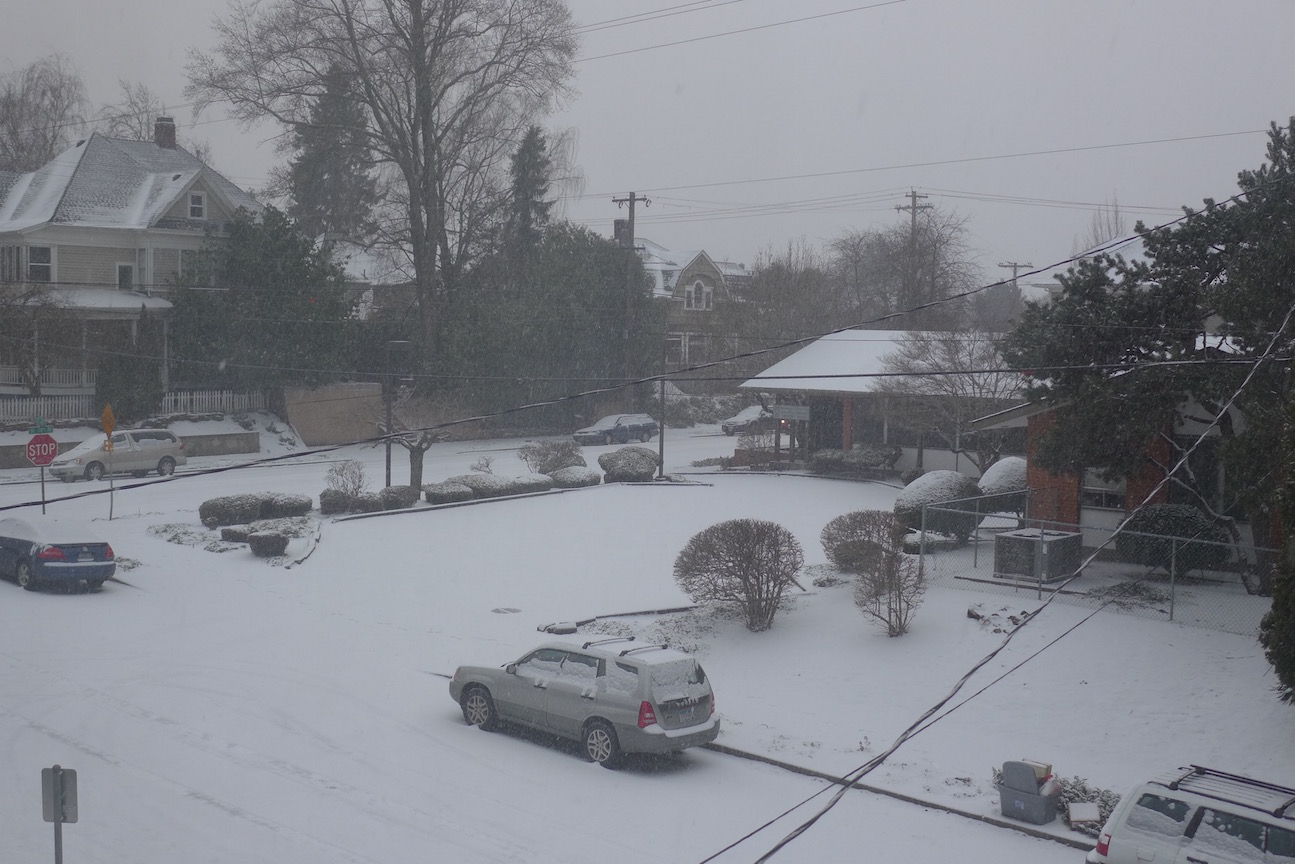
Dear Friends:  Here’s the view out our bedroom window on January 3, the day before our flight to Ecuador. (This is a color photo, by the way)view window

By January 4, the first snowstorm of the season had turned into a treacherous ice storm. We decided to spend the night in an airport hotel so we’d be sure to catch our 6:00 AM flight. No taxis available, not even Uber, so a friend drove us, slipping and sliding, to the Holiday Inn, where we spent a brief night. Next morning, our flight to Los Angeles was cancelled – no apology, explanation or friendly reroute. Once we reached Dallas on an alternative flight, our plane to Miami had already boarded and we had to sprint about 20 gates to make it as the doors were closing. In Miami, Cuban sandwiches and beers and a Cuban coffee restored us before a delayed flight to Guayaquil, where we arrived at 2:30 AM. With our bags! As we headed for customs, I looked with pity at the large crowd around the “lost luggage” window. 

Enough of this January travel chaos! Two years ago, we were stuck in an east-coast storm that caused all our flights through DC and NYC to be delayed or cancelled. After an expensive night in a crummy motel near JFK, we arrived a day late. We’ve decided that next year we leave in November.

After a few hours of sleep in Hostal Tangara, at 85 degrees, with noisy air conditioner off and chirping crickets in the room, we woke to this:

arch guacamayasP1110640  P1110637

(OK, the macaws were on the wall of our room, painted by Lucia, the hostel owner.)

After breakfast and naps, we ventured out into the hot humid air for our ritual crab soup, crab ceviche, patacones and ice-cold beers in an open-air restaurant on the Malecon Salado, the seawater canal near our hostel. This has been our routine for years, and the place always reminds me of my mother, who came to visit when she was 87 and loved it. She bought a CD from the guy who was fake-playing his panpipe. crab cevichewaterworks

January 6:  After another night in the hostel to recover, things move more smoothly. A good driver with a vehicle with seatbelts that work gets us to our gate in Cañar in a mere three hours. The house looks much as when we left it in July. This is the dry season, so the yard is scruffy, and inside the house is dusty and cob-webby, but this climate – dry and cool year-round – is kind to a house like ours, made of wood and mud and straw. house first vewInside, the macho aloe lords it over the patio, bigger than ever, and I complain to Michael, as always, that it needs to be taken down to size. As always, he resists. And by the swallow-like birds that flit in and out (through an open space between glass and tile roofs), and seem to feel right at home, I suspect there is a nest or two hidden there.patio first vew

We follow all our usual arrival rituals, including the uncovering of San Antonio, the patron saint of Cañar who keeps watch over the house.  uncovering st anotnio san antonio alone

And then, Michael’s first fire, first beer and his favorite Oscar Peterson on the CD player.  Ahhh, we are at home in Cañar.M. first fire2

May Day, Cañari Style

Jose Acero w flagIn the US we don’t place so much importance on May 1, but here in Ecuador as in many countries around the world, it is a national holiday to celebrate the “laboring classes.” In fact this year in Cañar it was a three-day school holiday, which my cynical Cañari friend suggested was a strategy on President Correa’s part so the students couldn’t get organized for a big opposition demonstration. (In fact there were for-and-against-Correa marches in Quito, Cuenca and Guayaquil.)marchers w bannerIn Cañar it is always a huge event, as the indigenous organizations have taken on the day as a their own, even though 80% of campesinos still work in agriculture and not for a wage. My own history here is related to May 1, going back to 1992, when we lived in Cuenca and I had barely begun my work in Cañar, with little success. Mama Michi Chuma, the mother of my first photography student, José Miguel, invited me to take a portrait of her agricultural cooperative after the march, “but only if you make a copy for every member.” I was thrilled. This was my first “public” photo in Cañar, one I would never have been able to make if not invited. I set up my big old Rolleiflex camera and took two shots: one post-march of the members relaxing on the grass with their picnic lunch, and a second standing at attention with their flag. Today I can only find the second shot. (And I recall that I did make an 8 x 10 copy for every person.) MM coop 1992

Last Friday, the march was organized to go from El Tambo to Cañar, a distance of about 10 kilometers. The idea, of course, was to block the busy Pan American highway for the duration of the march, always a strategy of Cañari organizations when protesting or sending a message to the central government. (You can see the line of parked cars below.) The message to President Correa on the placard: “Don’t insult the people; respect the people.”marchers w parked carsNormally I would not choose to walk this stretch of the highway, which runs down to the river valley from El Tambo and then climbs steeply to Cañar. But a colleague, Judy Goldberg, and I got caught up in the excitement of day – she is here for a few months coordinating our new story exchange project, Voces de Cañar/Cañarikunapa Raymi. So at the last minute we hired a taxi-truck and took along a bunch of other celebrants who had missed out on rides.anastasio + belisarioWe met up with the march just outside El Tambo – hundreds of people surging downhill, chanting, singing, carrying banners and placards, while the police directed all traffic to stop. The day was brilliant sun, not so good for photos or walking at the incredibly fast pace the Cañaris always take, but spirits were high and the police were friendly. Judy and I quickly separated as she took off with her recorder to capture sounds, and I did my usual thing of walking backwards while photographing, trying not to trip and fall on my butt while the the fast-paced crowd rushed towards me, and avoiding being run over by the pickup carrying the mayor and other municipal authorities.IMG_4657The walk downhill to the river was easy, but the fast climb up the other side on this hot day quickly wore me out and I fell back. I saw Judy once, fresh and energetic and ready to walk the distance, although she kindly offered to stop with me. But then a second truck came by, handing out water to the marchers, and I gestured to the “water men” that I wanted to get in. They hauled my camera bag, and then me, over the back of the truck and I took my place amidst the plastic bags of water and, increasingly, young children and overheated women carrying babies, until the back of the truck was jammed. But I was able to stand and get some great shots of the marchers and mountains, before resuming walking again at the top of the hill. (Michael, seeing all the rainbow flags when I showed him the photos, said, “Everyone in Cañar is gay!”) man on horse w flagI never saw Judy again until we met at home for lunch, but it turned out she had stayed with the march until the very end, when the crowd gathered at the UPCCC, the indigenous center in Cañar. I was there too, taking some last shots of the crowd,UPCCCBut once the speeches began, I knew the event would go on without me, with hours more of speeches, dancing, and music ahead. May Day in Cañar was a big success. The soundtrack of the event, edited by Judy, was broadcast on Radio Kichwa Hatari in New York this week, and you can see the audiovisual on our new website: Voces de Cañar.

Finally, because music is so important to any Cañari event, I can’t resist adding a gallery of photos of the musicians who didn’t make it into the blog. I love this guy on his horse with his violin.man on horse w violenman w round hornI don’t know the name of this spherical horn, but my guess is it’s made of plastic pipe…bocina…as is this bocina, an instrument traditionally made of thick bamboo with a cow’s horn for mouthpiece. red scarf w quipaThe quipa, or caracol marino (seashell) is traditionally used to call country people together for a meeting, or as an alert, as the sound carries over a long distance. We still hear it some days from our comuna, albeit over a loudspeaker. boy with quipa

And it’s wonderfully heartening to see young kids learning these customs and instruments.