2019 Cañari Women’s Scholarship Foundation Update

Featured

I begin this year’s update with exciting news related to Ana Margarita Gasteazoro, the original inspiration for our scholarship program. Ana was a Salvadoran friend from my Costa Rica days, a political refugee after years of resistance and imprisonment during the El Salvador civil war (1979-92/75,000 lives lost). During the late 80’s and early 90’s, with friend/colleague Andrew Wilson, we recorded, transcribed and edited Ana’s oral history. But before we could make a book together – our original plan – Ana died of breast cancer, at age 41, in 1993. Just before, she had visited Michael and me in Cuenca, Ecuador, and we had a chance to spend a night in Cañar. On hearing the news of Ana’s death, I established a women’s education fund (that later became Cañari Women’s Education Foundation). A born teacher, feminist and organizer, Ana fervently believed that women’s education was one of the most important tools for social justice and political progress in Latin America.

Twenty-six years later, we not only have thirty-four university graduates and current scholars, but we have a book! In October I was in El Salvador for the launch of Tell Mother I’m in Paradise: Memoir of a Political Prisoner, based on Ana’s oral history. Many dedicated volunteers helped bring this Spanish edition to life: from translators, transcribers, editors and artists to the director of MUPI, Museum of the Word and Image, in San Salvador, publisher of the book. The banner/poster pictured above was presented various times during the visit to El Salvador, along with the story of Ana’s scholarship. I heard so many of her family, friends, and others who had known her, say – “Ana lives again!” And that is never more true than in our Cañari women’s scholarship program. Stay tuned for an English edition that we hope will be published in a year or two.

Book presentation at MUPI in San Salvador, October 8, 2019

Our early graduates are now mid-career (a term their modesty would never allow), but I thought it would be fun to do some updates – where are they now? – along with before/after photos.


Alexandra Mariana Solano (2006/Cuenca/Agronomy) is the new director of CENAGRAP, the potable water organization that serves rural regions of highland Cañar. Here she signs a convenio with city officials. Alexandra is also midway into a new master’s program at University of Azuay in Cuenca: “Climate Change, Sustainability and Development.” (Our program provides $3000 over two years for master’s degrees for our graduates.

Mercedes Guamán (2006/Cuenca/Law) represented Ecuador at the United Nations Permanent Forum on Indigenous Issues in 2019, as she had in 2018. She is president of her local community of Quilloac and, as a lawyer, serves a wide contingent of Quichua-speaking clients. She is also our first graduate to receive an honorary degree in jurisprudence for her service to the community and social justice.

Pacha Pichisaca (2011/Cuenca/Medicine) has just finished an advanced diploma in dentistry. Pacha has established her own clinic in Cañar and told me recently that she has added a “second chair” (e.g., business is good). She too serves her neighbors and others as one of the only Quichua-speaking women dentists in Cañar.

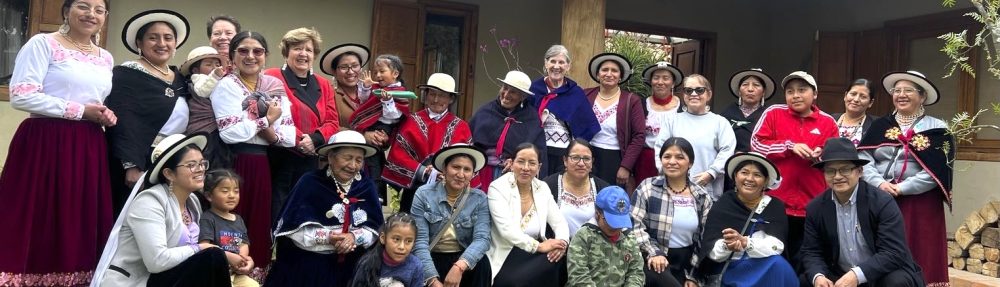
Juana Chuma (2015/Cuenca/Veterinary Medicine), finished her master’s at UNAM in Mexico in 2019, and is charging ahead for a PhD in the same program. Although CWEF is not able to support doctoral studies, we are so proud that Juana will be our first graduate to get a doctorate. Juana appears in the photo above with her fellow graduates (first row, far right, white blouse). And on the right, her proud parents in Cañar. Juana has several younger sisters yet to be sent to university, but in order to serve a wider population of young Cañari women, CWEF has a policy of one scholarship per family.


In January we had two special visitors to Cañar from Oregon, representing the Bend Giving Circle, a group of six women (now eight!) who have chosen CWEF for monthly support. We had a great gathering of the scholarship women, past and present, and families to meet Helen and Laurel. Maria Esthela, our board treasurer, made red bead necklaces for the group and I recently received this photo taken at their October meeting, showing off their Cañari jewelry. We are so grateful to them – as well as to all of you – for sustained interest and support.

So – a quick recap: the Cañari Women’s Education Foundation has 21 graduates, 13 current scholars, and an amazing board in Cañar that we couldn’t do without, but that could manage very well without me. We meet two or three times a year to look over applications, assess where each woman is in her studies, and decide how many spaces we have to fill. We keep the current group at about 12, which makes the accounting and monthly payments easy to handle. We pay stipends in cash so as to have personal contact with each scholar on a regular basis. Charlotte Rubin, our treasurer in Portland, keeps track of contributions and manages the banking. Michael and I have willed our Cañar house and property to the program – a long time off, we hope – in a move that will help insure long-term sustainability.

The Cañari Women’s Education Foundation is an official 501(c)3 nonprofit, which means your contributions are tax deductible. We have zero administrative costs other than a yearly mailing, so every dollar goes to the women’s education. Please make checks to CWEF and send to Charlotte Rubin, 2147 NW Irving St., Portland, OR 97210 (some of you will receive this letter by snail mail with return envelopes), or you can contribute through PayPal with the secure “DONATE” button below.

Last note: We are returning to Ecuador on December 16 and the regular Cañar Chronicles will begin in January, along with the Cañar Book Club. I have missed you all, and we will have so much book news to share!

“Indigenous Ecuadorians Too Strong to be Ignored After Deal to End Protests”

Featured

Dear Friends: We are not returning to Cañar until December, but I wanted to post blogs on current events: the recent protests in Ecuador (and resolution – with headline from The Guardian, October 16), and my recent trip to El Salvador for the launch of a book that was inspired by Ana Margarita Gasteazoro, for whom the Cañari Women’s Scholarship Program is named. So…first the protests and the resolution, in an online article published by my good friend Alan Adams, a Peace Corps volunteer in Ecuador in the 1960’s who has rekindled his Canari friendships in retirement, working with Mushuk Yuyay, a local community development organization and reconnecting with those local indigenous leaders he knew back then. Thanks to Alan, and thanks to his editor at https://www.esperanzaproject.com for allowing me to reprint the article. (I have edited lightly and added a few extra photos from various sources). Next chronicle about El Salvador coming soon…

UPDATE, October 12: At publication time, the Cañari caravan was in Quito joining the throng of demonstrators in a victory celebration. The Moreno government agreed to rescind the austerity decree and has promised to rewrite it with input from the people. Nicolás Pichazaca of Mushuk Yuyay wrote me: “Our work and strategy have not been in vain, not only for the Indigenous people, but for all Ecuadorians. It is one more story.”

Superheroes don’t wear capes. They wear ponchos and sombreros.” The phrase is often repeated in the Andean highlands. And now as they see their lands and their culture under increasing threat, the Indigenous people of Ecuador are employing that phrase once again, as they go out into the streets in the face of danger, as they have many times during their history.

High in the Andes of southern Ecuador live the Cañari people, who have been struggling for their freedom and for Sumak Kawsay, a good life, for thousands of years. Their present challenge comes at the hands of the President of the Republic who made a pact with the International Monetary Fund and expects the poor of Ecuador to pay. When Lenín Moreno Garcés took office, the Cañari people were cautious, hopeful, and patient because he promised to break with the extractive policies of his predecessor, Rafael Correa. He humbled himself before Indigenous people in a solemn ceremony where he accepted the blessing of the many nations that comprise the State of Ecuador.

Lenin Moreno becomes president, February 2017, Reuters.

Slowly it became obvious that the winds in Quito had shifted, as the President began to move in a different direction. I often describe Lenín Moreno in Shakespeare’s words, “Commanded always by the greater gust…” The greater gust these days was coming from the IMF, which demanded austerity, and Moreno decided to find cash by removing fuel price subsidies that have been in place since 1970. Fuel prices shot up by a dollar a gallon, enough to wipe out the budgets of most small businesses as well as of most families. In addition to the gas prices going up, the IMF is requesting an increase in fees for all government services and for utilities, a new value-added tax, a consumption tax, and an increase in the ceiling on interest rates so that banks can charge whatever interest rates they want.

Immediately, the Cañari people responded with peaceful, but vocal, demonstrations throughout their communities. They joined in support of labor unions and other groups, but mostly in collaboration with other indigenous communities and organizations of Ecuador. They blocked roads and joined the general strike. They requested dialogue with the government. Violence began to erupt in the protests — which some, in civilian as well as governmental sectors, suspect was being incited by infiltrators paid by Correa. President Moreno declared a State of Emergency to quell the violence, which only increased the people’s determination to find a solution that would benefit all and lead toward a more secure future for the country. 

President Moreno responded that the austerity policies would not be changed. He said that the demonstrations did not originate with the people but were encouraged by the former president of Ecuador, Rafael Correa, working with President Maduro of Venezuela. The statement only fanned the flames of resistance. However, there is evidence that Correa and other actors are taking advantage of the situation to sow doubt and suspicion. The Indigenous organizations need to weave through this confusion cautiously to keep the issues in focus.

Disrespect is not new for the Cañari people. After centuries of being used as beasts of burden, as the Cañari poet José Buñay put it years ago, they are determined not to go back to the abuses of the hacienda days. Last week, as the protests continued to escalate and began to grow violent, Moreno took his government from the capital of Quito to the coastal city of Guayaquil. When the demonstrators set out to meet him there, the mayor of that city stated bluntly that “Indians” are not welcome in her city. They should go back to the páramos, the high mountain grasslands. 

Mayor of Guayaquil Cynthia Viteri in her signature white shirt. Photo El Universo

But Cañaris will not be humiliated. Indigenous people don’t take abuse lightly. A movement was launched to withhold  food from the highland farms to Guayaquil. Several Indigenous people posted photos of their páramo homes with pride. They also posted the reminder that Indigenous peoples can be found in the universities, the professions, government offices, elected positions, and everywhere in Ecuadorian society. They even live in Guayaquil.

The declarations that I read over and over again from Cañari friends are not simply that the price of gas should go down, but that neoliberal policies must end. The IMF must go. What they are demanding is a complex set of changes, each affecting the other, that cannot be oversimplified. There is no simple fix. They are proposing a comprehensive solution on the other side of the insults and accusations that will insure that a way toward a peaceful and lasting social and economic system can be secured. This solution will be sought by large numbers of determined and united people.

Faced with this necessity, the people of the Cañari communities, both those in Ecuador and those who have emigrated, decided to add their voices. Truckloads of people departed. They made laughing videos of people climbing aboard moving overcrowded vehicles. Wave after wave of men, women, and children declared their determination to protect their rights as Ecuadorian citizens.

The last trucks to departed Cañari on Saturday morning. It was not lost on anyone that this was Columbus Day, the day set aside to commemorate the beginning of the struggle that they have been involved in for over 500 years. They drove slowly over roads that had been blocked and made contacts with others along the way. On Saturday evening, the caravan announced that they had Puruhua People in their company now. They are the Indigenous Nation to the north of the Kañari in the province of Chimborazo. On Sunday they set off again in trucks, cars, buses, and on foot on a cold and cloudy day.

Photo by Kusikayo Naula, Zhud.

The plan was to arrive in Quito in time to lend force to the words of the leaders in a meeting with the President, to show the strength of a united people and to prove that hardship and danger will not deter them. We remember, too, that over the recent Ecuadorian history, Indigenous demonstrations have led to changes of government and policy changes. What sets this demonstration apart is its spontaneity and comprehensiveness.  The people responded immediately to a threat with thought and care to find a solution consistent with their goals. To get elected, President Moreno said and did some things he seems to have forgotten, but the people didn’t forget.

This is but one more chapter in the history of the people who developed their science and art over the millennia, resisted the Inca, survived the haciendas, rebuilt their lives through the Agrarian Reform, ended the agro-chemical-based Green Revolution, confronted (and continue to confront) climate change, and now are dedicated to help redesign the social and economic institutions of Ecuador. The significance of this continuing struggle cannot be overemphasized.

ALAN ADAMS

The Winds of Change

We came back from Spain on June 1 to Cañar’s equatorial winter – unrelenting wind and cold and rain with night (and sometimes day) temperatures in the 40s. No heat other than the fireplace, which Michael keeps going all day now.

Three sweaters, wool cap, and boots, trying to work by fire.

We’d forgotten that we like to be in Portland by June, but our house was firmly rented until July 1, so here we are. I’d picked up a respiratory virus the last days in Spain and the first couple of weeks here were devoted to following everyone’s home remedies: milk with garlic before bed; tea made of violets; ginger, garlic, honey and rum hot toddy; Hedera helix (ivy leaf) extract expectorant; and so on. But with a virus like this you just have to ride it out…

Meanwhile we fall back into our usual routines. Market on Sundays.

My herb and flower vendor in market. “Drink the violet tea three times a day.”
Cesar, Michael’s fish guy: “Bring me a hat like yours next year!”

Our near neighbor Magdalena, after years of living in a near hovel with several children, is building a mega-migrant house, two-and-a-half stories flush with our property line, as is the practice here. We have tall shrubs and trees that mitigate the view somewhat, but we can only be happy that Magdalena – and it appears new daughters-in-law and babies and maybe a new son-in-law – have a house. Magdalena’s husband has been in the U.S. as long as we’ve been here. We assume. Magdalena is rather fierce with us – guardedly friendly but no exchange of information. Probably because we share a property line – a very delicate business here and we did have a few issues years back when she insisted her property line was “where the rock used to be.” But someone has obviously been sending money and Magdalena has had a pile of bricks waiting for years for this important moment in the lives of migrant families: pay off the debt, send a son or daughter, then begin saving money for a truck or house.

We see these houses everywhere – oversized, mostly badly designed, made of concrete block or brick, but the source of great pride with the family. Then they sit empty for a few years before a For Sale sign goes up. I don’t really understand all of this.`

Then there is my gardening, or my “zen” gardening as I think of it, because no matter how many weeds I pull, how much I prune, plant and plan, when I come back six months later everything has returned to its original state. The kikuyu African grass has invaded the flower beds, the fuchsia bush outside our bedroom window – that I cut back every year before we leave – is as bushy and invasive as ever. The vegetable garden, planted by our compadres who watch the house, is overpopulated with way too much cabbage, onions, cauliflower and lettuces. More than we can ever eat, and they refuse to take the produce to market, insisting it for us. So, a lot goes to waste, but before we leave, I usually do the same – plant vegetables for them (not this year, too cold!)

Another part of our agricultural cycle happens in the back field, where our compadres plant. The corn and beans are done, the field is covered in sticky weeds and two days ago we looked out to see two bulls and two sheep at work, eating all that remains. Such an efficient system! They fertilize while they eat, of course, and once the field is cleared – in a week or two – Jose María and Narcisa will till the field using the same bulls yoked to a wooden plow. And, I suspect, those same sheep will be chomping on the grass around the house while we’re gone.

Finally, this particular June will be memorable because, after 18 months of frustrating paperwork, innumerable trips to Cuenca and Azogues (regional capital) to a horrible building called “Center of Citizen Attention (see above image), several moments of my head-on-desk in front of a government agent – “no es possible…” when I was turned down once again because of an error made 10 years ago at an airport in my passport, or a mistaken date in an office in Quito – I HAVE A NEW VISA! I didn’t cry during the process, which has taken such a chunk out of my time here in 2018 and 2019, though I was tempted at times. When I told the agent this past week that this has been the worst experience of my 15 years living in Ecuador, she didn’t blink. Then, because it had just happened as I was waiting, I said – “And a man just walked by sobbing!” “That’s different,” she said, “he’s from Venezuela,” as though that made a difference. (There has been a huge waves of Venezuelans coming to Ecuador, trying to work and make new lives.)

Anyway, three days ago I had my last interview when I knew I’d cleared all the hurdles. I gave the agent my two passports, old and new. She asked me to go into the waiting room while she processed the visa. I asked if I could observe. No. She called me back in a few minutes, handed my the passports and said, “Your visa is in an email.” I couldn’t believe it. Do I stick it in my passport? I asked. “No, no just carry the paper with you as you leave and come into the country.” Here it is

An interesting update to my last post about the Jewish community in Gerona, Spain from my favorite daily blog, Spitalfields Life. “Built in 1901, the Bevis Marks Synagogue in London is the oldest synagogue in the UK, and it has been continuously in use for over three hundred years, … Its origin lies with Spanish and Portuguese Jews who came to London in the seventeenth century, escaping persecution of the Catholic Church and taking advantage of a greater religious tolerance in this country under Oliver Cromwell’s rule. When war broke out between England and Spain in 1654, Antonio Robles, a wealthy merchant, went to court to prove that he was Jewish rather than Spanish – establishing a legal precedent which permitted Jewish people to live freely in this country for the first time since their expulsion by Edward I in 1290.”

The Cañar Book Club

Coming back from Spain, my worst reader’s fears were realized when I saw I was out of books. I had loaded one on my mini-iPad for the trip – my first ever ebook – and I turned back to that source out of desperation. That took me down the rabbit-hole of Amazon’s 1-click buy (click-bait?) and I haven’t stopped ordering books since, and reading at a much faster pace, for some reason (partly, all the bus reading time for visa business). So, graded by stars: The Hand that Held Mine, Maggie O’Farrell (****), West by Cary Davies (***), Educated by Tara Westover (****), The Great Believers, Rebecca Makkai (**), Anything is Possible by Elizabeth Strout (****), and The Friend by Sigrid Nunez (*). This was getting expensive and I had to stop. It occured to me I could order ebooks from my home library and I put in a couple of titles. Normal People by Sally Rooney – over 500 holds!

So, now I’m back to re-reading “paper” books from my Cañar shelves, The Story of Lucy Gault by William Trevor, a favorite author, and My Name is Lucy Barton by Elizabeth Strout, a prequel to Anything is Possible. Those’ll take me home to Portland, next week, June 30, when I’ll start stockpiling books for next year’s trip to Ecuador.

Meanwhile, some faithful book club members have stayed active through June. Here are their comments.

Irene from Salem sent my all-time favorite title:.  The Gentle Art of Swedish Death Cleaning. Author?

Maggi Redmonds from Toronto: The End of Days: A Story of Tolerance, Tyranny and the Expulsion of the Jews from Spain, by Erna Paris,

Patty in Portland: The Book of Unknown Americans by Cristina Henriquez and Go, Went, Gone by Jenny Erpenbeck.

Joanne in Portland read The Great Believers on the plane back from Philly and loved it; also started The Ninth Hour – a bit dark but excellent writing. Before that she read Say Nothing, which was really compelling and she loved Milkman. (Not everyone does.) And like me and hundreds of others, she’s on the list at the library for both of Sally Rooney’s novels.

Mel in Vermont is reading Michael Ondaatje’s Cat’s Table.

My sister Sherry in Santa Fe: reading the best book! The Night Of The Gun by David Carr

Who sent this? I’m sorry to say I lost track, but it goes so beautifully with my previous post and the update above. The Weight of Ink, by Rachel Kadish. This is about descendants of Portuguese Jews who escaped the inquisition by moving to Britain, and how modern-day researchers uncovered this history through 17th century manuscripts found in an English home.

Fond regards to all.