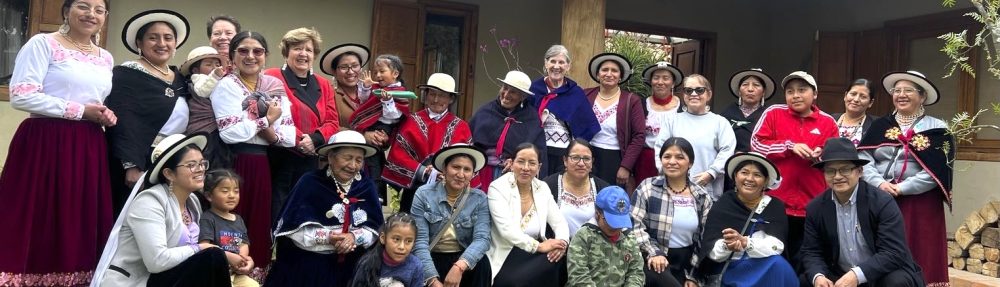
 Dear Friends: Today is (was) May 1, International Workers’ Day, and an important anniversary for me as Michael and I mark 25 years since first arriving in Cañar, and twelve years living the “half-life” here. So, to go back: May 1, 1992, was my first real invitation to take a photograph in Cañar (see above) – it came from Mama Michi Chuma, who was president of her agricultural cooperative – unusual for a woman even back then. “You can take the photo after our march,” she told me then, “but only if you make a copy for every member.” I was thrilled. Mama Michi is in the center of the photo, looking to her right.
 This extraordinary woman has been a part of our lives in one way or another since even before that day. Her son José Miguel was one of my first two photography students, and Mama Michi welcomed us on our first visit, she later said, because we arrived “on foot and without a bible.” (Michael, in fact, was carrying the high-efficiency portable wood stove he was promoting in those years.)
Mama Michi is now a well-known curandera, a native healer, and every year I arrange for a group of Lewis & Clark College students doing a semester in Cuenca to have a “healing session” with heri, a highlight of their Cañar weekend. Here she is with this year’s group: In other news, an article on the Cañar archive project just came out this week in Archival Outlook, publication of the Society of American Archives, with cover and photos from Cañar and text by yours truly and Natalie Baur, the wonderful archivist who first connected me with the SAA and who is supporting the archive project here as she pursues her PhD in Mexico. The full article can be found here: http://bit.ly/2qA0DWy


The striking cover image is from a glass-plate negative of town photographer Rigoberto Navas (1911-2001). Most likely from the 1940’s, this ritual dancer is wearing a wig with long thin braids and headdress, part of a costume still used today by the few remaining dancers and musicians of “Mama Danza” in the Cañar region of Zhud/Suscal. (Another project that needs researching!)
The national meeting of the Society of American Archivists is in Portland this year (July 23-29) and although I don’t usually enjoy gatherings with 5000 participants, I’m excited to be a part of it this time: http://www2.archivists.org/am2017
 Lastly, we are in the familiar process this week of packing up the house, wrapping up projects, cleaning like crazy, saying goodbye to friends and preparing to leave Cañar on May 15. But this year is different because we’re headed to Spain instead of Portland and because my passport has less than six months left on it, I cannot come back to Ecuador. So it’s a complicated dance – mostly for me – figuring out what to leave here and what I need to take – via Spain and New York- to the US (like a couple of hard drives, cameras, extra laptop and so on).
Meanwhile, Michael’s firewood supply is well under control for next year – and the next and next!

We had a hurried meeting of the International Cañar Book Club this month, as everyone was busy with one thing and another, but there was time for a good discussion of what we’re reading.
From Liz in Toronto: “Euphoria” by Lily King, a novel loosely based on the life of the anthropologist Margaret Mead. (I read it last year and liked it). And Eva Stachniak’s “Chosen Maiden,” a terrific bio of Bronia Nijinsky.
From Pat in Bend, Oregon: Alice Hoffman writes historical fiction. I’ve enjoyed “The Museum of Extraordinary Things” (19th century U.S.) and “The Marriage of Opposites‘ (Caribbean). Another good read and important non-fiction book about the concepts of wilderness and the environment is J.B. MacKinnon’s “The Once and Future World.”
From Suzanne in Portland: Two good fiction reads, “Around the Next Corner” by Elizabeth Wrenn – a woman examining her life as her children transition out of the house, by and thru deciding to foster a puppy to begin its first year of training as a seeing-eye dog.
Suzanne continues: 1,000 White Women tells the story of what could have happened if the US government had gone along with the matrilineal Cheyenne tribe’s suggestion that, to further the assimilation, the government should give the tribe 1000 women.
From Bruce in Portland: Exit West (Mohsin Hamid) and A Horse Walks into a Bar (David Grossman). Both quick reads with some good writing in parts but very lightweight literature. Currently reading The Sleepwalkers (How Europe Went to War in 1914) by Christopher Clark. A tour de force masterpiece of historical analysis and very relevant to the slow-motion train wreck currently unfolding on the world stage.(
He adds: (A Man Called Ove was a sententious book and a saccharine and silly movie.
From Nancy H in Portland: Evicted by Matthew Desmond – a most compelling, authentically-told, story-based telling of the plight of those in poverty challenged by keeping a clean, safe roof over their heads. The characterizations are nuanced–including those of their landlords, often caught in tough situations themselves. I heartily recommend it!
Also just finished Ann Patchett’s Commonwealth. In an interview, she said shes decided to allow herself to write closer to home. With her sharp eye and ability to find both humor and grace in all her characters, I think this one is truly a great coming home. I have always preferred her nonfiction to her fiction, and this book seems to combine the best of both genres. In tone it reminded me of many of her wonderful personal essays, captured in another highly recommended book, This is the Story of a Happy Marriage.
From Maggi in Toronto: I’m currently reading “Stalin’s Daughter: The Extraordinary & Tumultuous Life of Svetlana Alliluyeva” by Rosemary Sullivan and finding it totally gripping.
Finally, from Judy in Cañar: I’m seriously worried about what to read in Spain. So far I’m taking: Madrid: The History by Jules Stewart, The Pyramid by Henning Mankell (“The first Wallander Cases,” meaning his publisher has scrounged around after this wonderful writer’s death last year to find short stories that had never been collected in a book. And In The Woods, by Tana French. That’s it. I’m hoping to find a used English book store in Madrid.
Until the next time, keep in touch!


