
The best thing to happen in the last two weeks was the launch of a book here in Cañar that was originally published in Denmark in 1977: Juncal: una comunidad indigena en Ecuador. (below: front & back covers)

 Produced by anthropologists Niels Fock and Eva Krener, the book was one result of their research in 1973-74, and again in 1977, in the small hamlet of Juncal, nestled in a beautiful valley about 30 minutes from where I live. To give you an idea of this place, here is one of their photographs from that time:
I knew of Niels, well-known for his research in the Amazon and his writings on Cañar, but I knew nothing of this book until three years ago, when another anthropologist and friend, Jason Pribilsky, sent me a photocopy. Written by Eva, the book beautifully describes every aspect of daily life in Juncal during their time there. (I didn’t know that yet as I don’t read Danish, but I certainly recognised the importance of the great photos taken by Niels.)


At the time I was beginning to think about creating a digital archive of Cañar, so I sent Eva and Niels a formal snail-mail letter in Copenhagen: would they consider donating digital copies of the photos to the Cañar archive? And could I have a copy of their book? Back came a package with their book and the answer: yes, they would have their black/white negatives professionally scanned, and would I like to help (or maybe I offered?) publish a Spanish edition?
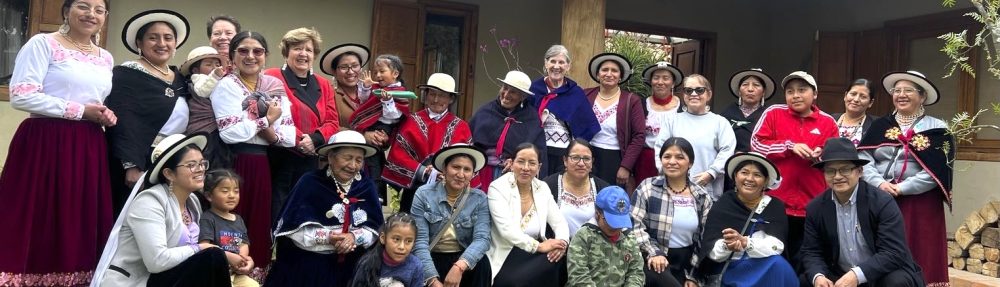
Within months, I received scans of 500 images, with a spreadsheet with data on every image – an archivist’s dream! Last year they sent another 300 scans of color slides. At our event last Friday, I showed a revolving slideshow of those images, and the audience was riveted. Here was their village some 43 years ago. Fast forward: following a translation in Mexico, editing in Cañar, and a printing in Azogues, with support from the Casa de la Cultura and Municipio de Cañar, we had a Spanish edition of the book. On Friday, January 29, at a ceremonial event in the community, we gave copies to everyone who showed up – about 80 people. The young woman below is this year’s queen of Juncal, and she was in charge of getting a signature from each person who received a book. The older woman signed with a thumbprint, a reminder that in her time and place, when Niels and Eva were there, literacy was a luxury not available to many.
 It was a happy day. Tayta Geronimo, who had been the local young assistant to the anthropologists, is now an older man – he read the introduction he’d written for the new edition. Gregorio, a local teacher and town councillor who helped plan the event, claims he will translate the book into Kichwa. Here they pose with a banner of the back cover, a gift to the community.
After the speeches, there was some dancing, then lunch at the church hall, and as we left town in the late afternoon, we saw everyone everywhere – young and old – sitting on park benches, in their doorways, or in their patios, reading the book or examining the back cover for someone they knew: grandparents, aunts, uncles, godparents. History lives! .
.
The Cañar Book Club

“I cannot sleep unless I am surrounded by books.” –Jorge Luis Borges
I was thrilled at the enthusiastic response to my first Cañar Book Club post, and I’m going to pass on all the great reading suggestions and comments. But first, my book report: I am not a happy reader these days. I just finished The Sound of Things Falling by Colombian author Juan Gabriel Vásquez, who annoyed me greatly with his protagonist’s macho, self-referential view of everything that happened to him in 1980’s Bogota. If I had been his wife, Aura, I’d have left him too and taken little Leticia with me. Then I started A Rose for Winter: Travels in Andalusia, by Laurie Lee, whose first book I’d loved (Cider with Rosie). I dunno. The language seemed so dated, the description of post-Civil War Spain so overblown. I put it aside to read with more patience while we will be traveling in Spain in May. At that moment, while on the bus to Cuenca, Michael handed over his just-finished book: The Lost City of Z: A Tale of Deadly Obsession in the Amazon by David Gramm. So I started to read about the British explorer Percy Fawcett who in 1925 disappeared in the Brazil with his 20-year old son, Jack, and his son’s friend. What is it with men doing these crazy impossible things, and dying, and taking their sons with them? (Remember River of Doubt: Roosevelt’s Darkest Journey to the Amazon with his son, Kermit?) Fawcett had been on several other dangerous adventures, and if I’d been his wife, Nina, I’d have left him long before and taken Jack with me.
OK. Now to some recommendations from other readers:
- A Constellation of Vital Phenomenon, by Anthony Marra. Just started and it’s great thus far.
- Foremost of pretty amazing novels I’ve read this year is Anthony Marra’s A Constellation of Vital Phenomena. I’d also include Paul Beatty’s The Sellout, and Valeria Luiselli’s The Story of My Teeth.
- I finished the second Ferrante book yesterday evening, relishing every detail of their friendship, but mostly riveted by the politics of class and gender.
- I read all three of the Elena Ferrante books. Would love to talk to you about them.
- I abandoned Elena Ferrante 2/3rds of the way through book 1. Yes, obsessive detail and terribly repetitive (she likes the clever friend, she hates the clever friend, she likes the clever friend, she hates…)
- Elizabeth is Missing. Superbly written sort of mystery from the point of a woman descending into dementia. Seriously exceptional
- I just finished a lovely book by Colum McCann, Transatlantic. He is a wonderful writer whose book Let the Great World Spin is on my top 10 of books I’ve read in the last five years.
- I am loving My Venice and Other Essays by Donna Leon, an American writer living in Venice for thirty years or so. Even better, if you enjoy her writing, you can start to read her twenty mystery novels that are really delightful: the adventures of Commissario Guido Brunetti.
- For my lighter reading, I like the Louise Penny mysteries. Starting a new book called All the Light We Cannot See by Anthony Doerr for my trip to Germany. I recently finished an interesting book called These is My Words, a story inspired by the diaries of a pioneer woman.
- The Dragon Can’t Dance by Earl Lovelace. Short fiction about Carnival in Trinidad. Very good for a Caribbean read!
- All Our Worldly Goods by Irene Nemirovsky.
- The Marriage Plot, by Jeffrey Eugenides (slow & pretentious).
- A Thousand Splendid Suns by the guy who wrote the Kite Runner (can’t put it down).
THANKS TO EVERYONE FOR YOUR SUGGESTIONS AND COMMENTS.
PLEASE KEEP THEM COMING.