The house in the clouds – 15 years later

Featured

Dear Friends – coming up next month is the anniversary of moving into our “house in the clouds,” so I thought it would be fun to do a before/after look, remember the 14 months of construction, and realize again how much this home has meant to us, and all the visitors, friends and family who have come to share it with us over the years. I started thinking about this theme because this weekend we have our first visitor in two years – Emily – a fellow Fulbrighter and Portlander, now living in Ecuador. So, here we go…. (photos below: June 2005 and February 2022.)

We bought the land in July 2005, at the end of my second Fulbright grant and just as we were preparing to leave Cañar for what we assumed would be “forever.” Previously, for several years, we’d  been looking in Mexico for an alternative life, but as we talked about how much we would miss this homely place called Cañar, we had one of those “AHA -DUH!” moments when we realized everything we’d been looking for in Mexico was right here. Community, endless walking opportunities, good/bad climate (e.g. always chilly), and, for me, open-ended work as a documentary photographer. Only downside was how far we would be from friends and family in the U.S. But that very day Michael went out to look around, accompanied by a Cañari friend, and a couple of weeks later we had bought a cornfield in the comuna of Chaglaban, half-kilometer from where we’d been living in a little rental house. (There’s a lot more to this origin story in my  book, but for this blog we’ll stay with the CliffsNotes version.) Here’s Michael on the day we closed on the property. We left almost immediately for Portland, and returned six months later to find a few new residents.

But work had already begun with our architect, Lourdes Abad, from Cuenca, whom we’d hired after seeing the beautiful adobe house she’d built for a friend.Back in Portland, Michael had made a rough drawing Inspired by our many trips to Mexico of a simple square house with a central courtyard. We sent it to Lourdes, and by the time we came back to Cañar she had refined Michael’s design into a not-so-simple house, with three off-set rectangles to allow a larger courtyard, porches front and back, and a better layout.

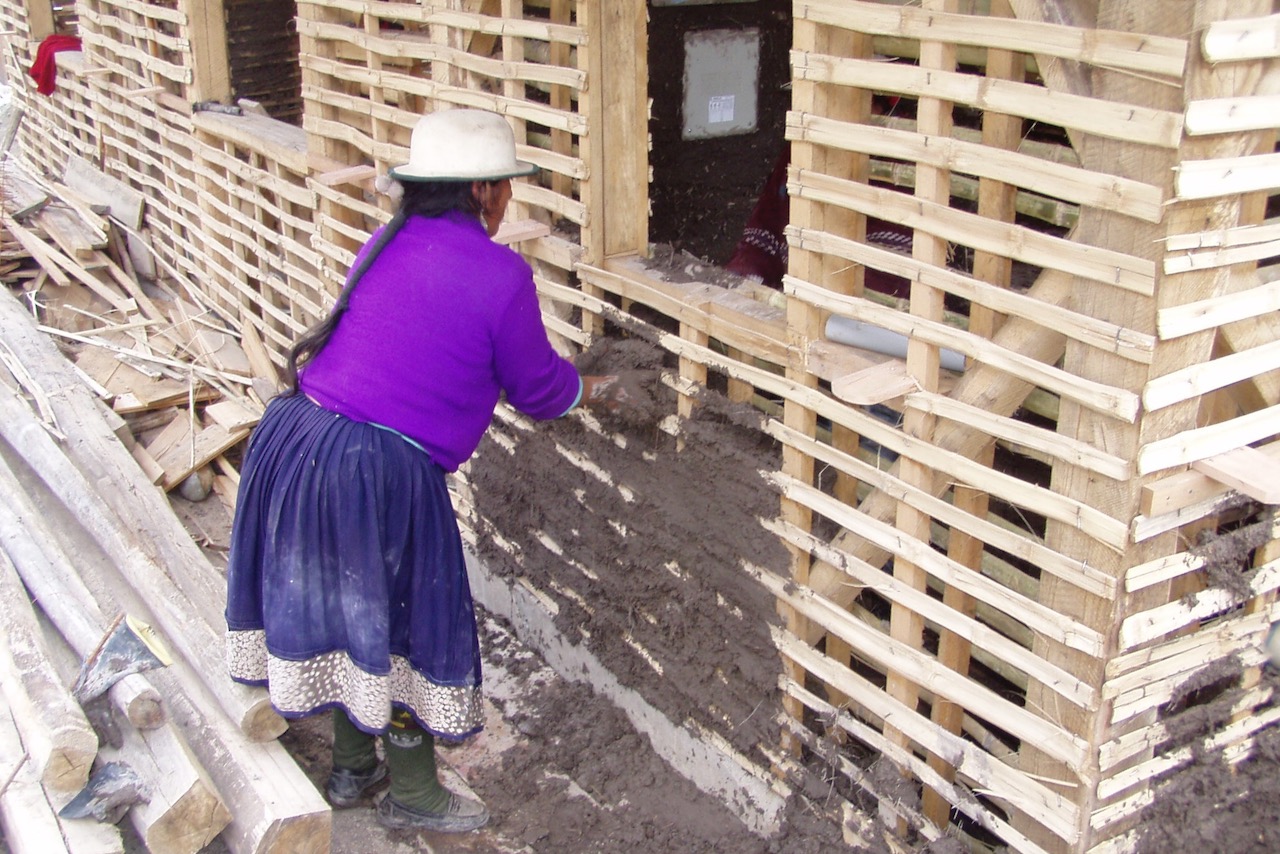
After soil engineers determined that our land was not stable enough for an traditional adobe block house – this region is riddled with geologic faults –  Lourdes proposed a house made of “bahareque”- an old Spanish term for walls made of bamboo and soil. For us, it meant a house with a post-and-beam frame with mud walls, held by thin strips of bamboo. But I’m jumping ahead. We broke ground in 2006, and I have to say that, for me, watching a house being built from the ground up for the first time was a revelation. To begin, you draw an outline of house on the ground with chalk. No kidding.Then you dig channels around the chalk lines – with shovels, by hand.Then  you have a bunch of rocks delivered to fill in the channels and begin foundation walls.Then comes the wood for posts and beams, which Michael and the workers bought at the local wood market down the road. All eucalyptus. So you could say that making a house in Cañar, so far, is about chalk, sticks and stones, though we’ve yet to add the mud, straw and horse manure.

Dear readers: I’m going to break in here to speed up the process. In reviewing the photos I took during the construction period, it looks likes I documented every single day, and I’m having a tough time wading through the files. While I’m happy to have these images, I don’t think you will want to go through the entire construction with me. So I’m going to add a bunch of images with minimal text.

OR – you can always skip to the Cañar Book Club below, with some wonderful reading suggestions from our members.

I’m ending with before and after shots of our courtyard – March 27, 2007 – the day we inaugurated the house with a Wasipichana ceremony with Mama Michi officiating –  and today, February 21, 2022.

And if anyone should want more – the story of building the house and making a life in Cañar is told in my book, Our House in the Clouds, Building a Second Life in the Andes of Ecuador, University of Texas Press, 2013.

PS: Lourdes has asked me to add that in 15 years the house has not required any maintenance, inside or out!

C a ñ a r   B o o k   C l u b

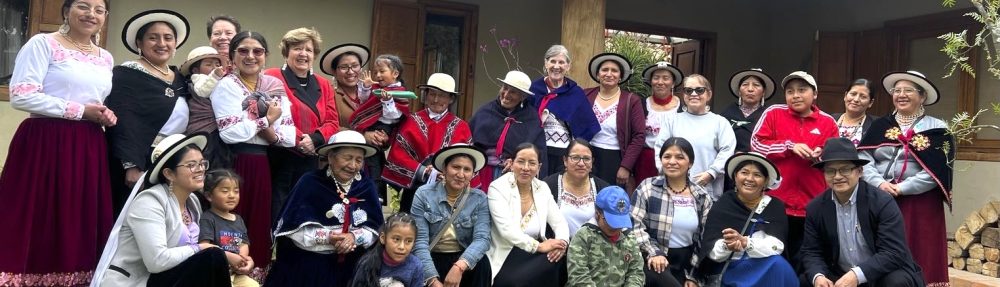
Thanks to our dear club member Joanne from Patzcuaro, Mexico and Portland, Oregon, for the above photo. She recommends Small Things Like These by Claire Keegan. “This beautiful, spare little book I read on the plane was so wonderful I wish it had been longer. Set in an Irish village at Christmas time, a local man confronts his past and the scene at a Magdalene laundry.”  

From Lisa in Savannah: I just read a fantastic, page-tuner entitled  Provenance: How a Con Man and a Forger Rewrote the History of Modern Art by Laney Salisbury & Aly Sujo.  It’s the fascinating non-fiction story of art forgers in 1980’s and 90’s London. Also,iIf you liked  Song of Achilles – you would love Circe by the same author (Madeline Miller).

From Sandy in Toronto: How the Word is Passed by Clint Smith. “Really beautifully written book that manages to talk about slavery in a way that is neither pedantic, nor preachy. One of the best I have read on the subject – the kind of book that might actually help others learn and change.”

From Maya in Portland: “Top of the list is Rabih Alameddine’s latest, The Wrong End of the Telescope.  I liked his An Unnecessary Woman quite a lot but I like the new one even more. A transgender doctor, Lebanese in origin, goes to the island of Lesbos with several friends to help support the immigrants arriving there. It is warm and funny and well written, all the while  showing the terrible plight of refugees from the Mideast in the Mediterranean.”

Maya continues: “To that I’d add Nawal El Saadawi’s biography, Walking through Fire: The Later Years of Nawal El Saadawi, In Her Own Words. She’s an Egyptian feminist and author who recently died after living a remarkable life. And last – The Art of Losing by Alice Zeniter, translated from the French, about three generations of an Algerian family who flee to France during the Algerian revolution. Very well done.

From Bruce in Tucson: “Been reading Seed & Dust: Life, Nature, and a Country Garden by Marc Hamer. (Judy adds, as she has just ordered it from the library:  “Hamer describes a year in his life as a country gardener in the same 12-acre garden in the Welsh countryside for over two decades. As he works … he reflects on his own life: living homeless as a young man, his loving relationship with his wife and children, and – now – feeling the effects of old age on body and mind.”

Bruce continues: Hamer also wrote another great book: How to Catch a Mole. David Mitchell’s  Utopia Avenue is also great, about a rock band in 1960s England.

Scott in Portland recommends The Free World: Art and Thought in the Cold War by Louis Menand. “In his follow-up to the Pulitzer Prize–winning The Metaphysical Club, Louis Menand offers a new intellectual and cultural history of the postwar years.”

From Liz in Toronto: “I just finished Elizabeth Strout’s The Burgess Boys in preparation for reading her new book, Oh William, and wanted to recommend it for your book club. Such a wise, deeply humane and psychologically acute writer! I might even re-read.”

From Patricia in Cuenca: “I continue to dwell in the 19th century although this takes me into my own lifetime.” I’ve read Margaret Fuller Ossoli: A Biography, by Thomas Wentworth Higginson. Not the easiest read until the later chapters, as Ossoli developed into a journalist, feminist, abolitionist, and revolutionary in Italy, before her tragic drowning off Fire Island. Now onto the Autobiography of W. E. B. DuBois.

From Natalie in Mexico, but coming to Ecuador and Cañar soon: “I’ve lately read two novels by Ecuadorian-American writers lately: The Spanish Daughter by Lorena Hughes. A telenovela-worthy historical family saga-drama set in 1920s Guayaquil; and The Inheritance of Orquídea Divina, a fun magical realism/female empowerment tale also
set in Guayaquil.

From Mary Day in Colombia, who seems to read a book a day: Como polvo en el viento, Leonardo Padura. On Juneteenth, Annette Gordon-Reed ( history of Texas and the rest of us). Drinking the Sea at Gaza, Amira Hass (vital book I should have read in the 90s when it first came out, but still bitterly relevant, by an Israeli reporter who lives still on the West Bank). Alec, William di Canzio (wonderful novel picking up on EM Forster’s Maurice). The Kingdom, Emanuel Carrere (French intellectual’s struggle to understand the politics and theology of the early Christian era). What Just Happened, Charles Finch (brilliant scream of anti-Trump outrage by writer most known for murder mysteries set in Victorian England. This is a very American book and also very funny). And, on the side, this was the year I rediscovered and reread all of Josephine Tey.

Finally, my dear sister Char in Austin is reading Station Eleven by Emily St. John Mandel.“So compelling, so fearlessly imagined, that I wouldn’t have  put it down for anything.” –Ann Patchett. And Once There Were Wolves by Charlotte McConaghy. “Propulsive and spell-binding…. the unforgettable story of a woman desperate to save the creatures she loves – if she isn’t consumed by a wild that was once her refuge.”

Whew! 

Given that long list of books that could keep us all busy for the rest of the year, I’m debating whether to add my own. I think I’ll wait until next time.

Until then, please stay in touch at:  judyblanken@gmail.com


Here comes 2022 with the años viejos

Featured

Dear Friends:  Well, since it’s still barely the first week of 2022 I can say – best wishes to you all for the new year, and please let it be better than 2021!

Looking back this past month, the holiday season in Cañar is always mixed for us, without family, visitors from far away or Portland friends. Christmas and New Year’s here are all about family gatherings, and it’s rare to include outsiders. However, we had just enough special visitors and events to make us feel loved. Here’s a lunch with our favorite architect, Lourdes Abad (red necklace), and her sister Ana.

I debated whether to take part part in my first crowd event on December 31 (called Año Viejo, or Old Year), but it was a beautiful day and I knew the hours-long, outdoor procession would be in constant motion. In the Cañari world, this day is all about music, dance, masks, disguises and irreverent fun. So early afternoon I tried out my persona/mask – I think it’s Ugly Betty? – packed camera, water, sunscreen, and joined several hundred comuneros at the highest village of Junducuchu at about 11,000 feet,-truly up in the clouds.There, with a 10-piece band leading, and dancing women and girls called damas, we began winding down the steep mountain. I in heavy boots, concentrating hard not to slip on the loose gravel or tip over the edge where the roadway collapsed, hanging onto tree branches and an occasional fellow walker… …while the women and girls stepped alongside me in their little wedgies sandals and plastic slippers without a pause. We stopped in several other comunas on the way down the mountain where the band played, the damas danced, and others joined in, many in funny masks and disguises.Men dressed as women is the favorite (no Cañari woman would ever make such a gesture).

Along the way I saw various life-sized rag dolls propped up at the entrance to villages, called monigotes, with names tacked on representing known figures, to be burned at midnight in a symbolic gesture of “regeneration” (though history says these were often effigies of hacienda overseers or other hated authority figures). Past years Michael and I have stayed up late enough to burn Trump, but this year I bought two masks to add to my collection and I don’t want to burn any of them: the devil signifying the pandemic, and a Dr. Fauci representing medical heroes.

By the time we got to the next-to-last village it was nearly 6:00 PM, the temperature was dropping, I was tired and Michael was at home by the fire with dinner on the stove. I nodded goodbye to the last monigotes and started on down the mountain.

I’d like to give a last credit to the great mask makers of Cuenca, the Alejandro Flores family who have been hand-crafting these papier maché masks for seventy years. Made with scrap paper from schools and other sources, glue and paint, they show up in the markets in Cañar the week between Christmas and New Year’s, costing about $2 each. Pictured below is Susana Flores, one of Alejandro’s ten children, four of which have stayed in the business.

Cañar Book Club

Our Cañar Book Club members have awaken after their holiday stupor and are reading books like crazy. From my Wine and Whine girlfriends in Portland: The Master and the Emissary. “Iain McGilchrist presents a fascinating exploration of the differences between the brain’s left and right hemispheres, and how those differences have affected society, history, and culture.” Cloud Cuckoo Land. “Already in 100 pages; Anthony Doerr is certainly a master of simple writing that makes for page-turning.” Two memoirs of special interest according to reviews: Home in the World by Amartya Sen and Sentence by Daniel Genis.

From Bibi in California: Mothering Sunday, Graham Swift; Moonglow, Michael Chabon  and  Rescue, Anita Shreve. “All of them are intriguing stories well told. The kind that makes you sad when they’re over. But my favorite book of the year: Garlic, Garlic, Garlic, by Linda & Fred Griffith. Even if you are not a gardener or cook, it is a wonderfully informative and entertaining book.”

Bruce in Portland gets the prize for most complicated title:  “I’m reading The Standardization of the Demoralization Procedures by Jennifer Hofmann. It’s about a career Stasi officer in East Germany around 1989. So far, it’s a pretty good read. Very tight prose.”

Pat in Bend, Oregon: I am in the midst of The Old Ways: A Journey on Foot  by Robert Macfarlane, and it’s great. I picked it up after reading Mountains of the Mind by him, a geological and psychological  history of mountains and mountain climbing. Braiding Sweetgrass by Robin Wall Kimmerer, Native American botanist and teacher of environmental biology, weaves science with indigenous wisdom and teaches us how to listen to plants. I wonder what your aloe has to say? Louise Penney recently co-authored a political thriller with Hilary Clinton called State of Terror that has details only an insider could know, and has cameos by Penney’s characters from her mysteries. Loved it! (Daphne from Edmonton, Alberta seconded this opinion.)

Alan the “The Avid Indoorsman” in New Jersey seems to be reading a book a day: Of Women of Salt, Gabriela Garcia. “It is beautifully written brutally honest and hard to put down. The story is brilliantly woven together and ends with unexpected hope.” Word By Word: The Secret Life of Dictionaries, Kory Stamper. “Finally, a book that tells the truth about our language. Here is why the rule against final prepositions is preposterous. Its bent and worn pages are a testament to how thoroughly I studied this tome.” Lies My Teacher Told Me: Everything Your American History Textbook Got Wrong, James Loewen, “…about how we remember and avoid the facts.”

Claire in London (with with a leek and lentil gratin in the oven, reminding me we need to start again with our recipes – Claire?). The Plot by Jean Hanff Korelitz. “Great fun, well structured with lots of twists and turns and very entertaining.” Love After Love by Ingrid Persaud. “If you don’t mind getting into the patois (it’s set in Trinidad) it’s a wonderful story of love and loss through food and friendship. I couldn’t put it down.”

Song of Achilles by Madeline Miller. “It takes a few pages to get into it but I was soon gripped. Beautiful writing and so evocative.”   For those, like me, who LOVED  A Gentleman in Moscow, the new Amor Towles, The Lincoln Highway, might well be a disappointment.  Multiple characters, none of them that believable or interesting and a story that seems to be taking ages to get going. However, I see from Twitter reviews that people who didn’t take to Gentleman rather like this one!  I adored All the Light One Can Not See by Anthony Doer and was initially dubious about his latest – Cloud Cuckoo Land. But I kept going and it grew on me, though I still had reservations about some elements (and mostly skipped those elements). Next I might try The Promise by Damon Galgut which won the Booker last year.

Ed on Vashon Island noted my interest in walking books and sent this recommendation: The Salt Path: A Memoir by Raynor Winn, who with her husband walked 600 miles of coastal paths in southwest Britain when they found themselves homeless and broke. I read it earlier this year and loved the story.

I’ll finish with a couple from my own very eclectic reading list. Friend Liv in Oslo recommended Trieste: A Novel by Dasa Drndic that I have just begun to read and had a hard time grasping the jumble of facts/figures/time periods. But I’m just getting into “this many-layered novel of WWII combines fiction with a collage of facts to explore the fate of Italian Jews under Nazi occupation, through the intimate story of a mother’s search for her son.” For some reason I brought Old Filth by Jane Gardam with me to Cañar, and for some reason I loved reading about the last days of an elderly lawyer called affectionately by the acronym FILTH: Failed in London Try Hong Kong. First of a trilogy that I’m hooked on. I’m also meandering along with The Old Ways by Robert Macfarlane, but yearning for a really great novel or thriller. I’ve already ordered several from the fantastic recommendations above.

That’s it, dear friends. Please stay in touch and write me with all your news and book recommendations at: judyblanken@gmail.com


Settling into our 16th half-year in Cañar

Featured

Dear Friends:   Brrrr, it’s a foggy chilly day as I begin this – the inside temperature is 13C (55 degreesF). Although we yearly head south, no one can accuse us of being wimpy snowbirds on this, our 16th half-year in cold Cañar. We count on a little sun in the mornings to warm the glass-covered atrium and make the day comfortable. Not today. Michael wants to hold off to 4:00 PM before making a fire (he claims our woodpile is critically low), but once he has his KenKen puzzles, a beer and the fire, all is well in our little corner of the Andes.

We arrived a little over a week ago in Guayaquil, with a hard landing after a full day of travel from Portland. Turns out the Ecuadorian government changed the entry requirements for travelers the day before, so there was no way to know that we had to have a Covid test within 24 hours of travel. Nor did the hundreds of other travelers stuck in the airport with us at 2:00 AM. We finally emerged at 4:00 AM, after a quick and painful screw-up-the-nose antegen test. I laud Ecuador for being careful about the new variant, but it was unconscionable not to let us know what was going on, as we stood waiting 30 minutes in the jetway, then in a corridor, then another corridor, the in two waiting rooms. Finally, we were called to an improvised clinical setting and asked for our Covid exam results. Whaaaat? I’ve made a sort of cartoon of our travel day, with a nod to Roz Chast of the New Yorker. I hope you’ll be able to make sense of it.

After recovering in a Guayaquil hotel for a day and a night, we made the familiar drive to Cañar, leaving the hot and humid coast to zigzag up through the clouds to over 10,000 feet. Looking down on Cañar from the highest point, I thought back to my first writings about this place –  that I’d first called a village, then a town, and now I have to say it is a small city. A scrappy, homely and cold small city, where we are still the only extranjeros who choose to live here. (Though who wouldn’t want to live here with a view like this?)

This high and dry climate is kind to our house, however. Other than dust and spiderwebs, it looks exactly as we left it six months ago. In fact it’s pretty much in the same shape as when we moved in, in 2007. Our compadres Jose María and Narcisa have left an offering on our kitchen table of a big basket of dried beans (enough for a few years) and a bowl of mazorkas, dried corn in various colors. These are from the harvest of our back field, where they follow the custom of being partidarios – planting land not your own and sharing the harvests. Over the years we’ve learned to acquiesce to the custom of receiving our symbolic “share,” even though we can never use the amount they give us.

The interior garden requires little care, with it’s succulents, cacti, aloe, geraniums, ferns and orchids. While we’re gone, Andean sparrows take up residence and build their nests in the monster Aloe, and I can peer in and see at least two nests. They appear empty of eggs, but the mamas still make regular visits during the day through the six-inch gap between the steel/glass structure and tile roof, circling the space, hopping around the patio and sometimes checking out our rooms.

The yard is another story – the compadres‘ sheep and the neighbors’ chickens have pretty well decimated the flower gardens and much else. Last year I wrote about my Sisyphean garden: no matter how much love I pour into it while we’re here – planting, pruning, mowing –  it goes back to square one when we go away for a few months. Then, this time, after a few days of rain, just as I think the front lawn might recover, here comes Chirote in his heavy truck with a load of wood for Michael. Thirty-six vigas, or square wooden beams, some from old torn-down houses. Perfect heavy wood and truck tires to gouge out the grass.And because Chirote’s an old friend, Michael invites him in for a beer by the fire, where I can’t resist making a portrait of old friends.

And because it happens that the next day, when Mike finds his old chainsaw sputtering, he has a perfect excuse to make the trip to Cuenca to drop it off for repairs, and buy a new one. Although he will deny this, nothing makes him happier than to have a new toy – I mean tool.

(I want to stop here to say how much I love hearing from you all, and and ask that you respond to my Cañar Chronicles with my email judyblanken@gmail.com: Something is screwy with my MailChimp account and I know it’s been impossible to use the reply.)

That brings us to the moment we’ve all been waiting for…..

The Cañar Book Club

Dear Members – it’s been way too long, I agree, and I know it will be hard to make up for lost time trying to remember all we’ve read in the past few months. Speaking of memory – here and gone –  I opened the book I brought for the long travel day, A Constellation of Vital Phenomena, by Anthony Marra, and within a few pages I realized I’d already read it. But I could remember almost nothing, so I kept reading through the week, and the next, and found it (again) to be a beautiful, moving, reading experience of a story that takes place in Chechnya – a place I knew nothing about. I’ll let the New York Times Book Review say it all: “Extraordinary…A 21st Century War and Peace.” It’s currently #1 on my list.

Otherwise, given that an extra bag now costs $65 on American Airlines, I brought way fewer books this time. Here they are, looking rather pathetic on their own nearly-empty shelf on my bed-side bookshelf. They are:

Little Failure, Gary Shteyngart memoir (after enjyoing reading his articles in the “New Yorker,” humorous but serious writing. (Just finished – loved it!)

Oh William, Elizabeth Strout – a gift from a reading friend. I love Strout and am holding back on reading it so I can keep anticipating it, like a delicious meal.

Meaning a Life: An Autobiography, Mary Oppen (after references read in Maggie Nelson book The Argonauts, which I found riveting. I felt the same about Nelson’s The Red Parts: Autobiography of a Trial, but she lost me with her most recent On Freedom.

The Book of Aron, Jim Shepard, because my serious reading friend Bruce said that he is one of the best authors he knows. Shepard also shows up on lots of best-of lists, but I don’t think I’ve read anything by him.

The Piano Tuner, Daniel Mason, because I read a later book by him, The Winter Soldier. Like “A Constellation…,”  it captures previous centuries and worlds I don’t know – Siberian Russia and Burma.

Old Filth, Jane Gardam, I don’t remember, but I think it was mentioned in a book I recently read and loved –To the River: A Journey Beneath the Surface by Olivia Laing, about walking the length of the River Ouse from source to sea. The river where Virginia Woolf died, Laing muses on that history and much else that’s taken place over the centuries along her walk.  A slow meander to savor. And that led me to this strange title. Old Filth?  Will report in next book club.

The Old Ways: A Journey on Foot, Robert MacFarlane – because I love books about walking. Part of a trio of books about landscape and how we live in it. “…Macfarlane sets off to follow the ancient routes that crisscross both the landscape of the British Isles and its waters and territories beyond. The result is an immersive, enthralling exploration of the voices that haunt old paths and the stories our tracks tell.”

Landmarks, Robert MacFarlane (same author), also walking, this one about terms that comes about from particular landscapes. Each section starts with a glossary of words you’ve never heard before, such as rife: small river flowing across the coastal plain, or  sike, small stream, often flowing through marshy ground.  “Landmarks is a celebration and defense of such language.”

And just so I don’t get nervous about running out of books, I loaded a few on my iPad. I must confess I have no idea when, where or why I ordered these titles.

Earth Beings: Ecologies of Practice Across Andean Worlds, Marisol de la Cadena

Bring Me Back, B.A. Paris. A novel, but I know nothing else

Still Life, Louise Penny. A mystery, because I read one of hers before and like it. Not my usual fare.

PLEASE SEND YOUR READS AND RECOMMENDATIONS FOR NEXT CANAR BOOK CLUB, IN JANUARY 2022!