Dear Friends: I love it when things turn out the way you’ve hoped and planned. A couple of years ago, I came across an article published in 1984 by an anthropological linguist from England, Rosaleen Howard, “Dyablu Its Meanings in Cañar Quichua Oral Narrative.” I took note, as published material on Cañar is rare, and when I later came across her book, Dioses y Diablos: tradicion oral de Cañar, Ecuador, (Gods and Devils: Oral Tradition in Cañar, Ecuador) with more than 50 Cañari myths and legends, recorded in Quichua and transcribed into Spanish, I knew I had to find her and invite her back to Cañar. So I began to search by the Internet and email…and searched, and searched. No luck. Finally, about a year ago, my contact at University of Texas gave me Rosaleen’s correct address. Success! She answered immediately, delighted to have been found.

She is Director of the Centre for Latin American and Caribbean Studies and Chair of Hispanic Studies – School of Modern Languages, at Newcastle University in the U.K. She wrote that she’s now doing research primarily in Peru and Bolivia but was already planning a trip back to Ecuador. I described the Archivo Cultural de Cañar, and the great importance to the Cañari community to have access to these stories, in live recordings and written text. Could we find a time to work together in Cañar? We began to compare our schedules and plan.
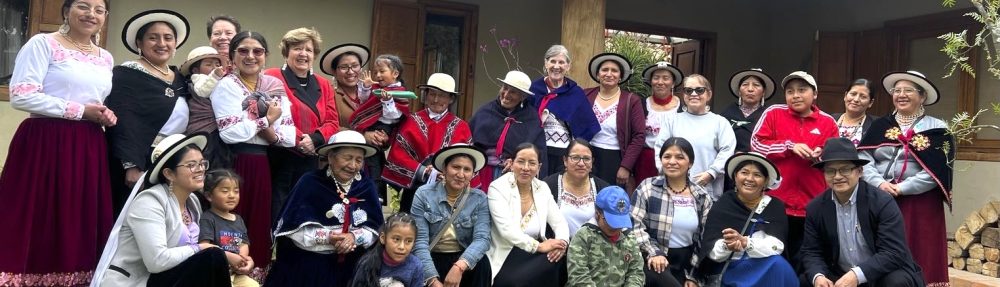
Spoiler alert: she’s here! Barely a day after she arrived last week, she gave her first talk on Cañari myths and music to an audience of bilingual (Kichwa/Spanish) teachers, administrators, students, and one of the original narrators from 1976, Pedro Duy (on her left in photo). Everyone loves that Rosaleen speaks Kichwa. And I was so pleased to present her in the name of the Archivo Cultural de los Cañaris, and just that morning had delivered our new banner with the name in Kichwa.

Rosaleen was in her twenties in the 1970’s when she came to Cañar to do her doctoral research, when this was a dark and dreary place with no electricity in the villages, no roads, no amenities such as potable water. The agrarian reform had barely begun, this was pre-migration, and the people were poor. In our working visits to villages to interview those narrators still alive, she marveled at the changes.

Rosaleen in 1976 with Cañar coat of arms. 
PhD results published in France in 1981.
Our first visit was to the village of Juncal to speak to Gerónimo Guasco Guamán, one of Rosaleen’s original narrators 43 years ago, and whom I know from my work with the book of Danish anthropologists Niels Fock and Eva Krener, which we published in Spanish as Juncal: Una comunidad indígena del ecuador in 2016. Tayta Gerónimo wrote the introduction that edition. It was a gorgeous day when we took a taxi/truck about 20 kilometers away to a spectacular mountain valley that has changed little, geographically speaking (sheep are still there too).

Since we published Juncal in Spanish, I’ve been working with three bilingual educators to translate it into Kichwa and the day of our visit I took a mock-up of the new version to show Tayta Geronimo and his wife, Rosario María. After the family gathered around for a look…


…Mama Rosario took possession of the book and worked through every page, identifying people and places, including a photo of herself in a distant field. She couldn’t have cared less about the text; it was the images that transported her back almost 50 years. A wonderful moment for me as a photo archivist – I only wish I had recorded her information.
Rosaleen waited patiently to talk to Tayta Gerónimo. Although he can’t hear well, she wanted to play one of his recorded stories, so he held two little speakers to his ears and was delighted to listen to a long story he’d recorded with her in 1976.


Next day we made a visit to the village La Capilla, near Cañar, where we met two original narrators: Pedro Duy and Segundo Avelino. After a tasty lunch of fried trout (it was Good Friday), Rosaleen took out her computer to show photos she’d taken in 1976. Suddenly, Segundo said, “That’s me, joven!” as he pointed to a young man in the back of a truck dressed for a fiesta.

And there he was, as a young man, 43 years ago (back right, with banner across chest, holding hat). Very excited, Segundo said he had to have a copy of the photo, and we sat there for a moment, thinking. Then – this being 2019 – he took his iPhone out of his pocket and made a copy from the computer screen.

That led to reminiscing, which led to the proper moment for Rosaleen to take out her recorder and ask how things have changed since 1976. It was a mostly a sad litany, with some nostalgia: “We’ve lost our language, our traditional clothing, our agricultural practices, our music (Pedro gave up the accordion ten years ago), and so on…

But then we look around at Pedro’s and Laura’s large and comfortable house and enclosed patio. At 71 years, Pedro still works on the mountain with his animals and crops. His daughter, Laura, has just graduated from the University of Cuenca. Segundo mentions his horses and cattle, and shows us his Borsalino cowboy hat (he’d given up the white Cañari hat from the photo). In this particular community it appears there has been a shift from Cañari culture to a mestizo life, but these folks are vital into old age, tending their crops and animals, educating their children, living in good houses, and they are no longer poor.

After, Rosaleen and I took the long way home, walking along unknown roads that dead-ended in steep pathways, to finally reach our house in time for wine, the fire, and Michael’s dinner of BBQ’d pork chops and mashed potatoes, plus salad with homemade pickled beets. Ahhh…
Rosaleen will present her work this week at two universities in the area, then head back to Guayaquil, Quito and Newcastle. But I’m happy to say she’s already planning her next trip back to Cañar. Yupaychani, Rosaleen, and come back soon!
The Cañar Book Club is BACK!

Many of my dear book club members were outraged that we skipped a meeting of the Cañar Book Club in the March blog, and I apologize. One should never be too busy to pass on recommendations of good books. So here they are a month late – and I promise never to miss a meeting again (except for next month, when I’ll be in Spain).
From Claire in London as she was leaving for a holiday: Tangerine by Christine Mangan that was strongly recommended by the cashier at bookstore. And I’ve just started The Capital by Robert Menasse. She adds: “anything by Maggie O’Farrell, my go-to when I can’t think what else to read; I’m going to run out soon.” Judy’s comment: I agree on Maggie O’Farrell. She never disappoints.
And from my great archive collaborators, the Peace Corps guys who served in Cañar in the 1960s. Alan, in New Jersey, recommends: The Sixth Extinction, An Unnatural History by Elizabeth Kolbert. And Dan, in Florida: “The Woman in the Window,” a novel by A.J. Finn, Mrs. Sherlock Holmes, a nonfiction work by Grace Humiston, set in early 20th century New York, about the city’s first female detective. Finally, Gringolandia by Matthew Hayes, a Canadian sociology professor who writes about the ex-pat community in Cuenca, Ecuador. “He’s not exactly an Oscar Lewis but some of his interviews with expats are very illuminating.”
From Sandy a reader in Portland of serious books: The Uninhabitable Earth by David Wallace-Wells, These Truths: A History of the United States, Jill Lepore, and Citizen: An American Lyric by Claudia Rankine. ” I still find myself reacting to Citizen. Partly because I had to read it multiple times to even come close to understanding it all. I really do think it is one of the best books I have ever read.”
From Pat in Bend, Oregon: Daring to Drive by Manal Al-Sharif: “A Saudi woman who suffered the culture of her country, worked to reform the treatment of women, ended up in prison, and eventually emigrated. Her answers are ambivalent; she loves her country, but her country’s culture brutalizes women.
From Arlene in Toronto: Brother by David Chariandy: “beautiful short novel that won the Toronto Book Award and Rogers Fiction Prize about two brothers of Trinidadian descent growing up in Scarborough.” The Silence of the Girls by Pat Barker: “a feminist rewriting of The Iliad from the point of view of the Trojan Women.” (Judy’s note: I love anything by Pat Barker; this one goes on my list.) The Five Invitations: What Death Can Teach Us about Living Fully by Frank Ostaseski, the founder of the Zen Project Hospice in San Francisco. Women Talking by Miriam Toews (See the recent New Yorker profile here: https://bit.ly/2Frwe3a.) And The Redemption of Galen Pike a book of short stories by Carys Davies. “I think her work is spectacular. I roll her sentences around on my tongue as though they were delicious food. Am reading her West: A Novel right now.” (Judy’s note: I don’t know this writer but reading the rave reviews and awards, I certainly plan to bring her with me to Cañar next year.)
From Patty in Portland. “Just finished Becoming and loved it. Michelle’s story is amazing Made me miss the Obama White House even more.”
From my sister Char in Santa Fe: Figuring by Maria Popova. “It will take me all year to read it, but every page is wonderful. I’m also reading The Wife by Meg Wolitzer, which is well written with a sense of extraordinary observation. I like it. Haven’t seen the film.” (Judy’s comment: Glenn Close certainly should have won the Oscar for the film. See if if you haven’t!)
From Nancy In Portland: Pig Boy’s Wicked Bird by Doug Crandell about life with his sharecropper parents and four siblings (Derrick, Darren, Dina and Dana) during one particular year in childhood, 1976. Poe Ballantine (one of my favorite Sun essayists) wrpte Love and Terror on the Howling Plains of Nowhere. Takes place in Nebraska.” Judy’s comment: After this I get to say that my birthplace (Nebraska) was the ‘howling plains of nowhere.’
Phew! That was a long meeting with lots of good book suggestions. So I’ll keep my part brief by saying my greatest fear has been realized: I’ve run out of books and it’s only April! My last good read was The Company You Keep by Neil Gordon, a writer who died too young after producing two other great books: Sacrifice of Isaac and The Gunrunner’s Daughter. All complicated stories that require a lot of attention, but my favorite was the last as it deals with the underground life of Vietnam War protestors from the famous Weather Underground. A lot of factual info intertwined around fictional characters. A riveting read. After that, my friend Lynn in Cuenca loaned me two Henning Mankell books. An author I’ve loved over the years with the Wallander mystery series, since his lamented death two years ago it appears his publishing machine has gone into overdrive, scouring anything not yet printed. So skip An Event in Autumn (written for a Wallander give-away in Holland many years ago), and After the Fire, a novel without Wallander but with a protagonist I heartily disliked. Desperate, I asked visitors from Portland to bring me, The Essex Serpent, by Sarah Perry, which I’ve just started and am enjoying getting my feet into the deep dark mud of the Blackwater Estuary in1883 Essex. Stay tuned for final report on that one.
Until then, keep reading and sending your recommendations for the next Cañar Book Club, in June (May club meets in Spain….)


