Sleepless in Cañar

Dear Friends – sorry for the long pause between blog posts. Events since our arrival in Cañar on January 5 have kept me awake with worry (for some hours through some nights). For example, in my first week I worried if I would I be able to gather enough of the scholarship women to Cañar for a meeting with two important donors from the Women’s Circle of Giving in Bend, Oregon. They had long planned a visit here after their trip to the Galapagos. The problem: twelve current students are scattered in universities all around the country; twenty-two graduates, some working as nurses and a doctor and in emergency call centers with turnos – shifts – that wouldn’t allow them to come. To begin, I emailed or texted everyone…to almost no response. I left voice messages, using the terms “urgente” and “obligatorio.” I installed WhatsApp and called or texted again. Slowly, a few responses, some yes, some not able to come, some asked if they could send their mother or sister (yes!). Then it was the Sunday morning of the meeting, and I could only hope. How many will come? Did the Bend guests Helen and Laurel (with husbands Oscar and Owen) arrive OK in Cuenca from Galapagos and Guayaquil? Will their driver be able to find our place? And what will the weather be?

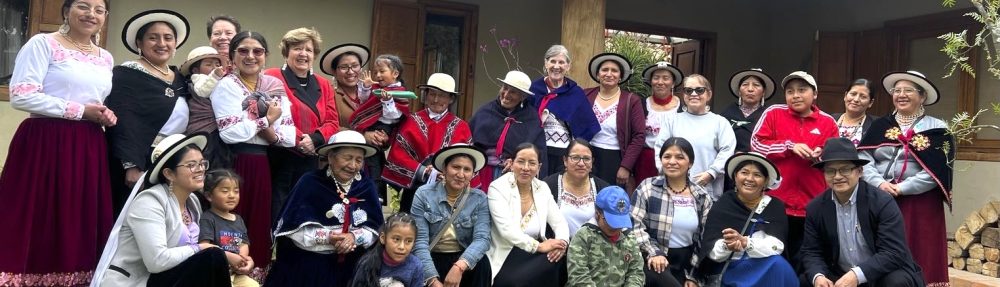
I should not have worried. The turnout was spectacular, the weather was beautiful, the women spoke eloquently of their experiences and the communal lunch pampamesa was an abundant success.

Helen and Laurel were very pleased with it all, including their new red bead necklaces made by a member of our committee, Maria Esthela, for all the women of the Bend Circle of Giving.

Only two days later came the visit of Allison Adrian, the ethnomusicologist from St. Catherine’s University in Minneapolis who, two years ago, spent six months working in Cañar, and was now returning to present her videos on Música Cañari, and to thank all those who collaborated on the project. My job was to coordinate the event at the cultural center here in Cañar, and help promote another event two nights later in Cuenca. For this, at least for the local event, calls and texts and emails won’t do. Only walking into town, or into the country, for several face-to-face encounters. First, present the idea, then clarify the event, then follow up, then take care of snafus, then send or call with reminders. The day comes and I hope for the best. Will Allison arrive from Guayaquil on time? She only flew in last night and is driving in a rented car, which always worries me. Won’t she be exhausted coming up to 10,000 feet and presenting a program within the hour? What will the weather be?

I shouldn’t have worried. Allison with her son Sevi (11+ years), pulled into the gate at 2:00. We got to the cultural center at 2:45, where a few chairs had been set up, along with an old-fashioned screen and projector. The main lobby of the cultural center is entirely a curved glass wall; the weather was brilliant and the room flooded with light. Allison and I immediately saw the problem – the videos would not be visible on the screen. (For once I would have appreciated dark clouds.) The small audience – only Cañaris, no townsfolk – politely sat through 30 minutes with occasional faint flickering images, and with tinny sound from the projector because the cultural center guy couldn’t find the cable to the speaker. Still, the audience was attentive, and after the videos several spoke, both about the importance of Allison’s work, and the fact that for the first time the town cultural center was welcoming the indigenous community. For that alone I felt the event was a great success.

Juan Carlos Solano, Allison’s co-presenter at Casa de la Cultura.

(Two days later we had another, video-perfect, well-received, presentation at Museo Pumapungo in Cuenca. With the approval of the Cañari community Allison has made the videos public on YouTube (with English subs – take a look here!):

The third event that had me worrying is nearing its end. Every year I manage the three-day visit to Cañar of students from Lewis & Clark College in Portland, doing a semester in Cuenca. After years of going the easy route – putting the students up in a nearby hotel, taking them to see Mama Michi and Ingapirca, arranging a fun dance and musical evening at our house (with beer) and finishing with a quick visit to the Sunday market, I wanted to plan something much more “authentic.” After all, the purpose of the three days is to learn about the Cañari culture. So I decided to use a Cañari community tourist center up the mountain in a small village about 30 minutes from here. Built and run by the community of Sisíd Añejo, one of six community tourism sites developed with the help of the government about ten years ago, this is the only one that’s made it work. A charming but rustic “lodge” sits alongside a historic church (circa 1605), which I had a chance to draw while local kids kept me company. Then they brought out their own works, a delightful moment.

I’d arranged for the Lewis & Clark students to spend two nights at the lodge, with day trips to Ingapirca and to Lake Culebrillas. Problem was, I didn’t want to spend two nights in the dorm-like setting of chilly lodge; I also didn’t want to keep up with 20-year olds on the breathless walk around Lake Culebrilllas, where I’ve been many times. (At 12,000 feet I worried obsessively about the weather; when rainy and windy and cold it is a miserable experience).

I shouldn’t have worried. A young(er) Spanish teacher and guide who works with the students at Fundación Amauta agreed to accompany them for the nights, leaving me free to go home to sleep with Michael. My job was to show up for dinner and evening programs, manage the budget, and join the students at Ingapirca on Sunday. The weather yesterday for Culebrillas was good, and the misting rain today at Ingapirca – where I duly made the full hike – hardly noticed. I’ve also put Fundación Amauta on notice that this is my last year. The community tourism center is an efficiently-run place that can manage next year’s group without me. Or someone such as Gabriel can take on my job. But I will miss the students who this year, as always, are wonderful and open to new experiences, such as volunteering for a limpieza (cleansing/healing) with Mama Michi that included some alarming moments.

Or dressing in Cañari clothing for the noche cultural at the community tourism center.

So this brings me to February and freedom. I plan to finish sending out the thank-yous to contributors to the scholarship fund, clear the weeds from the vegetable garden our compadres so kindly planted before we got here, prepare for my visa hearing next week, and finally get to the work of the archive. More on those last two items in next chronicle.As for Michael and domestic news, he played chess with a little nine-year old with lots of nervous tics, a national champion – and lost two out of three games. Michael was philosophical: “the kid’s a genius.”

Then he went up on the roof to clean the chimney with a wire brush, and help of a assistant.

Cañar Book Club

It’s only been a month in Cañar but my reading time has increased exponentially. Book buddy Lynn Hischkind, in Cuenca, loaned me Quicksand, by Henning Mankell, in return for all the Henning Mankell books on my shelves. Reading the last journal-like musings as he was dying of lung cancer at age 67, I mourned again the death of this great humanist, theater director and playwright, author of the great Kurt Wallander mystery series and many other books. Allison brought me two books: Signs Preceding the End of the World by Yuri Herrera (“best translated book award winner 2016”) and The Ninth Hour by one of my favorite authors, Alice McDermott. I was puzzled by Signs, and at barely 100 pages I’ve made a vow to read it in Spanish. The Ninth Hour I’m loving because it adds to my view of the unknown world that all of McDermott’s books so precisely circumscribe: immigrant Catholic Brooklyn, early 20th century, a young woman finding her way in the new world.

I’m happy to have heard from a few members. From Maggie in Toronto: A Disappearance in Damascus by Deborah Campbell, and All We Leave Behind : A Reporter’s Journey Into The Lives Of Others by Carol Off. “Both give rather frightening insight into & analysis of the terrible conflicts that made refugees of the protagonists & their families.” From Patty in Portland: A Terrible Country by Keith Gessen, ” It’s placed in present day Putin-time so very interesting, amusing and instructional.” Next up is Prague Spring by Simon Mawer. From Claire in London: “I’m half way through the amazing A Gentleman in Moscow” by Amor Towles. Her further explanation of the 100-page test (don’t give up before 100 pages) has convinced me I need to go back and again try reading this book.

Finally, from prolific reader Joanne in Mexico: I adored The Friend by Sigrid Nunez, really liked A Life of My Own by Claire TomalinIntrigued by Chalk (about Cy Twombly) and partway into Ninth Street Women by Mary Gabriel.

I love hearing from you all, so please respond in the field below or to my email: judyblanken@gmail.com.


Back to Cañar 2019

Hello Friends: 

Three days, delayed flights, missed connections, two hotel nights, $12 food vouchers for 24 hours in Miami airport, a taxi from Guayaquil and we are finally here in Cañar, on January 5. Below is Michael blowing his $12 voucher on a Cuban sandwich and guava cheese pastry in Miami Airport at La Carreta, one of our favorite layover stops.

If I count right, this is our 25th year of knowing this chilly, homely, lovely place; our fourteenth year living here half-years, and twelve years in our house. Which, amazingly, stays safe and sound for the time we’re gone. Perhaps because this guy was guarding it?

At least he was on duty the day we arrived, cropping and fertilizing the grass. It’s obvious from the droppings all around the house that our compadres José Maria and Narcisa and family and animals have been an effective security presence around the property during the eight months we have been gone. Inside, some dust and spiderwebs but otherwise dry and ready to settle in. It takes a couple of days (with altitude headaches, me) to open the shutters, uncover the furniture, unpack the sheets, towels, pillows and such, before the house begins to look like home. We uncover San Antonio in his nicho and take a look at the plants

Michael finally agrees that we have to do something about the massive macho aloe that is taking over the interior garden; in a couple of years it will reach the glass ceiling. From the time we moved in I have tended my (low) side of the patio, and Michael his. Many of the flowers I planted early on died during our times away (although volunteer geraniums are thriving along with a variety of sedums). But slowly, M. has invaded my side by planting cacti and jade and that big spiky blue-green creature a friend gave us years ago that keeps producing hijuelos. We’ll wait to see how things get resolved on the pruning issue.

Staying with the patio, a few days after we arrived I was crossing it to the living room with a large 3T hard drive in my hands, when my foot slipped off the brick edge and I went flying. Trying to hang onto the hard drive, I landed nose-first in the garden (hard drive went flying anyway), exactly between a rock and an watering spigot. Either would have done terrible damage, though my face still left a clear impression in the ground. We had no ice yet, but Michael had frozen two pork chops, so those went onto my nose in the first few minutes. After that, things got very ugly with purplish black eye and cheek and scrapes and scratches (no photo please!). During this past week I’ve had to explain over and over why my face is such a mess. Today I’m entering the bluish-green stage with patches of white skin showing through. (In photo below: I landed just to the right of the rock you see at knee-height.)

On to Michael – who is delighted with the result of his hip replacement in September, which means he can climb the hill into town without pain for his daily shopping. At home: cooking, chopping wood, building the fire, cleaning the chimney, hauling the propane tanks that give us the luxury of hot water. He’s so happy to be back in the land where a pound of large shrimp at the Sunday market costs $5.00. He’s in the kitchen now, cooking them along with camote (sweet potato) for a Peruvian-style ceviche tonight.

This is a short chronicle because I want to get it out before a busy week begins. But I must end by thanking all of you who contributed to the Cañari Women’s Scholarship Program these past couple of months. (Thank-you letters will be going out soon.) Gracias to our faithful contributors, we had a successful fundraising campaign to continuing support eleven women in universities full-time, two doing their masters, and various applicants waiting in line. Next Sunday will be our first meeting, with special visitors from the Women’s Circle of Giving in Bend, Oregon.

Cañar Book Club 2019

Finally, I’m anxious to hear what you all are reading and what books you have on your lists for 2019. For my report, I can say that the three-day trip to get here seriously cut into my stash of books. I finished The Gunrunner’s Daughter by Neil Gordon (fascinating, complex, still haven’t figured out all the twists and turns), The Rules Don’t Apply memoir by Ariel Levy, a New Yorker writer who must be one of the world’s most neurotic but charming journalists. Imagine Me Gone by Adam Haslett (hmm, no comment; found in a sidewalk library in Portland), and I’ve begun A Place in the Country by W. G. Sebald (a favorite writer but I believe these linked essays were pulled together and translated after his death and I’m not yet engaged), and a book by Paulette Giles, whom I knew as a writer in Canada but turns out she’s an American now living on a ranch near San Antonio, Texas. In News of the World she has written a lovely account set in post-Civil War Texas of an itinerant older man who makes his living riding from town to town to read newspapers aloud to live audiences, and the 10-year old Kiowa captive girl he agrees to return to her family. Reading, I cannot help but think of my mother, a great reader, who would have loved this book. Tomorrow will be her 99th birthday, and I dedicate this meeting of the Cañar Book Club to her memory. I miss her every day.

Please leave a reply here or email at: judyblanken@gmail.com. I do love hearing from you.

Cañari Women’s Education Foundation Fundraising Letter 2018

Dear Friends: I’m so pleased to report we now have twenty-one Cañari women university graduates, with professional degrees ranging from agronomy to veterinary medicine. Two of our alums have finished master’s and two are currently studying, one in Mexico and one in Ecuador. Our current scholars number twelve, and as they graduate we carefully review our pool of applicants and select new recipients. The scholarship is for five years, the usual time for an undergraduate degree in Ecuador.

Since 2005 our program has “lost” only two scholars; each suspended her studies for personal reasons. But we have a policy that they are welcome to return if we have a place. In other words, it’s almost impossible to fail in our program. Once a young woman is accepted as a scholarship holder, we make sure she succeeds by accommodating pregnancy and childbirth, childcare, family crises and other problems – a policy that has paid off with our high success rate.This year we had two graduates, Vicenta Pichisaca in gastronomy and Mercedes Chumaina in accounting as a CPA. I add the photo of Mercedes receiving her diploma in her white hat because, as is usually the case, she was the only indigenous woman in her group (and maybe her class).

Mercedes was special in another way. Through a Christian organization in the U.S., Tom and Kathleen Easterday have sponsored her education since primary school. When I heard about Mercedes through her sister, Margarita, one of our scholars, I wrote to to ask the Easterdays if they would be willing to sponsor Mercedes through university. They were, and they did.

They had hoped to attend her graduation in October, which was not possible, but they sent a generous gift and they are pictured here wearing embroidered shirts from Mercedes in thanks for supporting her education for over 15 years. In the photos below, Mercedes stands with her husband Noe and son on graduation day, and with her proud mother. 

So with two women graduating we welcome two “newbies.” Sara Duy is studying economy at the University of Chimborazo in Riobamba, and Lourdes Pichasaca in medicine at the University of Cuenca. Both have exceptional stories. Several years ago, Sara’s older sister had the rare chance (in Ecuador) for a kidney transplant after years of dialysis. Sara left her secondary studies to accompany her sister in dialysis and recovery from surgery, and they both lost two or three years of high school. Sara finally graduated this year and passed the exam to be admitted to university.

Lourdes Pichasaca showed up with her mother at my studio several years ago. She had taken the entrance exam and passed high enough to get in to university, but not in the field she wanted: medicine. She decided to wait to apply for a scholarship and retake the exam. After that, whenever I ran into her mother in town, she would report that Lourdes was preparing to take the exam yet again. After three tries, she scored a place in the school of medicine at the University of Cuenca, one of the best!

Now for news of some older graduates. Mercedes Guamán was one of our first scholars. She famously became a lawyer and a mother within hours (rushing from the podium with her diploma to the hospital to give birth) and since then has served her Cañari community with legal services and our program as president of the board. Under President Correa she was elected as an alternate to the National Assembly. After six years I think she’s a bit burned out on politics, but one perk was her invitation this year to the United Nations meeting on indigenous peoples in New York. In 2018 Mercedes also received an honorary degree in jurisprudence for her service to the indigenous community.

Carmen Loja went in another direction. After graduating in economy at University of Cuenca, she had a stellar few years in finance, managing a credit union and ending up as comptroller for her hometown of Suscal. Then she left it all to create an organization promoting Andean culture through native agriculture, architecture, food and ancestral medicine. Kinti Wasi invites groups and individuals for stays long and short. (That’s Carmen- our favorite entrepreneur/ innovator – second from left.) Check out her website at: (https://www.facebook.com/kintiwasi.ec/

Juana Chuma is our first to pursue a master’s degree outside the country, in Mexico, where she won a scholarship to UNAM in veterinary medicine. (We subsidize master’s studies at $1500/year for two years, or $3000 total). In the photo at left, Juana is in Puerto Montt, Chile with her research group. She writes that her thesis is focused on a cooperative of cattle producers in the south of Chile.

The Cañari Women’s Education Foundation is an official 501(c)3 nonprofit, which means your contributions are tax deductible. We have zero administrative costs other than this mailing, so every dollar goes to the women’s education. Please make checks to CWEF and send to Charlotte Rubin, 2147 NW Irving St., Portland, OR 97210 (some of you will receive this letter by snail mail with return envelopes), or you can contribute through PayPal with the secure “DONATE” button below.

A final note on this subject: A couple of weeks ago, CWEF treasurer Charlotte Rubin and I visited the Oregon Community Foundation (OCF) to talk about the idea of an endowment for our program. OCF has a plan for 501(c) 3 foundations such as ours that looks really good. It’s too soon to launch a campaign, but I would appreciate a note or call from any of you interested in discussing, or helping, with “succession planning.”  I’m a novice!

Heartfelt thanks to all for your ongoing support, and don’t forget that you are invited to visit us in Cañar, any year between January and June. In a couple of months we will welcome two contributors from the Women’s Giving Circle of Bend, Oregon. And earlier this year we had a visit from Portland photographer Rick Rappaport, who took a bunch of beautiful photos during our annual all-scholarship meeting in April.