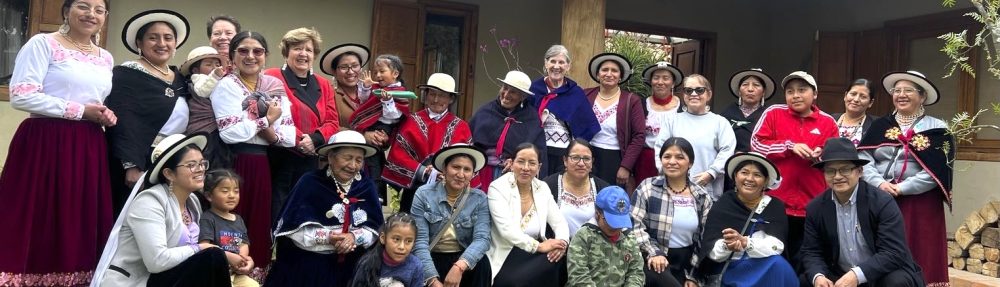
Celebrating Indigenous Peoples’ Day

Dear Friends:  Our Cañar world seems very far away these past months in Portland, but I was happily reconnected this week across generations, geography and cultures, and I thought this post would be a good excuse to celebrate Indigenous Peoples’ Day, (October 8). Created as a counter-celebration to Columbus Day in – where else? – Berkeley, in 1992, the 500th anniversary of the arrival of Columbus in the Americas, Indigenous Peoples’ Day has been adopted by many cities and some states as an official holiday (including, I’m happy to say, Portland, Oregon).

Anyway, our story came together around Lucinda Duy, whom I first met years ago as a teenage ñusta, or queen, of Inti Raymi, the summer solstice fiesta. Here she is a few years later, promoting quinoa, one of the traditional Andean crops that many of you know and love by now.  And again, a few years later, married and with two boys, working in primary schools promoting nutritious lunches based on Andean heritage crops. (Thanks to Nicolas Pichisaca for the photos.) …and closer to the present, poised and fully professional, appearing at conferences, giving talks, and selling cookies and cakes and other products in the weekly Friday market, where I often see her, promoted by Mushuk Yuyay, the cooperative of native grains and seeds producers where she works. Lucinda was recently invited to the First Global Conference of Amaranth in Puebla, Mexico, this coming week.

Anxious to go on her first trip outside Ecuador, but neither her family nor her organization had the funds to send her. And here’s where our story brings in the other players. (This is not a fundraising pitch, so please read on….)

(But first, a couple of words about the amazing amaranth, quinoa’s cousin. A leafy plant that blooms extravagantly into long cascades of tiny protein-packed seeds, it contains more than three times the average amount of calcium and is high in iron, magnesium, phosphorus, and potassium. In other words – a powerhouse of an edible seed  (That’s Lucinda in a field of amaranth in the above banner). Our compadre José María grew it several years ago in our back field, with technical advice from Mushuk Yuyay, and while I loved watching and photographing the crop, I found the tiny seeds frustrating to use – tried popping them, and cooking like quinoa, but never got a handle on it. Lucinda and her team, however, teach others how to use the seeds in soups, stews, cereals, cookies and cakes. (The spinach-like leaves are also edible, apparently.)

So back to our story…

Last year, Alana Mockler was a gap-year student in Cañar with Global Citizen Year (great program!), when she lived with Lucinda and José. Alana’s now at Willamette University in Salem, Oregon, and it was she who contacted me last week to say she was creating a GoFundMe website to help Lucinda get to Mexico. Fight Child Malnutrition in Ecuador https://bit.ly/2C3dOEr

Add into our generational mix Alan Adams, a Peace Corps volunteer in Cañar in the1960’s who, since his retirement as a teacher, has reconnected with the people he knew back then, and helped Mushuk Yuyay write several winning grants. He also helped Alana create the GoFundMe site (which met its goal within the week!), and used his own contacts to make sure Lucinda gets to Mexico. Alan has also been a creative partner of the Cañar archive project in gathering the Peace Corps materials and connecting me with other ex-volunteers. That’s him in his Cañari poncho, a gift from Nicolas Pichisaca of Mushuk Yuyay on a visit to New Jersey a couple of years ago.

Finally, to the mix, we add Juana Chuma, one of our scholarship graduates now studying for her master’s in veterinary medicine in Mexico at UNAM, and Skyler Narostky, another amazing gap-year student, also at UNAM, who helped with fundraising. These two will meet Lucinda as she arrives in Mexico City and make sure she gets to Puebla. Thanks to all these folks, Lucinda Duy will represent Cañar and Mushuk Yuyay in the First Global Conference of Amaranth.


It’s a small world

Dear Friends. I miss you!  I miss writing. I usually only send blogs during the months we are in Cañar or traveling, but this year I’m going to try writing from Portland on ideas that relate to our connected worlds – Cañar/Portland, North/South, immigrant/traveler/ home. The light went on a couple of weeks ago when I was walking to meet a friend not far from where I live when I came across these murals on a commercial building.I immediately recognized the graphic style of Guamán Poma de Ayala,16th-century Peruvian artist whose illustrated chronicle depicted the ill-treatment of his people by the Spanish conquistadores. Below is an example of Poma’s illustrations. The foot plow is still used in Peru and back strap loom weaving is still common in both Peru and Ecuador.

I couldn’t quite believe my eyes. A few years ago, this building was such a wreck that one wall detached and fell down the ravine towards Interstate I-84. Even though repaired, it’s been empty for ages. I went back the next day and was lucky to find the artist, Jahmal Landers who filled me in on what’s happening…

Jahmal was hired by Gabriel’s Bakery to create branding and design for their new space and a coffee shop. Previously a teacher in Portland and in Taiwan, Jahmal works now as an independent creative consultant/art director/ designer. He said he’d come up with the designs working with Gabriel’s owner, Almicar Alvarez, who was inside making bread, so I got to meet him too and hear his story. Almicar immigrated from Peru to Portland in 1979, when he fell in love with a traveler from here. He started out at a small french bakery in Portland, then in 1987 launched his own business named for Gabriel, his new-born son. Thirty-one years later, the family business includes a second son, Sandro and is a Portland institution. (http://gabrielsbakery.com/) Promising to come back once the coffee shop is open in a couple of weeks, I walked around the corner to my favorite tea place, Jasmine Pearl Tea Company, and found this young man. When I mentioned I’d left all my good teas behind in Ecuador he said HE was from Ecuador – his father from Otavalo (an indigenous area in the north), his mother from Portland. (http://thejasminepearl.com/)

So there you are! In one day, in a couple of hours – two connections between two worlds. That was a week or so ago, and I got no further with this blog until yesterday, when Michael and I and our friend Joanne met downtown at the Families Belong Together rally. There, a gathering of many worlds – thousands of us – toddlers, kids, parents, oldsters, workers, politicos, Latinos – everyone came together to peacefully protest Trump’s immigration policies. The crowd was so large we couldn’t even see the stage, but I was able to grab a few photos, beginning with Michael with his Guadalupe shirt alongside a young protester, and a woman with her “The Supremes” t-shirt: Ruth, Elena, Sonia and Sandra, the 5 women supreme court justices.


That’s it for now dear friends. I’ll try to write another Portland blog in a couple of weeks and maybe we could even convene a PDX virtual book club. I know I’m certainly overwhelmed with books now I’m back in the land of public libraries. Until then, stay in touch!

Spain May 2018: following the conquistadors and Cervantes

Dear Friends: A week or so ago we were in Cuenca, Spain, where I looked for a trace of the Spanish conquistadores who in 1557 gave Cuenca, Ecuador its name. According to legend, those guys were marching north after conquering the Incas in Peru when they got the order to establish a city. They came to a place that reminded them of home (which most would never see again) and called it Cuenca. But here in Spain, in this gorgeous UNESCO city, I find nothing that connects the dots other than dramatic landscape and converging rivers (and the unrelated fact that the very modern archive is in the medieval inquisition building, with torture cells in the basement. That’s the archive in the photo above. It is an entirely different matter in the small hill town of Trujillo, a few hours to the southwest and variously described in the guidebooks – without a trace of irony – as: “where twenty American nations were conceived,” and “the cradle of the conquistadors.” A little over 500 years ago, a young man called Francisco Pizarro left Trujillo on his first trip to the New World. He was somewhere in his 20’s, the illegitimate son of an infantry colonel and a “woman of poor means,” but acknowledged by his father. After several expeditions around Panama with Francisco de Orellano, another homeboy, Pizarro landed on the coast of Peru in 1528 and began the terrible business of conquering the Inca Empire. He died in Cuzco in 1541, but Trujillo has never forgotten their local “heroes.” The town is choc-a-bloc with plaques on stone buildings that say “Palacio of Francisco de Orellano, discoverer of the Amazon,” and the “Museo de Francisco Pizarro, discoverer of Peru.”

I was particularly interested in visiting Trujillo because Orellano and all four Pizarro brothers were born here. All left for the riches of the New World and one of them, Gonzalo, ended up “owning” our land in Cañar for his services in helping conquer the Incas. His older half-brother Francisco made him governor of Quito and gave him extensive land grants, among them “the territory of the Cañaris and all the natives within it.” I’ve actually seen a facsimile of the document (not it below, but maybe one like it?)

Gonzalo’s putative job was to convert these “natives” to Catholicism, of course, but according to history he was one of the most corrupt, brutal and ruthless conquistadors. And like all the Pizarro brothers but one – he died a violent death, beheaded in 1548 by the Spanish king’s forces in Quito when he refused to support new laws to protect the indigenous peoples. Meanwhile, Francisco lost his head in Cuzco, the result of infighting with another conquistador, Diego de Almagro (not from Trujillo, apparently.)

Today, this small city of less than 10,000 is a lovely tourist destination largely because of the conquistadors’ grand palaces (now museums, municipal buildings, and hotels), and churches still gilded with gold beyond belief. All built on the fabulous riches plundered in 16-17th century South America. (I should also mention that Trujillo has amazing cheeses and chorizos and wines, located as it is on the dry hot plain of Extremadura.)

Here we had a wonderful 3-night stay in the small Hotel Baciyelmo owned by a delightful Dutch and Brazilian couple, Herman and Carla. It took a few discussions and additional reading to figure out that “baci-yelmo” is a compound word referring to a debate in the book Don Quijote where the beloved main character insists that a basin (baci) is a helmet (yelmo) to keep out the rain, while other characters insist it is nothing by a basin. Don Quijote’s sidekick Sancho Panza tries to settle the argument, and thus the word, baciyelmo, has come to be “a symbol of a courageous … attitude to unite two opposing worlds: fiction and reality.”

There it is! I’ve had a really hard time writing this blog, working off and on and giving up, but this quote perfectly captures my dilemma: I’m trying to reconcile the long-past reality of the violent invasion and subjugation of entire New World cultures – the effects still very much felt today – while we enjoy the lovely open-hearted generosity and beauty and gastronomy of present-day Spain (and now Portugal, where I’ve finally had a free day to struggle to the end with this blog).

It was Carla and Herman who told us about O Facho, a hotel in a tiny coastal corner of Portugal where we are the only guests in a 40-room hotel built in 1910. O Facho (or lighthouse back when it was actually a fire built on the cliff that served as a light beacon for ships) owned by Jorge and Elsa, a taciturn couple who mysteriously glide along the hallways turning on a wall sconce at exactly the right time, adjusting the classical music in the dining room or appearing by the fire in the bar to offer a beer or wine. Jorge – many years in Canada as immigrant Portuguese family before coming back 38 years ago and buying “this ruin” and restoring it while keeping its old-world charm. And Elsa – who reveals nothing but is younger and serves breakfast without a word. Pure peace – no credits cards, no TV, no shampoo, no body lotion, no website… (But I will happily reveal the email address for anyone who asks…)


In between Trujillo and here we have been to Evora, Portugal, a gem of a small city with loads of Roman ruins, where we had a wonderful meet-up with my sister Char and husband Fred. And then Lisbon, where we coincidently and briefly met up with good friends Andrew and Claire from London. But in Lisbon, what I think of as the “Seville Syndrome” happened: we just never got our bearings. Wrong hotel in a shabby neighborhood, confusion on the Metro that left us on opposite sides of the turnstile (“one person, one ticket” the guard kept saying as I gestured desperately), train tickets out of a diabolical machine that took too long to get and took us too far, a closed museum after a long bus ride on the evening of “International Night of Museums,” and missteps in finding good food. Oh well, this happens once or twice every trip and we are accepting (which is  not to say that Michael doesn’t complain…)

Now we ready for the last stage of our month’s travel on our way back to Madrid for our flight home to Portland on May 31. Two nights in Viseu (“one of Portugal’s best-kept secrets”), and in Spain a stop in Salamanca (“most magnificent main square in Spain”). Then we will be will back to Madrid and at our beloved Hostal Dulcinea on Calle Cervantes, down the street from the house where Miguel Cervantes died in 1616, and around the corner at the  where he was interred at the Convent of the Barefoot Trinitarians, with morning coffee downstairs at the cafe owned by Alfredo from Peru who will greet us with a kiss on each cheek. It all comes together in wonderful ways.