Christians and Moors, Romans, Goths, Visigoths, Ostrogoths (and more) in Northern Spain

Dear Friends: As I begin writing this final post from Spain early one morning, church bells are ringing, signaling the start of the Fiesta de San Antonio – same patron saint as in Cañar. The name of this beautiful little town, Cangas de Onís, is puzzling. Even the woman at the tourist office has to Google it to tell us that its Latin origin is “mountains surrounding water” or maybe, she says, “water surrounded by mountains.” True in both cases. Oh, those pesky Romans – they were everywhere, spreading their language and religion, naming places and building bridges! They came to Spain about 200 BC and stayed for 700 years. Then the Moors arrived from northern Africa, conquered Spain, built their beautiful structures and lived peacefully with everyone – Jews, Christians, Gypsies, Goths, Visigoths and Ostrogoths (I’ve been Googling, can’t you tell? And excuse me for mixing up a bit of history.)

Here’s the view from our hotel, appropriately called Puente Romano (both the bridge and hotel). Look closely and you’ll see the cross hanging from the peak of the Gothic arch with and A for Alpha and O for Omega – the first and last letters of the Greek alphabet. It’s meaning, as Michael-raised-Baptist explains is: When Jesus said, “I am the alpha and omega, he meant his God was the beginning and the end.

Later, I visit the small Roman Catholic chapel of Santa Cruz, built in 737 to honor the “cross that re-conquered Spain.” It was here in Cangas de Onís, apparently, where the Christians began the long series of wars and battles to kick out the muselmanes. That took another 700 years.

Typically, this chapel was built on top of a pre-Christian sacred site, a burial mound maybe 3000 years old, over a perfectly preserved burial stone, or dolmen, that one can see through a glass window in the floor.

The plaque also mentions that the chapel was destroyed in 1936 and rebuilt in 1943, an oblique reference to the Spanish Civil War. Being a tourist in Spain you would hardly know the war had happened – I happened to see a postcard in the museum at tourist office of this town after it was bombed. The war is never mentioned in official literature, and only by the dates can one read between the lines.

As I read the plaque, I was reminded how things have not really changed that much in 2000 years. Repeated conquests, wars, repression, inquisition, one group building on top of the sacred site of another. Later today we visit a monumental example. A few miles from Cangas, the Basilica de Santa Maria was built in 19th century adjacent to a holy cave. Reading THAT plaque I see a priest died in 1936  “a martyr”  another reference to the civil war when many priests were killed in the first few years. 

It was here, as we made the long walk up the zig-zag road to the Basilica that I saw my favorite “desire path” of the day. A perfect example where walkers have stepped over the wall and walked around the fence to take a shortcut between a zig and a zag. We took the shortcut down and had a picnic lunch 

The same day, we made the hair-raising drive (along with mini-buses and tour buses) on a near-one lane winding road high into the mountains to the Lagos de Covadango, where we saw almost as many cows as tourists. The different sounds of their bells made that trip worthwhile, though the site was just too overrun by tourists to feel special (the cows didn’t seem to mind, and they ruled the roads). 

I close this blog in Madrid, where it is 97F today, and 100F tomorrow. Time to leave for New York, where we’ll spend a few days before heading home to Portland. It’s been a good month, our best in Spain these last few years because of the weather. This time we got lucky – four weeks of glorious long days, endless servings of pulpo a la gallega (octopus served warm, often on top of sliced potatoes, with paprika, olive oil and coarse salt), many picnics with jamón y queso and these tasty flat peaches, mountains galore, small hotels, good beds, wonderful folks. We’re already planning our trip back next year.Meanwhile, I think the broken link for comments has been fixed – so please stay in touch. I love to hear from you.

Desire Paths, in Spain and elsewhere

Dear Friends: this morning I was ready to go back to my first Spain Chronicle, after my website was hacked a week or so ago (more on that later), but first I checked the Guardian news and saw the terrible events in London yesterday – where seven people were killed on London Bridge when run down by terrorists in a van and others stabbed. I was further horrified to see Portland, Oregon sharing the front page with an article about a white supremacist who a week ago, on a city train, fatally stabbed two men and injured another after they came to the aid of two young women being subjected to anti-Muslim racial abuse. What is happening to our world? Our own world. Three days ago we were in London and enjoying a night tour with friends near the London Bridge. In little more than two weeks, we will be at home in Portland, where a rally is to be held today, Sunday, June 4, to mark the deaths of the two men. White supremacist groups called the Oath Keepers say they will attend the rally to “provide security” and the chair of the city’s Republican party told the Guardian he was considering contacting groups like these to provide security for party events.

Although in the face of all this it seems superficial to be writing about our trip to Spain, I will go back to where I left off a week ago, when this was the title on my website:  . And when I tried to log in I got this encouraging note: The explanation from my Portland website host was just about as mystifying, but at least they’ve put me back in business. Desire paths – the title of this chronicle. I’m a fan of Spitalfields Life, a daily blog by “the gentle author” in East End London who writes daily about past and the present – working class people, markets, historic buildings threatened with demolition, parks, cemeteries, spring flowers, and cats. A couple of days ago he wrote about “desire paths” – user-created pathways between the shortest or most easily navigated way, often in defiance of authority or established sidewalks. I was captured by the idea, both as metaphor and by our lives; I love to cut across fields (and gingerly climb over an electric fence as we did yesterday), step off the concrete to walk on that parallel path, or just bushwhack between our trail and that one on the other side of the ravine (that recently got us into trouble).

Today – Sunday, June 4, we are in a small town of Panes (pa-nays) in the Picos de Europa, a mountainous area in the north of Spain, in Asturias. At the moment it feels just like Cañar – cloudy, raining, 57 degrees F, and we are huddled in our rural hotel room with the picnic bought for our walk today. Which will now be a picnic in our room:  Michael worried about leaving crumbs in the room so to cut the bread he stepped out onto the balcony, where it looks like this. Those are high mountains in the distance, covered by clouds. Tomorrow we’ll drive through them to a place called Cabrales (of stinky cheese fame).During our first two weeks in Spain, however, the weather was glorious. Madrid – Bilbao – Pamplona – Bilbao – Asturias. Last time I was in Pamplona was in 1968, on my first trip to Europe with my two sisters – a graduation present from our parents. All I remember of Pamplona is a campground with many others looking like us – long hair, short skirts, VW campers – (were we camping too? I don’t remember), but certainly oblivious to the fact that we were in Franco’s Spain. Just as we had been oblivious to the strikes in Paris where we had been that June, or later in July to the military government that ruled Greece. In other words – we were American flower girls, not quite mindless but certainly unaware of events in the rest of the world. The photo alongside was not us then, but maybe seven years ago at the wedding of nephew Alex and Elena. I’d never seen the photo until last week when it popped up on FB. That’s Char, happy mother of groom, in middle; Sherry on left, me on right.

Anyway, I am wanting to say that in Spain this time we are following “desire paths” – no fixed itinerary, no tours, no guides, just going where our serendipitous wayfinding takes us. In Pamplona, I discovered the Archivo General de Navarra and talked to an archivist, Diego. When I asked about the oldest document in the archive, he deadpanned “1000 years” – and brought it up on the screen.The building itself is from the 12th century, refurbished and sensitively modernized by Spanish architect Rafael Moneo. A dream of a building for those lone-arranger archivists like yours truly.

We loved Pamplona for the street life and parks and ramparts we walked that encircled the city, outdoor eating, and yes, Michael, we loved the hams too.In the area of Asturias where we are now, coastal Llanes and inland, we saw these fantastic overly-large, overly-rich and mostly empty houses that don’t fit in with the rest of local architecture. Turns out they were built by Indianos, the general term for the hundreds of thousands of poor from northern Spain who migrated to Latin America in the 19th and early 20th century – Cuba, Argentina, Uruguay, Venezuela, and Mexico. Some returned rich to build grand colonial-style houses in their home village and plant the signature palm tree. (All the photos below from the small town of Llanes.)   

We were fascinated by this story because it is so familiar to us from southern Ecuador, where in the past 30 years hundreds of thousands have migrated to the U.S. or Europe, sending money home to build over-sized, brightly-colored, and often empty, houses. (I guess bright colors were not the mode for Spanish emigrants.)

That’s about it for now. I’ll end with two photos from Llanes and our last beautiful weather day, when we walked along the coast and had our first picnic of the trip. Michael shopped hard for that ham – bellota – cut by hand “with the bone in.” No machine-sliced ham for us!  Please stay in touch – I love hearing from you all. 


Goodbye Cañar, hello Spain

Dear Friends: Today is (was) May 1, International Workers’ Day, and an important anniversary for me as Michael and I mark 25 years since first arriving in Cañar, and twelve years living the “half-life” here.  So, to go back:  May 1, 1992, was my first real invitation to take a photograph in Cañar (see above) – it came from Mama Michi Chuma, who was president of her agricultural cooperative – unusual for a woman even back then. “You can take the photo after our march,” she told me then, “but only if you make a copy for every member.” I was thrilled. Mama Michi is in the center of the photo, looking to her right.
This extraordinary woman has been a part of our lives in one way or another since even before that day. Her son José Miguel was one of my first two photography students, and Mama Michi welcomed us on our first visit, she later said, because we arrived “on foot and without a bible.” (Michael, in fact, was carrying the high-efficiency portable wood stove he was promoting in those years.)

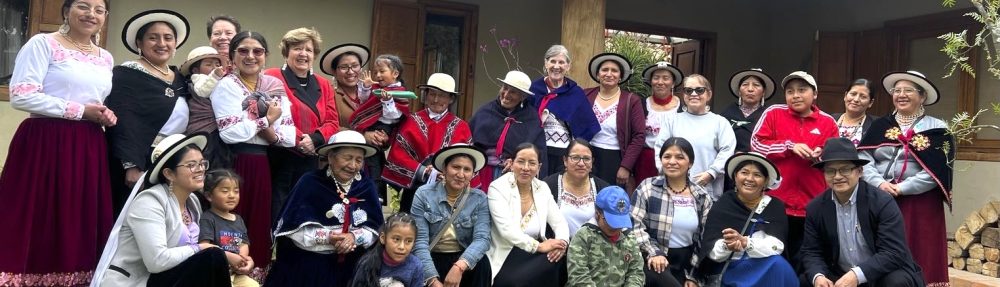
Mama Michi is now a well-known curandera, a native healer, and every year I arrange for a group of Lewis & Clark College students doing a semester in Cuenca to have a “healing session” with heri, a highlight of their Cañar weekend. Here she is with this year’s group:In other news, an article on the Cañar archive project just came out this week in Archival Outlook, publication of the Society of American Archives, with cover and photos from Cañar and text by yours truly and Natalie Baur, the wonderful archivist who first connected me with the SAA and who is supporting the archive project here as she pursues her PhD in Mexico.  The full article can be found here: http://bit.ly/2qA0DWy


The striking cover image is from a glass-plate negative of town photographer Rigoberto Navas (1911-2001). Most likely from the 1940’s, this ritual dancer is wearing a wig with long thin braids and headdress, part of a costume still used today by the few remaining dancers and musicians of “Mama Danza” in the Cañar region of Zhud/Suscal. (Another project that needs researching!)

The national meeting of the Society of American Archivists is in Portland this year (July 23-29) and although I don’t usually enjoy gatherings with 5000 participants, I’m excited to be a part of it this time: http://www2.archivists.org/am2017

Lastly, we are in the familiar process this week of packing up the house, wrapping up projects, cleaning like crazy, saying goodbye to friends and preparing to leave Cañar on May 15. But this year is different because we’re headed to Spain instead of Portland and because my passport has less than six months left on it, I cannot come back to Ecuador. So it’s a complicated dance – mostly for me – figuring out what to leave here and what I need to take – via Spain and New York- to the US (like a couple of hard drives, cameras, extra laptop and so on).

Meanwhile, Michael’s firewood supply is well under control for next year – and the next and next!


CANAR BOOK CLUB

We had a hurried meeting of the International Cañar Book Club this month, as everyone was busy with one thing and another, but there was time for a good discussion of what we’re reading.

From Liz in Toronto: “Euphoria” by Lily King, a novel loosely based on the life of the anthropologist Margaret Mead. (I read it last year and liked it). And Eva Stachniak’s “Chosen Maiden,” a terrific bio of Bronia Nijinsky.

From Pat in Bend, Oregon: Alice Hoffman writes historical fiction. I’ve enjoyed “The Museum of Extraordinary Things” (19th century U.S.) and “The Marriage of Opposites‘ (Caribbean). Another good read and important non-fiction book about the concepts of wilderness and the environment is J.B. MacKinnon’s “The Once and Future World.”

From Suzanne in Portland: Two good fiction reads, “Around the Next Corner” by Elizabeth Wrenn –  a woman examining her life as her children transition out of the house, by and thru deciding to foster a puppy to begin its first year of training as a seeing-eye dog.

Suzanne continues: 1,000 White Women tells the story of what could have happened if the US government had gone along with the matrilineal Cheyenne tribe’s suggestion that, to further the assimilation, the government should give the tribe 1000 women.

From Bruce in Portland:  Exit West  (Mohsin Hamid) and A Horse Walks into a Bar (David Grossman). Both quick reads with some good writing in parts but very lightweight literature. Currently reading The Sleepwalkers (How Europe Went to War in 1914) by Christopher Clark. A tour de force masterpiece of historical analysis and very relevant to the slow-motion train wreck currently unfolding on the world stage.(

He adds: (A Man Called Ove was a sententious book and a saccharine and silly movie.

From Nancy H in Portland:  Evicted by Matthew Desmond – a most compelling, authentically-told, story-based telling of the plight of those in poverty challenged by keeping a clean, safe roof over their heads. The characterizations are nuanced–including those of their landlords, often caught in tough situations themselves. I heartily recommend it!

Also just finished Ann Patchett’s Commonwealth. In an interview, she said shes decided to allow herself to write closer to home. With her sharp eye and ability to find both humor and grace in all her characters, I think this one is truly a great coming home. I have always preferred her nonfiction to her fiction, and this book seems to combine the best of both genres. In tone it reminded me of many of her wonderful personal essays, captured in another highly recommended book, This is the Story of a Happy Marriage.

From Maggi in Toronto: I’m currently reading “Stalin’s Daughter: The Extraordinary & Tumultuous Life of Svetlana Alliluyeva” by Rosemary Sullivan and finding it totally gripping.

Finally, from Judy in Cañar: I’m seriously worried about what to read in Spain. So far I’m taking: Madrid: The History by Jules Stewart, The Pyramid by Henning Mankell (“The first Wallander Cases,” meaning his publisher has scrounged around after this wonderful writer’s death last year to find short stories that had never been collected in a book. And In The Woods, by Tana French.  That’s it. I’m hoping to find a used English book store in Madrid.

Until the next time, keep in touch!