Dear Friends: Since the 7.8 earthquake off the Ecuador coast last Saturday, the daily news has only been worse and worse. Initially, many coastal villages were completely cut off and, once reached, found to be entirely destroyed. As of today, 650 are confirmed dead, 130 still missing and 12,000 injured. Beyond that, 26,000 survivors without homes are living in parks and shelters. A series of small aftershocks have kept everyone nervous, though with no new damages. We felt only one, a 4.8 on Friday morning because it was nearer to Guayaquil and thus nearer us. I pulled these photos from today’s Guardian. 

 This was the worst disaster in 70 years, coming on top of “la crisis” – a reduction since 2015 in oil prices that has kept the country on a tight leash and borrowing heavily from China. In fact, I was planning to write a blog, “The Price of Oil,” enumerating the small ways a contracting economy affects everyday life. (The IMF predicts that Ecuador’s economy will shrink 4.5% in 2016, and some say the country is on the brink of bankruptcy; only Venezuela is in worse shape.) Small examples: The music classes my friend Magdalena organized for local kids as part of her job with a municipality cannot afford to buy a third guitar. La crisis. A cultural institution that issued a biannual magazine that a Cañari friend and I wrote for, “Patrimonio Cultural,” has ceased publication. La crisis. Same with the beautiful publication of CIDAP, the artesania and popular arts magazine. La crisis. This doesn’t even touch on the big things: reduction and delay in state salaries; road projects stalled, and so on. Many blame President Correa, who cashed in the previous government’s savings accounts of oil reserves that would have been used in such a disaster.
In spite of this, the response of the general population to the earthquake disaster has been amazing. As one Ecuadorian journalist, Martín Pallares, observed in this New York Times article “The country has become one huge relief center, and in almost every neighborhood, in towns large and small, there are collection points for donations of clothing, food and blankets.” In Cañar, this includes everyone from children in schools bringing in supplies, to our garbage collector who with his work group is gathering food and water. In the photo below, Quilloac community members gather food, water and basic foodstuffs to take to a central distribution point.
* * * * * * *
But of course despite the disaster life goes on, and so the day after the quake Michael and I became godparents to Luis Gabriel, the eight-year son of Mercedes Guamán. She was an early scholarship student and is now a lawyer and alternate to the national assembly. She’s also one of our oldest friends, and I’ve known for many years – since Gabriel was born – that she would ask us to be godparents. Although Michael at first resisted (see comic below), saying he would never take on another godchild, we found ourselves at the chapel of San Jose at the appointed hour.
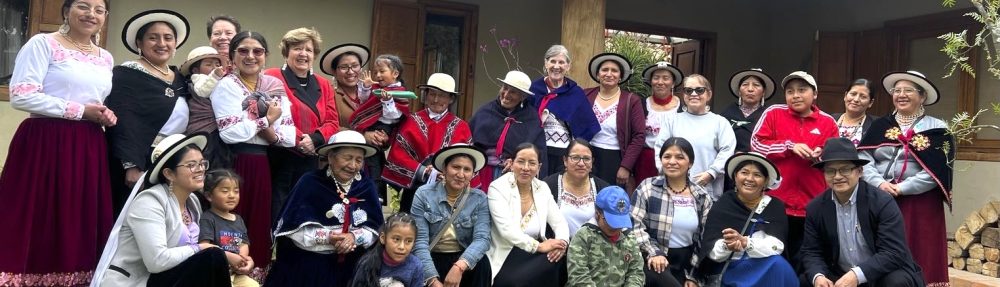
 And before all the family (second godmother above) and Father Mario, who earlier in the week had requested to see our marriage certificate to prove that we were “married ecclesiastically” – and that after we had attended a two-hour cursillo (little course) to learn about our responsibilities as godparents – we agreed to help raise Gabriel to be a good Catholic.
 Then it was off to the family house for the fiesta.
  Where we had a few drinks
  and a bite to eat…
 As godparents, we were served four roasted guinea pigs (each!), three chickens, pounds of roasted pork, potatoes, rice and half a basket of mote (hominy). All to eat or to take home to share with others – a beautiful concept in the indigenous culture known in Quichua as warilla.
We were home by midnight and very happy to be godparents to Luis Gabriel.


 ..
..

 S
S


