Election Fever

belesario(Belisario Chimborazo, mayor of Cañar, 2011, with wife Rosa Camas and vice-mayor Ezequiel Cárdenas)

“Do you mean we can’t buy alcohol between Friday noon and Monday?” I asked our local mini-market guy as I purchased two bottles of my favorite (and only available) wine on Thursday afternoon. “Si, es la ley seca,” he said – the “dry law” before elections. “But don’t worry, I can always meet your needs,” he said with a wink.

Ecuadorian regional elections were held a week ago, on February 23. As a foreigner with five years’ residency in Ecuador, I knew I was qualified to vote, but I hadn’t bothered to register until a few weeks ago, when the nudge came from one of those Kafkaesque moments so familiar. For years I’ve been trying to get good broadband service, but every time I’ve gone to the local telephone office – one that keeps re-inventing itself, trying to keep up with the times – and now newly refurbished, called CNT, and with a new Internet logo: “Fast Boy” (is that a surfboard?) – I heard:

CNT FAST BOY

“Sorry, señora – no more lines. Come back next month,” or, in some cases, “…next year.” After three frustrating years of private and terrible internet service, I was absolutely determined when I got here this January to…well…try again!

So I walked into town to the telephone office (photo: central Cañar, circa 1969, by George Mowry, Peace Corps Volunteer)town streettook a number (an innovation), sat on a plastic chair and watched the Grammy’s broadcast in English on the television high in one corner (another innovation), until my number was called.

The young woman behind the desk began to fill out the formulario on her computer. Telephone? Check! National ID card? Check! Voter card? “No. But as a foreigner, I’m not required to vote.” She consulted with an older colleague sitting beside her (the one who always gave me the bad news). Nothing definite. She called her boss, then said: “Sorry, without a voter number I can’t complete the formulario. And we only have two lines left and the deadline is tomorrow.”

“Do you mean that I can’t have broadband service unless I have a voter card?”

Yep – there’s the Kafka part, and I saw not a flicker of humor or an ironic shrug. So I ran for a bus to the provincial capital, Azogues, one hour away, took a taxi to the Tribunal Electoral where, in one minute, the Republic of Ecuador had issued me a voter card. I rushed back to Cañar 15 minutes before the telephone office closed, and within a few minutes heard the sweet words: “Señora, the técnicos will come tomorrow to install your service.”

belesario building

belesario w sign

So back to the elections. I voted for Belisario Chimborazo to be re-elected mayor. Quiet, intelligent and reserved, five years ago this secondary school teacher ran against one of the usual candidates for mayor, all from one of the powerful local families with names of Cárdenas and Ordonez who have traded the position back and forth for roughly 185 years, since Cañar was declared a cantón. Then, whether the town population was tired of the same old faces, or the indigenous population in the countryside was fired up to vote, Belisario won by a slight margin. That was 2009 and we went to his victory party, surprised at some of the town faces we saw there, such as my bank manager, who gave me a hug.

I’ve watched as Belisario has worked hard to develop rural hamlets that have been ignored for generations, with schools, roads, potable water, health services, meeting halls and commercial opportunities, while trying to satisfy the demands of the townspeople (fewer potholes, water 24 hours a day, a bus terminal). I think he’s done a brilliant job. Here here is a couple of years ago inaugurating a tourist guesthouse in Caguanapampa, a village on the mountain above Cañar.Belisario ceremonia

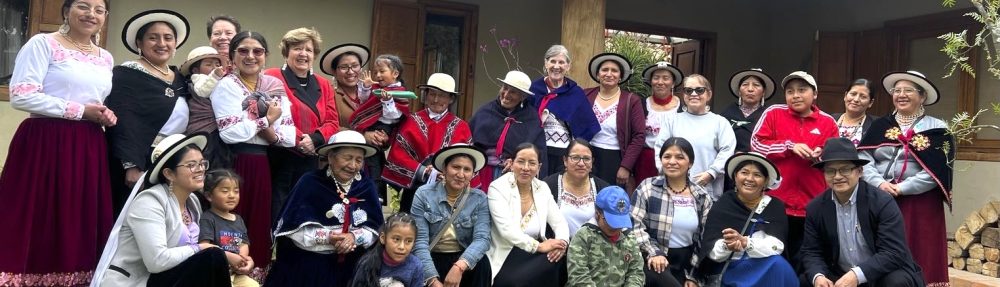
On election day I’d been directed to vote at one of the primary schools – all the schools in town and countryside are turned into polling places. I found organized calm and a quiet air of fiesta – folks sitting around chatting after having voted, outside on the street eating ice cream, with the benign presence of military and members of the five political parties standing vigil at each table. Ecuador has a long history of corruption when it comes to elections, and the indigenous-based movement and political party, Pachakutik is particularly wary. My friend Alexandra (in the white hat below), was one of those watchers, and she told me a group was standing by to follow the cars carrying the ballots to Azogues, where the official count would be made later that day.

school vote

soldier + old man

I voted at table #5, where four young women sat handing out ballots, explaining them, and taking our signatures after. I saw an old Cañari woman signing with her thumbprint, a reminder that we are not that far from hacienda times when there were no schools for Cañari children. After, I was given a new card, certifying that I had voted in 2014.me vote cardFor Ecuadorians this card is serious – voting is obligatory by law, and you cannot get a passport, driver’s license, a job, or leave the country without showing it. This does not apply to me as a foreigner, but I still followed the example of everyone else, and had my card “plasticated” at the portable business set up right outside the school emplasticate! me, card, closeup

This time, Belisario Chimorazo won by an even greater margin, making him the first indigenous mayor to be reelected in190 years!

That’s all the news from Cañar. Now I have to get my cameras ready for Carnival, tomorrow!

Goings On About the House

rooster profile

Dear Friends: Well, I’ve been trying to write a blog about the regional elections, in which I’ll vote for the first time, but since they will not be held until February 23, I’ll write a short entry this week about domestic goings on, with the election blog to come, after I’ve voted.

Although we’ve been in the house seven years now, the birds are just discovering us, at least those that want to move in. Last week a little black hen wandered into the yard and as dusk fell, tried to roost. She pecked at the window where Michael was playing chess, perched onto the deck rail, disappeared, showed up at the kitchen window, pecked again, then settled down on Michael’s rubber garden shoes to sleep, leaving a nice little gift. Next day she was out in the quinoa field, pecking away. Michael took her water and grain, thinking she belonged to one of the neighbors and was surely lost. She roosted again that night on the front porch, and by the third day was gone. We miss her.

rooster 2 roosting roosterNow we have two little finches, also pecking at the windows but also trying to nest in the light fixture on the back porch. After watching them for several days, Michael has decided to build a bird house. He got up this morning, put on his work pants, rustled around in his storeroom for materials, and by cocktail time, the glass birdhouse was done and hung on the back porch (looks like a frame in this photo). It remains to be seen if the birds like it.

birdhouse

Michael’s also been in the kitchen, of course – and in the garden – which our compadres Jose Maria and Narcisa planted before we arrived: broccoli, chard, scallions, and so much cauliflower that we are eating it pickled.

garden cropped veggie from garden

For Valentine’s day, he made a special meal chicken in sweet red pepper sauce, with potatoes. (The hilarious heart-shaped chicken breast a complete accident, only noticed later.)

valentine chicken chicken w potatoes

We also have a wild blackberry vine in a corner of the field that has produced enough for a couple of berry/orange cakes…

berries better cakeMeanwhile, we’re watching with interest the quinoa that Jose Maria planted for the first time in our back field (it’s always been corn, potatoes or peas). For the first month it was hard to tell the weeds from the quinoa plants.field of quinoa

But with recent rains the top leaves are turning lovely shades of pink, and yesterday Jose Maria brought an agronomist to show him how to weed and hill the plants. I can’t wait to see the maturation of this traditional Andean grain, which for some reason the local folks do not eat (they say it is bitter in its natural state, and takes too long to prepare).

quinoa close agronomo

Finally, for those who remember the medical saga of Lourdes, the young daughter of Jose Maria, I have great news. We had just moved into the house when she was diagnosed with end-stage kidney disease; then shortly after total kidney failure, a long hospitalization in Quito, two miserable years of dialysis in Cuenca, and then finally – the miracle – a kidney transplant in Quito two years ago. After a delicate first year without major complications, Lourdes is now a healthy 17-year old, back in school after losing three years, with good color and some growth, and enjoying a pretty normal life. Here she sits at my computer, researching music, asking me how to use Bluetooth to connect my computer with her cell phone (huh?)

Lourdes


Goings on about Cañar

January is always a busy time here, what with the five-day Fiesta de San Antonio de Padua, held this month despite the fact his official saint’s day is June 13, when he died in Padua, Italy, in 1231. Then there’s the Fiestas de Cañar, an annual civic celebration lasting fifteen days, beginning with a cleaning of the city streets, ending with fireworks, and in between a handcrafts fair, lectures, soccer games, concerts, dances, a bull fight, and an long-long parade on January 26 to celebrate Cañar as the self-proclaimed archeological capital of Ecuador.Cañar capitalI gladly photograph it all, sometimes by invitation; and sometimes I get a call as the big parade is forming up: “Judicita, we’re hundreds of people from Quilloac getting ready to march. Come take some photos!”

foto 2Other times, I come upon things by accident, as today when I walked into town and stumbled on the finish line of the wooden car race, always held the last day of the civic fiesta, when hand-made wooden carts race down the Pan American from the high hill on the outskirts of town.wooden car wins

wooden car

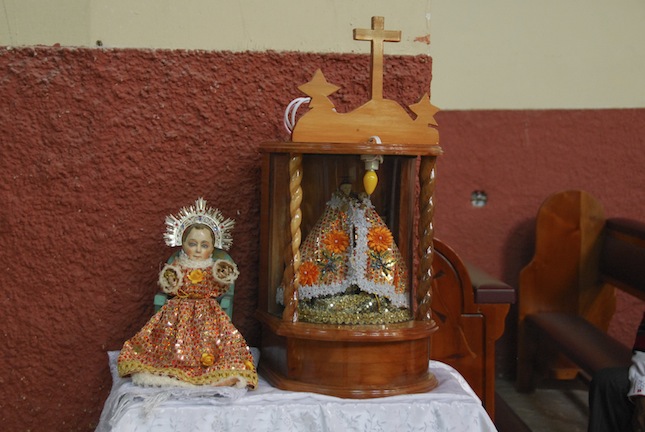
But my favorite event is the Fiesta de San Antonio, held in the hamlet of Junducuchu high on the mountain, with its own saint – a tiny figure or “doll” found in a mountain crevice 100 years ago by a woman of the village, and venerated ever since. (Below: tiny San Antonio is behind glass…the figure alongside represents El Nîño, or baby Jesus.) tiny saint

The tiny San Antonio lives with a host family that changes year to year, a transition marked by carrying the saint into town to the church to be blessed before being carried back up the mountain in the arms of the wife or daughters of the  prioste – the new guardian of the saint, who will also host the fiesta, including feeding hundreds of people several times in the course of five days.

two wm w saints

On a bright Saturday morning I joined up outside the church, where the vacas locas gather and dance while waiting for the saints and village leaders to emerge from the blessing. Men and boys prance around as huge “crazy cow” puppets, mooing and snorting, or pretending to poke onlookers, as a town band plays. These wonderful vaca locas are hand-made of cow hide stretched over a wooden form, with papier mâché heads, decorated in inventive ways, and a wooden bar across the front for the dancers to hang onto and maneuver for the hours they must be carried.

.dance of vacas locas vaca loca closeupMeanwhile, other figures join in, and onlookers gather, waiting for the taytas or community leaders to emerge from  the church

desfile de iglesia taytas in front of churchAfter a short march around the town we start up the mountain, the band playing nonstop. Meanwhile, another group has left the village to come down to meet us. This procession includes boys and girls, dancers, a man carrying a maypole, a trio of flutes and drum, accompanied by various other characters, such as the rukuyayas, or clowns, who make mischief as long as the fiesta lasts:

yucuyaya  rukuyays

And the bands:

band on hillside  flute + drums

And this wonderful old man, who appears every year in his mask and vaquero, or cowboy, gear, of rope and chaps. He dances for hours and hours, sleeps a bit sitting up, then dances some more. One year he grabbed onto me to dance, and insisting on calling me his warmi, “woman” in Quichua.

tayta con mascaraWell, this is only one day of the fiesta and I’m usually worn out by the third day. All this January activity wraps up in time to prepare for Carnaval, the biggest Cañari fiesta of the year, celebrated the Monday before Lent. This year it is mercifully late, on March 5.

We’ve had a month of brilliant weather – sunny and warm but so dry that the farmers around us badly need rain. They plow and plant in January anticipating the rainy season, which should have started before now.

One of the goings on I came across the other day was a minga, a cooperative work day that is part indigenous tradition, part hacienda custom, I suspect. Everyone in a comuna is called out to work, in this case on an irrigation project. The old way was to blow on a conch shell, called a quipo. Now they probably use cell phones.

boy w conche

Those who don’t work must pay a fine, or send a laborer for which they pay. I came across this scene the other day near our house – maybe two hundred people digging up old and broken concrete irrigation pipes, to be replaced with plastic ones. They live in a village far down the mountain, and no water has reached them during this drought. When I came by later in the day, the pipe was laid and the ditch covered. Irrigation is, and has always been, the life’s blood of agriculture, and of rural life. Next week there will be another minga near our house, and we were told we will be expected to colaborar – collaborate, meaning either work or make a contribution. Stay tuned!

minga