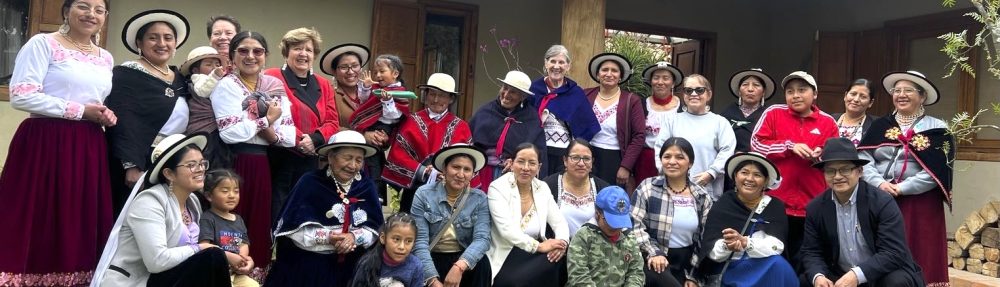
We are invited to a family event (at last)

Dear Friends: Going back a few weeks in time, and to a previous chronicle theme of rarely being invited to family events, I was absurdly pleased during the Carnaval procession to run into Mama Mariana Chuma, with her contingent from San Rafael, when she casually invited Michael and me to her house the next day (her granddaughter Naomi on right).“At 2:00, not 12:00?” I shouted over the cacophony of drums and flutes. I often don’t hear numbers correctly and doce for 12:00 and dos for 2:00 sound a lot alike. DOS she yelled. OK. Two o’clock on Carnaval Tuesday, we were invited to a traditional family gathering, which would most likely last all day into the evening with lots of sitting around, too much to eat and too much to drink. “We are going,” I informed Michael, and he readily agreed. We’ve known Mama Mariana and her family since her son’s baptism, in 1992, which, in fact, was the very first family event we were invited to in our early years here. Juan Carlos, then six years old, is now a professional musician with a master’s degree, married to one of our scholarship graduates, Pacha, a dentist. Shortly after Juan Carlos’s baptism, while we were on a visit to the U.S., his father Juanito died in a soccer accident. Mama Mariana raised her three children alone – now all university graduates – while working as a nurse in community clinics until her retirement a few years ago. I’ve always loved her.

Knowing that 2:00 was really just a starting point, we struck out walking from our house around then, intending to slowly cover the several kilometers to San Rafael so as not to be the first to arrive. Our plan was foiled when Segundo, Mama Mariana’s son-in-law, drove by and picked us up. We were the first to arrive.

Segundo, acting as host, led us to behind the house where we saw what looked like a newly dug grave, a few flowers stuck in at random. As Michael and I stood staring down, Segundo said, “It’s a pachamanka. It will be ready at 4:00.” This, we knew, meant our dinner was cooking somewhere under the tierra. In Kichwa, pacha means “earth” and manka  “pot,” and this is apparently an old Cañari/Inca custom being resurrected of cooking a meal underground with hot rocks. (MIchael chirps in: a mixture of a Hawaiian luau and New England clam bake).

We sat on a bench against the house, gazing at the countryside and the still smoking fire where the rocks had been heated. As the only guests, protocol dictates that we never be left alone, so Segundo sat with us while we had a few shots of Zhumir (sugarcane firewater) that Michael had brought, and then beer. Segundo is a good friend so we enjoyed talking of U.S. politics, and of the recent Ecuadorian popular referendum, where, it turned out after Segundo explained, Michael and I had voted SI for something we should have voted NO.

Soon, others arrived and our party livened up. Someone brought out a table to set in front of us, and Mama Mariana appeared with a pitcher of chicha, corn beer. I wondered where everyone else was, and when a helper passed by with a load of wood on her back, I realized cooking must be going on in the indoor kitchen too.

At 4:00, a flurry of activity as the flowers came off, shovels came out and kids appeared as the moment arrived to unearth the food.

First the choclos, or corn on the cob, protected by layers of husks.

Then fava beans in the pod and chorizo sausages (disappeared too quickly to photograph, eaten in bites by all of us standing around). Then, last, a huge calabaza (squash) that would be our dessert. By now it had started to rain, and within minutes the whole shebang was whisked inside – table, chairs, chicha, food, kids, adults. And, as I had suspected, there was a lot of action going on in the two indoor kitchens. Over an open fire on the floor, cuyes (guinea pigs) were cooking on long wooden skewers, boys at either end turning the poles.

…and in the other kitchen a huge wood fire with steaming pot of potatoes. We were about eight adult folks, seated around a large table, while Mariana, her two daughters and others were tending pots and pans around us on the large wood-fire in one corner, and a gas-cylinder cooker in another. Michael and an old friend, Santiago (Tayta Shanto), Mariana’s brother, grabbed places together against the wall, watching it all between shots of Zhumir and toasts.

But now I put away my camera. It was time to be a guest and not a photographer. Slowly, the first course of chicken soup arrived (always my favorite part, after so many hours of waiting), then seriously laden plates, with a cuy on top of huge slabs of roasted turkey, surrounded by potatoes, corn, beans and salad. More toasts. Then, after we could not eat another bite – the special dessert of cooked squash with milk, sugar and cinnamon. It was delicious!

Now about 8:00, Michael and I were tired, but we knew we couldn’t leave. In fact, no one around the table moved, recounting family stories and jokes and laughing while the women at the table held sleeping children, and the cooks sat behind us on low stools and chairs, chatting and snacking in their own circle, Two little boys no more than two or three sat in on corner, quietly playing on a shared cell phone. The older kids were outside, playing around the revived hot-rocks fire. More rounds of Zhumir and then another sweet liquor that appeared out of nowhere. By now I would delicately pat my mid-section and say “no mas, gracias,” but Michael couldn’t get escape so easily.

Incredibly, around 9:00 more family arrived – Mama Michi and her daughters, in great spirits. They’d had another invitation in another village. A second table and chairs were set up in the first kitchen. The cooks stirred, charged up the fire and cooker and began another round of serving each person – first chicken soup, then full plates.

It seemed a good moment to make our excuses. Juan Carlos offered to take us home in his car, and we gratefully accepted. The next day, satisfied that we had been included in a real family event, with people we’ve known so long and loved, we didn’t even mind the headaches with hangovers.  Well worth it!

The Cañar Book Club (with the Virgin of Cisne blessing our books)

Perhaps it’s something about the bad weather and books, but our faithful members from London to New York to Portland have been gathering and discussing and sending suggestions. Several readers have mentioned how much they loved A Gentleman in Moscow, by Amor Towles. (“Warm, entertaining, lovely story.”) This member also wrote that her favorite books of the last year were The Elephant Whisperer by Lawrence Anthony and The Soul of an Octopus by Sy Montgomery.

Two Portland members recommend Pachinko by Min Jin Lee, “an epic saga of a Korean family and National Book Award Finalist.” (Her previous novel with the intriguing title of  Free Food for Millionaires was one of the “Top 10 Novels of 2007).

Another Portland member wrote about her recent discovery of Jon McGregor’s  Reservoir 13, and  I see he has a bunch of other books with great titles, such as This Isn’t the Sort of Thing That Happens to Someone Like You. I’ve put him on my Cañar list for 2019.

Exit West by Mohsin Hamid seems to be on everyone’s list – certainly mine -and he’s coming to PDX Arts and Lectures in April.

A writer friend says she’s gone back to read some books she’d missed over the years: Cutting for Stone by Abraham Verghese  (“thoroughly enjoyable”), and Ann Patchett’s Commonwealth, (“sturdily good”).  A new “difficult” author is Mattías Enard, she writes. “A Frenchman of vast erudition, who wrote Compass, a rumination on the otherness of the East to the West and vice versa, told in the thoughts of a dying Viennese musicologist.”  Sound intriguing. She’s also read Claudia Rankine’s “devastating Citizen” and books by Shirley Hazzard, such as The Great Fire (“just wish she’d written more”).

Another member wrote how much he’s enjoying books by Ali Smith, a perennial Booker finalist whom I also love: Autumn, Winter and How to be Both.  Ha.

Meanwhile, I want to end with a book that’s generating a lot of excitement in many translations, brought to my attention by our London correspondent: Elinor Oliphant is Completely Fine, by Gail Honeyman. Read all about it here.

Have I missed any members’ recommendations?  If so, please remind me, and send new ideas for our April Book Club, when I’ll confess to some trashy reading on my part.

See More from Judy Blankenship

Fiesta & raymi season draws to a close (at last!)

Dear Friends:  It’s been an intense and productive couple of months documenting fiestas, raymis (kichwa for indigenous fiesta) and educational events with Buddy, my intern from Oregon State University. Working with a tireless 21-year-old in this rigorous business has kept me on my toes – and climbing mountains I might not otherwise have climbed. One way we kept track of our production of photo and video materials, and to share these with the community, was to create DVDs with covers using photos from the celebrations. So we began on December 21 with Kapak Raymi, the Andean winter solstice and Pase del Niño. As this is an event both profane (older kids dressed as Inca royalty) and religious (younger kids depicting bible characters), we made two DVDs.


On December 31 we ushered out 2017 with an all-day-into-night procession through the villages of Quilloac, called Año Viejo (old year). I’ve written before about this amazing ritual – filled with masks, music, jokes and fun. Because this event too had both religious and secular elements – my friend Mercedes carried “el Niño” or baby Jesus, in a little chair for hours – we created two DVDs, one of photos and one of video clips.

On January 12 the bilingual Instituto Quilloac invited us to document its 37th anniversary. I’m a big fan of this educational complex as it was created out of the Agrarian Reform in the 1960s at the behest (demand of?) the indigenous Cañari communities. “We’d never had a school before,” Tayta Antonio Quinde told me in one oral history session. “We wanted to preserve our language and our culture, so we made creating a bilingual (kichwa/español) institute a condition of the reform.”  The school grew to include all grades and at one time had over 2000 students, both indigenous and mestizos who came from other regions of Ecuador. It is now at about 800 students, but during the parade that wound through town we picked up graduates from all years and ended up on the grand patio of the school complex with a great crowd for a lively reunion of music, dancing, drinking and eating.

One benefit to me of these big events is that I come upon many old friends, reminding me how long I’ve been in Cañar. Pacari, for example, I’ve known since her birth. She’s the daughter of our compadres Zoila and Benedicto, and granddaughter of Mama Michi. I ran into her heading the parade as the ñusta, or queen, of Cañar Archeological Capital of Ecuador. Eighteen, beautiful, poised, Pacari is planning to study voice in university.

January 20 we filmed and photographed the Fiesta de San Antonio de Padua – in my opinion the best fiesta of them all. Although it lasts eight days, Buddy and I dedicated only one day to documenting the hours-long desfile (procession) climbing up to a height of 11,000 feet in the paramo (foggy highlands). I confess to catching a ride in a truck this year, while Buddy walked it entirely.

That left one final celebration on the Cañari calendar, and perhaps the biggest of them all: Pawkar Raymi, or Carnival. As with other carnival celebrations, it coincides with the beginning of Lent. But here the big day is Carnival Monday, when all the Cañari communities gather at a host village (this year our community of Chaglaban) to create a long procession through town and out into a large field in the country, where presentations of food, crafts, dance and music go all day and into evening.

Pawkar Raymi in the Cañari culture marks the flowering of the crops, abundance and generosity, and one important aspect of the procession is the cuy-naña carried by the women of the host community. (The name means “sister guinea pig” though English does not do it justice.) It is a heavily loaded platform with fruit and flowers, drinks and sweets, with two cooked cuyes and a chicken atop the poles of the platform and a cage of live cuyes at the bottom. With tremendous effort, the women must carry the platform for hours, with regular rest stops….

More than anything, a big fat guinea pig represents abundance and freedom from hunger. Here are the women from Chaglaban who carried the cuy-naña that day. A less favorite part of Carnival in Cañar for me is the custom of throwing water and maicena, or cornstarch, on passersby – in the streets, from the rooftops, during the parade, at house parties. Here’s Buddy after a maicena attack during the procession (in much better humor than I would be.)  A modern twist is the horrible kareoka, or spumy spray in canisters with triggers, that covers one in a chemical foam. I suffered a direct hit from one little two-year-old in her mother’s arms, who looked wide-eyed with fear as I yelled “NO” right after she covered my best camera with foam.

Finally, I want to mention the wonderful work being done by Allison Adrian, the ethnomusicologist who worked six months in Cañar in 2016. Back at her home university in Minneapolis, with help from professional editors, she is creating three films on Cañari music. Two of them are ready to be seen publically and next blog I’ll post online links. Meanwhile, we are making them available locally as DVDs.


The Cañar Book Club

Ah, the poor Cañar book club is in a funk. Everyone has been too busy to meet and we’ve exchanged little news of good new books. For myself, I tried one Michael had liked (That Bright Land by Terry Roberts (“a southern gothic thriller set in the summer of 1866), and didn’t get hooked, so I moved back two centuries and now I am well engaged with Caleb’s Crossing by Geraldine Brooks (set in Martha’s Vineyard in 1660’s, the story of a young woman). A faithful reader from London has suggested two books that sound intriguing: The Orphan Master’s Son, by Adam Johnson, about North Korea (“alarming and eye-opening”), 2012 Pulitzer Prize winner for fiction. And for these times we should all be reading: How to Live a Feminist Life by Sarah Ahmed, and The Power, fiction by Naomi Alderman.

We’re calling a regular meeting before the next blog in March, so all member readers – please send your suggestions!  Over and out…..

Neighbors!

Dear Friends: On this cold foggy afternoon, I look out the window where I sit at our dining room table and see our immediate neighbor to the west, Magdalena, doing her weekly washing in the small field behind her house. She pulls the clothes out of a big plastic basin sitting on the ground and rubs them hard with a bar of soap on a wedge-shaped tree trunk. The wedge is resting on a crude wooden box, propped up with bricks at each corner. It barely reaches 18 inches, but Magdalena is short and she has good leverage leaning over. She sloshes clean water from a bucket onto the pants and t-shirts of her teenage kids and her own bright wool skirts. She squeezes the water out and lays the clothes on the grassy ground beside her, to be hung on the barbed wire fence between our fields. I just checked the temperature outside: 55 degrees F. So I’m happy to see she is wearing rubber gloves, some slight protection. Now the fog is drifting in so thick I can barely see the long black braid that hangs down her back below the bottom of her pink sweater. Her white felt hat. Wool tights. Blue skirt. (Below: Magdalena several years ago when we were building our/her retaining wall).

There are no animals behind her house today – but we often see pigs (in a twig-and-stick shelter at the bottom of her land), sheep, a cow, chickens, and guinea pigs and rabbits in pens nearer the house. Magdalena owns another property up the mountain and the family seems to move their animals up and down.  This is really a story about our neighbors and the views from our house, not an easy subject while I try to respect privacy and cultural differences. When we bought the Cañar property 12 years ago, we had an almost 140-degree panoramic view that ran from the west, where the clouds come up from the coast, to the north view of the high mountains (my header image), and to the east, where we could just see the lower mountains that mark the boundary with the Amazon basin (though a neighbor’s tall concrete wall already blocked some of that view). This magnificent panorama was the reason we bought the land and positioned our house so the windows in the living/dining area would capture it. A beautiful cypress tree at the bottom of our lot (belonging to our neighbor) framed the view of the mountains. I loved that tree, and used it in every panoramic photo at the time.I painted the block wall a dark green and planted vines (despite Michael’s protests that it was not our wall). We came back the next year to see our neighbor Miguel up in the tree hacking away at it with a machete. I foolishly ran down and asked him if he had to do that – it was such a beautiful tree. Yes, he said, its branches were bothering his señora in her wood-fire, tin-roofed kitchen. Now it looked like this (below), but I still loved it and our crops (here quinoa) helped harmonize the scene.After that, every year we came back to find drastic changes to our sector which, unbeknownst to us, had been slated for urbanización to accommodate the fast-growing region of Cañar. We watched as a private “charismatic church” was built on the other side of Magdalena, constructed higgledy-piggledy of concrete block with a large back wall blocking our view to the west. The field below that became a housing development when a local man bought the agricultural land, went to New York and sold most of the lots to migrants from Cañar. I grew a thick hedge to block all that, with only the steeple and cross showing above, and for awhile I liked the green-neon cross but it soon went out.Another year we came back to see that Miguel had chopped off the top of the tree and it looked very sick.Our neighbors are poor. Magdalena has at least four children but only the two youngest live with her now. Years ago she told us her husband was in the U.S. and sending money back to build a new house, but the towering pile of bricks that she gestured to as evidence then is still there, stacked near the road. Meanwhile, her family lives in two small wattle-and-daub structures that abut our property: a windowless cook shack and a slightly larger shack for sleeping. Years ago they added a separate bathroom.

Magdalena is illiterate, and she knows her survival depends on her willingness to fight. Years ago, when we finalized property lines, she argued fiercely about where a rock marked the edge of her property. Michael measured, then moved the marker 20 centimeters into our side and said he was giving her a little bit of our land. She was happy – then!  But over the years, when she complained that our land was eroding down onto hers, we built a retaining wall; when she complained that our poplar tree was sending up seedlings in her dirt patio, we took it down. When she complained that our broom hedge was hanging onto her side, making it easier for thieves to creep in, we sent our garden-helper over to cut it back. Lately, when we run into one another on our road, Magdalena is very friendly.

MIGUEL: Miguel: lives to the northeast of us with his wife and children and grandchildren on a small lot. He’s older – between 60 and 70 – and mestizo, but like Magdalena he is poor. I frequently meet him on the road, always wearing a funny floppy cloth hat and raggedy clothes. Hola vecina! (neighborhe always greets me. When we moved in, Miguel’s back stone wall bulged into our property. When doing measurements for our fence, Michael told Miguel we would keep the line as defined by his bulging wall. He was pleased.

Then, last year I was horrified to see a block construction going up directly in our view of the mountains. Miguel and helpers were building a house. But wait – they’re tearing it down. No, here it comes again, facing the other direction and even more intrusive of our view. Of course. we could say nothing. Miguel and his wife deserve a real house, however ugly and despite lack of zoning laws.

When we arrived last year, the tree and bulging rock wall were gone and in their place a 10-foot concrete block wall, with the hated rebar sticking up another ten feet in case Miguel wants to expand upward. The house is done and it’s a mess, with an adjacent shed with corrugated tin sheets making a sort of overlapping roof. On the outside of the wall facing us for some crazy reason – a padded headboard with a heart – and a big yellow tarp hangs down from his balcony, which is blocked off with a sort of wooden pallet.

This year Miguel complains that the vines I planted are climbing into his house – “almost into our bed,” – he joked. We sent the garden-helper to trim the vines. I asked in exchange that his grandkids stop throwing garbage into our field. Agreed.  But what about that capuli tree? he asked, pointing to a volunteer cherry tree that I’m counting on to help partially cover up the wall. “The roots will be coming into our patio soon,” he said. “That’s MY tree,” I answered more strongly that I meant to, “and I don’t think the roots are coming for you.”  He backed down and the tree stays. For now.

I look out one late afternoon at a beautiful sunset and see Miguel standing on his half-made balcony, dreamingly admiring the view – the same 140-degree panoramic view we once had. Ours now – if measured from wall to wall – is down to about 45-degrees. But Miguel and I admire the sunset together, neighbors coexisting for good or bad in our gorgeous little world.


Cañar Book Club

Well, the members of our virtual book club have been quiet since the holidays, but I’d love to hear what new books have come your way, and what you are reading/liking/hating. For my part, I’m reading both non-fiction (lunch) and fiction (bedtime), a practice I learned from my mother to keep two books going. (In her case, it was to keep the dullest one for bedtime so the narrative wouldn’t get her excited and keep her awake.) I don’t have that problem, so I’m reading over lunchtime The Invention of Nature: Alexander von Humboldt’s New World by Andrea WulfHeavy going, but I love the early history of “our” part of the world. Humboldt was an early explorer of Ecuador and, according to one map, I think he might have come through Cañar territory around 1801. At night, for relaxation, a fiction book, An Atlas of Impossible Longing, by Anuradha Roy. The result of a mix-up: I thought I was reading the new book by Arundahati Roy, The Ministry of Utmost Happiness. Took me a while to figure that out, given the similarity of authors’ names and poetic titles. Not the brilliance of Arundahati Roy, but I’m enjoying it.

All for now. Stay in touch!