It’s a New Year: 2018

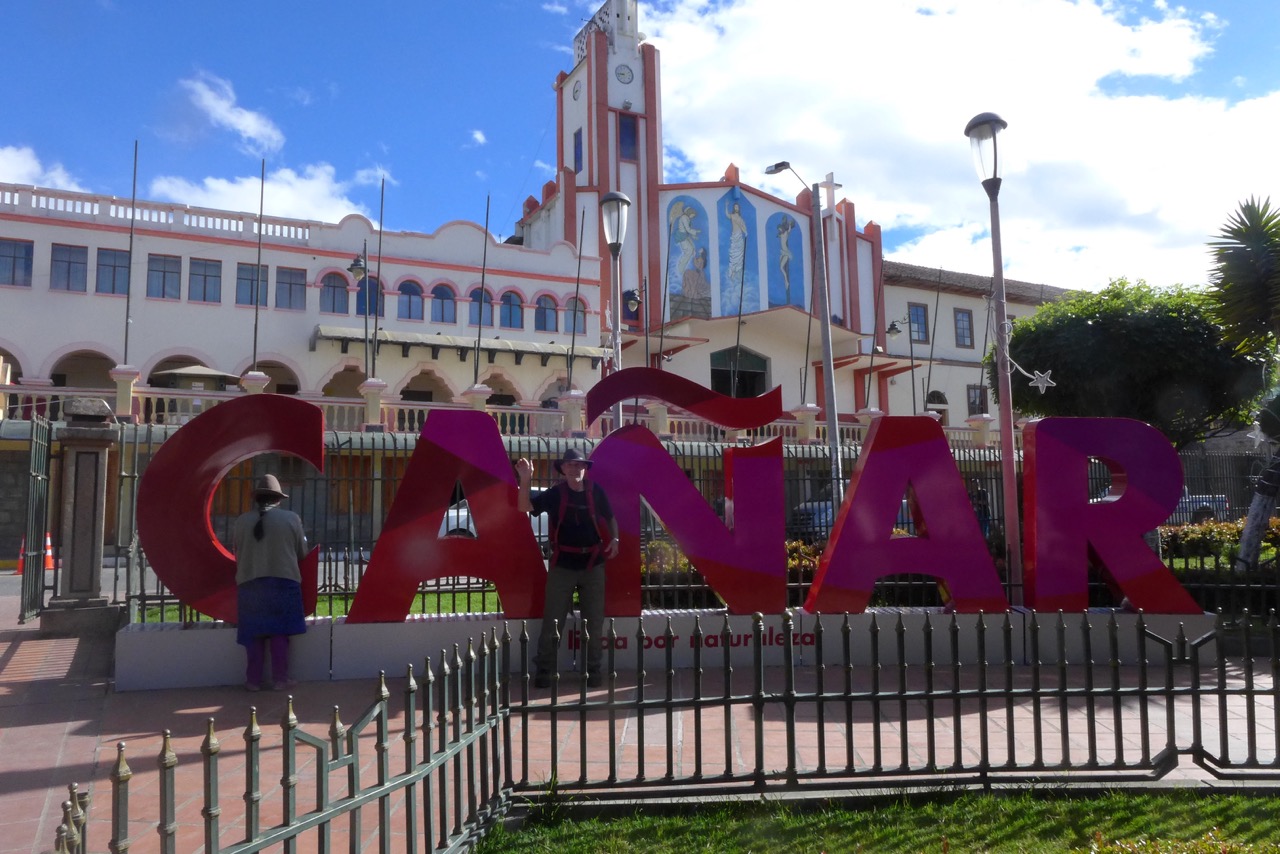
That’s Michael, between the A and ˜N, giving you a New Year’s wave.

Dear Friends: In reading over last year’s January post, I find our holiday life in Cañar follows a pattern. For reasons I don’t fully understand, we are not invited to family and community celebrations. Last year I thought it was because no one knew we were here, having changed our Cañar schedule. This year, however, most everyone knows we are here, but still… no invitations. Maybe because family and comuna circles are so tight, and customs so fixed, it just doesn’t occur to invite the gringos who come and go and don’t have an extended family here (poor things).

But why am I complaining? Almost all events happen at night, with lots of waiting around in the dark and cold, often with loud canned music, along with regular bombas (comets with one loud BANG) and fireworks. Usually, a meal is involved, which doesn’t reach the table until 11:00 PM or so, when Michael and I only want to be at home in bed. (I saw in the news that this holiday season 80 children and young people were injured by fireworks  – many homemade such as these bombas.) So I have taken the initiative to “invite” myself to certain events as a photographer, this year with an intern from Oregon State University, Buddy Terry. First, we shot and filmed Kapak Raymi, the mashup of an indigenous, secular and Catholic celebration of the December solstice (see last blog). Last week we shot the Año Viejo (New Year’s Eve) procession from village to village in Quilloac. As we struck out, climbing to about 11,000 feet at (what felt like) a 45-degree angle, I was happy to have 21-year old Buddy keeping up, because I was left behind, panting, beside the road. Near the highest point, a truck came by and someone gave me a hand and pulled me into the back.

This might be my favorite Cañar event of the year, filled with masks and costumes, musicians, and the fun of men dressed as women (below) and women as men, and jokes at every stop along the way. It’s totally in Kichwa so I don’t understand much, but I think some of the good-natured jokes might at my expense. At one point Pedro Solano, one the leaders, called me up beside him and said, “You know, here in Cañar ‘gringo’ is not an insult. It just means a person who knows nothing.”  I wasn’t sure how to take that.My comadre Mercedes Guamán, president of Quilloac cooperative, along with other leaders, led the procession, carrying “El Niño” (Christ child) on a little chair for hours and hours, from village to village. At each stop she would enter the casa comunal (community center) to remain while the crowd enjoyed jokes and music from an improvised stage.

Each community makes a tableau, also meant to be humorous, with straw-stuffed figures and signs having to do with current events, or complaints about the community, such as migration or lack of water.  Here’s Buddy at the first stop. Part of the fun is that everyone stays in character all day, with their masks and disguises. This “old man,” for example, with his two sidekicks, walked bent over with his stick the entire time. At each village he would mount the stage and make jokes in a high quavering voice.This guy played tirelessly (same tune) for about 4 hours, never removing his wonderful mask, and I couldn’t stop photographing him at every stop.

Finally, the fog and rain that had been threatening all afternoon caught up with us, and while the procession continued on for an evening outdoor program of music, dancing, fireworks and burning of giant effigies, Buddy and I headed home. 

*  *  *  *  * 

Cañar Book Club

As promised, we called a meeting of the virtual Cañar Book Club earlier this month. For myself, I can report that Alan Lomax: The Man Who Recorded the World, by John Szwed, was crammed with every detail of Lomax’s professional life, but very little about the man himself – my hero of oral history and ethnomusicology. And only one pinche photo in the entire book of a man who lived a long life (1915-2002) in interesting places. An antidote to that tome was the novella, Mothering Sunday by Graham Swift. Recommended by fellow member Maya before I left Portland, I consumed this sweet read in a couple of days, Michael – the slow reader – did the same in about five days, and now I’ve loaned it out to a friend in Cuenca and recommend it to everyone I know. A book club member in Portland has just finished it, and she posed some narrative questions that M. and I still talk about. It’s that good, so do read it! (Guardian review here.)

Then, a complete change of pace with Astoria, by Peter Stark – a horrifying true account of the John Jacob Astor’s effort to establish a fur trading empire in the Northwest (1811-14) sending out overland and by-sea expeditions. You think it can’t get any worse, then it does. Not brilliantly written, but well researched and a page-turner. I’ll never feel the same about the price paid by the Native American tribes in conquering our corner of the world.

Now I’m into In the Country of Men, by Hisham Matar, the story of a young Libyan boy in Tripoli in 1979. Beautifully written and taking me into a world I know little about.

OK: recommendations from you all. These from an apparently inexhaustible reader in Boulder: The Looming Tower–Al Qaeda and the Road to 9/11, by Lawrence Wright. The Way of Strangers–Encounters with the Islamic State, by Graeme Wood. Heretic–Why Islam Needs a Reformation Now, by Ayaan Hirsi Ali. The Strange Death of Europe, by Douglas Murray and God is Not Great, by Christopher Hitchens.

From a reader in Bend: The Heart’s Invisible Furies by John Boyne: “heartfelt saga about the course of one man’s life, beginning and ending in post-war Ireland.

And from another, always adventurous reader friend in Patzcuaro, Mexico: Home Fire by Kamila Shamsie (a great flight read), Signs Preceding the End of the World by Yuri Herrera’s and The Transmigration of Bodies Among Strange Victims by Daniel Saldaña Paris.

Two readers have recommended Oliver Sacks’ last book of essays, River of Consciousness, which I can’t wait to read. I am still mourning his death. 

Finally, with the cold weather lockdown, another friend in Portland reports she read:  Mrs. Fletcher by Tom Perotta & The Outlander by Gil Adamson. “Good winter reading. Passed the time. Not particularly memorable but good stories.”

I feel I’ve forgotten some others, so please keep our book club readers up to date on your latest literary likes and dislikes.


Winter light, summer solstice

Dear Friends:

Today (well, two days now) is December 21, the shortest day of the year for most of you, but here in the Southern Hemisphere the solstice marks the beginning of summer. According to the ritual calendar of the Cañaris, Kapak Raymi is the second in the cycle of four raymis that mark the agricultural year that began in September with the planting of the crops. An intern from Oregon State University, Buddy Terry, and I spent a seven-hour day documenting the Kapack Raymi celebrations at a large school in Quilloac, sharing a lunch of guinea pig, walking a few miles, and shooting hundreds of photos and hours of video. We began with a morning outdoor ceremony (pictured above) that was a mix of Inca lore, Cañari ritual blessings (guy on right in white), giggling Cañari princesses and voice-over announcements by school administrators.In the afternoon we photographed a procession from the church in town to the school, about 4 kilometers, that took several hours. Pase del Niño Viajero is a Catholic tradition introduced by the Spanish that re-enacts the journey of Mary and Joseph with baby Jesus through towns and villages. Over the years the tradition has become a mix of the sacred and profane, incorporating many aspects of commercial North American Christmas. There was Mary on her donkey with a baby-Jesus doll, and a king or wise man or two, on horseback.

The rest of us walked, including these two little angels, along with anxious parents of near-toddlers dressed as santa clauses, campesinos with miniature live chickens, ballerinas, animals and more.

The older kids brought up the rear, dressed as priests, shepards, princesses and, for lack of a better costume, boxed presents. As the afternoon wore on the sky grew darker, the clouds came down, the little ones grew tired and so did this photographer. By 5:30 we were back at the school, where the dancing and music and fireworks were just getting going, but it was cold and dark, and for me time to come home for a glass of wine, the fire, and Michael. Buddy packed up his gear and headed for Cuenca, happy with his first day of a two-month internship.

★ ★ ★ ★ ★ ★ ★

OK, Back to summer. It’s been in the high 60’s this week and everyone is complaining about the heat. Once you are accustomed to dressing in jeans, sweaters, jackets, boots and hat, with daytime temps in the low 60’s, having to peel off layers while sweating in the sun is a big bother. Being this close to the equator, our year-round twelve hours of daylight don’t vary much (we get an extra 15 minutes on December 21). But in the Andes “verano” or summer, means the dry season, or no rain. While in the coastal areas the solstice brings the rains, and so the season there is called invierno, or winter. Confusing.Our neighbors are complaining about this verano, as many have already planted crops. But until it rains they have to irrigate their fields with revolving access to water – about every two weeks. Our compadres planted this beautiful crop of fava beans in our back field before we came, and you can see the effects of regular irrigation. ★ ★ ★ ★ ★ ★ ★

Some of you will remember we had a serious chimney fire a few years ago. Since then Michael has been musing on the problem that our fireplace was constructed without a clean-out door for access between fire box and chimney. Fireplaces are rare in Cañar, and ones that work even rarer – I’ve seen many an artificial flower arrangement sitting in the fireplaces of middle-class houses, while most country folk gather around the open fire in their kitchens on especially cold days. After we had a second, less-serious, fire a year or two ago, it was obvious we had to find a way to clean the soot and creosote from the fireplace flue without a clean-out door.

So this year Michael brought a special wire brush from Portland – too small a brush, judging by the photo on right – and by coincidence the day he went up on the roof I was reading about a 19th-century occupational hazard of chimney sweepers called – horribly -soot wart, a squamous cell lesion that leads to testicular cancer. A Dr. Percival Potts in 1775 made the connection between the exposure to soot of chimney sweepers, often young boys 8-12 years sent up the chimneys wearing only trousers and shirt, and occasionally naked, and cancer in later life. Social reform came with the Chimney Sweepers Act of 1834. Well, Michael was not naked, nor did he go up the chimney, but he did build a special ladder to get onto the second level of the roof, where he had to remove all the delicate ceramic tiles before he could get to the chimney.


He kept a hose handy for the first couple of nights, knowing the debris had been dislodged from the chimney flue but caught on the interior smoke shelf. Again, a clean-out door would have prevented this problem, a solution that would require totally rebuilding the fireplace and chimney.

However, all’s well that end’s well – and so from the warmth of our fire to yours, we send fond Season’s Greetings!

Not sure if my comment field is working. If not, please send replies directly to me at: judyblanken@gmail.com.

PS: Cañar Book club will return in January.

Greetings from Cañar – Year Twelve!

Dear Friends: We arrived in Guayaquil late afternoon on November 28, welcomed by a 5.2 earthquake and the intermittent racket of ripe mangos falling on the roof of our hostel during the night. The next day we rode up 10,000 feet to Cañar in a hired car. Here, with the inevitable altitude-induced headaches for a day or two, we settled into our annual drill of opening the shutters, checking which systems were working (gas, water, lights OK), which were not (Internet, printer not OK), and which critters had moved in while we were gone. Last year it was mice. This year no mice, but avian occupiers were in evidence by a beautiful birdnest in my straw hat left upside down in a basket on the coat shelf. 
After a couple of days I carefully took down the basket and peer in to see two perfect eggs. I’m afraid we’ve scared away the parents as I’ve seen no sitting birds since we arrived. I try to imagine the small birds that regularly fly through the narrow opening under the glass-covered patio making this exquisite work of art – collecting the larger outer twigs for the superstructure, then the finer brushy plant matter, and finally “feathering the nest” with soft fuzz and feathers to hold the eggs. Maybe it was one of these birds we see all around, which Michael identifies in Birds of Ecuador as the Rufous-Collared Sparrow female.  (OK, my bird photography not great, but I plan to get better.)A day or so after we arrived, when our regular helper Patricia came to clean the house of dust and cobwebs, she accidentally vacuumed a railroad spike off a tall bookshelf onto a laptop I’d left sitting, closed, on the bench below. Neither of us realized at the time, but the point of the spike must have fallen directly onto the translucent apple logo. Later, when I later opened the laptop, I found a shattered screen,  but with the hard drive still working. I would imagine most of you have never seen a laptop screen shattered with a railroad spike (collected during our railroad walking years), so for the historical record, here it is:

I’ve looked up the translation – punto de ferrocarril – to explain to the Apple tech next time I go to Cuenca, but I don’t have much hope the screen can be fixed here, (though I did see a Youtube video of someone replacing a MacBook Pro screen with a heat gun, suction cup and tiny screwdriver. Scary!)

Otherwise, life in Cañar takes on its usual routines. We puff up the hill into town a couple of times a day – Michael out early to forage for food for dinner; then planning, cooking and chopping wood and making the fire; me at my laptop in the mornings, then out and about in the afternoons. “You back already?” we hear from shop vendors, taxi drivers, neighbors. “How long this time?”

Finally, I want to thank all of you who contributed to the Cañari Women’s Scholarship Fund this past month. We’ve done well in fundraising this year, and later in December our local committee will meet to review new applications and consider raising the monthly stipend for our current twelve scholarship women. I forgot to mention in my letter that one of our early graduates, Mercedes Guamán, a lawyer, represented Cañar and Ecuador at the three-week-long United Nations Permanent Forum on Indigenous Issues in May. We congratulate her!     (And keep reading for the Cañar Book Club blog that follows). 

Cañar Book Club

Well, the virtual Cañar Book Club has been on hiatus for six months, and it’s long overdue for a meeting. Welcome back! Here is the selection of books I’ve brought from Portland for your consideration and my pleasurable reading. Some are from your recommendations, such as Ornament of the World, In the Country of Men; most from reviews or my particular interests (Alan Lomax bio); at least one was a gift (Cannery Row), and the last three from an unplanned quick stop at the PDX library bookstore, with some time to spare before meeting a friend. The rest I have absolutely no idea why I bought them. I’m just finishing, and loving, When We Were Orphans by 2017 Nobel Prize winner Kazuo Ishiguro.

So please let me know what books or reviews or articles you are reading, and – as always – I appreciate your suggestions for my 2018-19 list.

  1. The Burnt-Out Town of Miracles, Roy Jacobsen
  2. Gloaming, Melanie Finn
  3. Caleb’s Crossing, Geraldine Brooks
  4. Before the Fall, Noah Hawley
  5. In the Country of Men, Hisham Matar
  6. Baltasar and Blimunda, José Saramago
  7. The Sympathizer, Viet Thanh Nguyen
  8. That Bright Land, Terry Roberts
  9. Alan Lomax: The Man Who Recorded The World, John Szwed
  10. Cannery Row, John Steinbeck
  11. The Life-Writer, David Constantine
  12. Ornament of the World: How Muslims, Jews, and Christians Created a Culture of Tolerance in MEdiieval Spah, Maria Rosa Menocal
  13. Astoria, Peter Stark
  14. The Invention of Nature: Alexander Von Humboldt’s New World, Andrea Wulf
  15. Victor: An Unfinished Song, Joan Jara
  16. When We Were Orphans, Kazuo Ishiguro
  17. Commonwealth, Ann Patchett
  18. An Atlas of Impossible Longing, Anuradha Roy
  19. Every Man for Himself, Beryl Bainbridge
  20. Travels in Vermeer: A Memoir, Michael White
  21. The Discomfort Zone, Jonathan Franzen
  22. The Farming of Bones, Edwidge Danticat
  23. Our Man in Havana, Graham Greene

The reply field below is now working – and I love feedback.