2017 Cañari Women’s Scholarship Foundation Annual Letter

Dear Friends: It’s been a great year for the Cañari Women’s Scholarship Program. Thanks to so many of you, nineteen indigenous women have earned professional degrees from Ecuadorian state universities. Two others will graduate in 2018, and we’ve accepted four new scholars to keep our roster at twelve.Graduations are the most exciting times, as all our women are required to complete five years of coursework and a thesis or internship, at great sacrifice to them and their families. The 2017 graduates pictured below are Nelva Solano, standing proudly with her parents and a diploma in communication, and Maria Esthela Chuma with a degree in nursing. Maria is a single mother with a 12-year old (center photo below), and she’s had a long hard road getting to this point. But now, as a registered nurse, she can look forward to financial security for herself and her son and being able to help her mother and grandmother, pictured below at her graduation.

Three years ago we began offering our graduates financial help for advanced degrees, and two have just finished: Pacha Pichisaca (l) with a specialization in dentistry, and Veronica Paucar (c) with an MBA in international business. Both are mothers with full-time jobs, so they completed low-residency degrees, traveling on weekends and evenings. Juana Chuma (r) is a first-year graduate student in Mexico in veterinary medicine. Our first international scholar! We will continue to offer a helping hand of $1500 a year to up to three graduates a year to pursue advanced degrees

. OK, let’s meet the “newbies.” As I wrote last year, a 2008 education reform law made state schools tuition-free, but students are now offered admission according to their test scores and chosen fields – in schools often far from home. Elizabeth is studying “food engineering” at University of Carchi, near the Colombia border and a 14-hour bus ride away. Maria, civil engineering at the University of Guayaquil; Gladys, human nutrition at University of Milagro, and Nube Sumba in economy at University of Chimborazo in Riobamba. These women have been carefully selected from a pool of financial-need applicants to receive a $160 monthly stipend for five years, plus a $500 bonus to cover costs of their last year and graduation.

For those of you who are new supporters, I want to revisit our “origin story” and give an update. The first version of the scholarship program was established to honor the memory of our good friend, Ana Margarita Gasteazoro, whom we met in Costa Rica while I was working there. A political refugee from El Salvador, Ana was active in the violent conflict that roiled her country in the 1980s, spending 18 months in prison without charges before being released in a general amnesty in 1983.  Ana told such incredible stories that we spent the next five years recording her oral history. The key story: when she finished high school, Ana’s father told her he had to send her three brothers to university because they would eventually need to support families. But he could not afford to send Ana because, he said, she was a woman, who would marry and be cared for by her husband. Ana never married and she never forgot this injustice. In 1993, when she died in El Salvador of breast cancer at age 39, we were living in Ecuador and the idea for a women’s scholarship program was born. All these years later, her oral history is finally being published in Spanish in El Salvador by MUPI (Museo de la Palabra y Imgén), and an English version has been submitted to the University of Texas Press.   Que viva Ana!

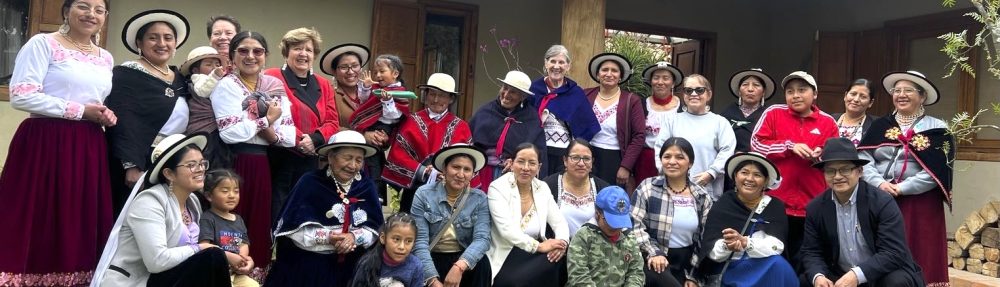
Every year we have an all-scholarship meeting for graduates and current students. The latest meeting in May 2017 (photo at top of page) represents our selection committee (3 graduates, two outside members, myself), fourteen current students and our nineteen graduates in law, medicine, accounting, nutrition, natural resources, economy, nursing, veterinary medicine, dentistry, business, agronomy and psychology – an impressive list! In the photo above, we are sharing the communal pampamesa lunch after the meeting.

A new member of our education foundation family is the Women’s Giving Circle of Bend, Oregon. This group learned about us several years ago when one of their members visited Cañar. In July, Michael and I went to Bend to meet this group of seven wonderful women. Every few years they choose an organization to support that is making education possible for women and girls who would not otherwise have the opportunity. Luckily, they have chosen CWEF to support with monthly contributions for the next few years. Bienvenidas Círculo de Apoyo, and I hope you all will come visit us in Cañar!  (Note: Michael and I are off to Ecuador on November 28 and I’ll begin my regular Cañar Chronicles in December.)

The Cañari Women’s Education Foundation is an official 501(c3) nonprofit, which means your contributions are tax deductible. We have zero administrative costs other than this mailing, so every dollar goes directly to the women. You can donate through PayPal with the  “donate” button below. If you’d like to make a direct bank transfer email me at judyblanken@gmail. (Finally, forgive me for cross-posting. Some of you will also receive this letter by snail mail and others by email. I haven’t yet figured out the perfect system.)

Best wishes to all, and again – heartfelt thanks for your ongoing support,   Judy B.


The weather, a wedding and books

Dear Friends:  It has been a long period of extremely cold, rainy and foggy weather in Cañar, with the temperature most days in the mid-50’s (F) and at night in the 40’s (F). Brrrr. Here Narcisa and José María plow our back field during the “dias feos” – ugly days. Michael has taken to building a morning fire and keeping it going all day until bedtime. We eat dinner in front of it, listening to KMHD jazz or Radiolab, and watching our films sitting there. Then, come @ 9:00, we rush towards the bedroom, sometimes one at a time, brush, jump into bed nearly fully clothed (that’s me), and read a book for 15-30 minutes. Then, before lights out, I peel off layers of (lately) an undershirt, two t-shirts, two sweaters, wool scarf, and I leave it all in a tangle, wrong-side-out, on the floor beside the bed.

We sink into good sound sleeps of around eight hours in the cold, dark and quiet. Next morning I only have to reach over and turn my clothes right-side-in and peel them back on, while still cozy in bed. Meanwhile, Michael is in the kitchen doing last night’s dishes and making coffee. In return for coffee in bed, I load Michael’s puzzles on my laptop: a NYTimes crossword and four KenKens (“puzzles that make you smarter), while simultaneously checking the headlines (oh no!). “COFFEE!” M. yells from the kitchen (unless we have guests, in which case the protocol is to come quietly to bedroom door). That is my signal to jump up, put on tights, and print his puzzles while I get my coffee. Then it’s back to bed for me while Michael has two double espressos with puzzles in his “chess corner” in the living room, still warmish after last night’s fire.And here I am at the moment. It is Sunday morning, March 5, and the brief sun has gone. Yesterday we were invited to a special wedding at Ingapirca, the Inca ruins about 30 minutes from Cañar that many of our visitors know. Although we have vowed, after all these years, to avoid baptisms, weddings, and graduation fiestas – all two-three day, late-night affairs – we went to this one for several reasons. Pacha, the bride, is one of our scholarship graduates and Juan Carlos, the groom, is someone we’ve known since he was 5 or so, back in 1992 when we attended his baptism fiesta. It was our first real invitation to a Cañari family event, and we were so thrilled we stayed late dancing and returned early the next morning to continue the celebration. We left Cañar soon after for a Christmas break in the U.S., and when we returned we learned that Juan Carlos’s father, a promising young agronomist, had died after a soccer-game kick that probably ruptured his spleen.

Meet the bride and groom, or “novios” as they say here. (That’s Mama Michi on left.)Pacha and Juan Carlos have an interesting story. They got together too young in high school, had a baby who died, went their separate ways, got back together, Pacha applied to the Cañar Women’s Scholarship Program in her second year of dental school at University of Cuenca, and we supported her through four more years and a specialist course – she now has a thriving practice in Cañar – during which time Juan earned a master’s degree in music and they had a beautiful daughter, Naomi, now nine. Naomi led the wedding procession as we wound our way through the archeological complex, stopping for ritual ceremonies at various points along the way. OK, so why get married…again? After 13 years, and a second child born a year or so ago. They surely had a civic marriage at some point, but in the eyes of Mama Mariana, Juan Carlos’s mother, a widow so proud of her three professional children, and the Catholic Church and maybe even the Cañari community, Pacha and Juan Carlos were not really married until…well, something like the ritual of yesterday. It was all very orchestrated, a mix of La La Land fantasy with music, flowers and flames and flags and dancing. But we all loved it, along with the lucky tourists in Ingapirca yesterday. Michael and I skipped the all-night fiesta at Pacha’s parents’ house, as we are skipping the mass today and will miss another late-night fiesta tonight at Mama Mariana’s house. Our stamina for such events – and mine as documenting photographer – is not what it used to be. But here we were: me with a brother of the bride; Michael with the groom.


Cañar Book Club

OK, we are WAY overdue for a meeting of the Cañar Book Club, and I apologize to my fellow members for being so long in calling a meeting.
However, I have been faithfully collecting the amazing list your good reads and suggestions. My own reading has been all over the place, from A Hologram for the King by Dave Eggers (hated it! although I’ve liked most everything else of his, but can’t believe such a boring story has been made into a movie with Tom Hanks). Then, desperate for a change of pace, I read Tana French’s Faithful Place. For years I’ve heard about her writing and her Dublin-based mystery stories. Too long, but I was captivated as much by the vernacular voice of her protagonists (e.g. incredibly creative cursing) as by the story. She’s great. Now Michael’s reading it, and I have her In the Woods on my bedside pile. But my best read by far the past few months was The Secrets of Mary Bowser, by Portland author Lois Leveen. A historical novel based on a real person, I learned a lot about the Civil War south as seen through the eyes of an ex-slave turned spy for the Union.

Your reads: (I fear I’ve missed some of your book club messages. Please send  anew, with updates…)

From Andrew in London: July’s People by Nadine Gordimer – humanistic, incredible writing.

 From Lisa in LA: That Bright Land by Terry Roberts and quite enjoying it… about a small North Carolina town post-Civil War and a former Union soldier sent there to discover who is killing Union veterans.

From Maggi in Toronto: Station Eleven by Emily St John Mandel and… just finishing The Intuitionist by Colson Whitehead – most interesting.

From Susan in PortlandBarkskins by Annie Proulx. A huge tome, 700+ pages. Deals with the European attitude toward the natural world, focusing on the huge forests in the northern New World.

From Daphne in EdmontonAnn Patchett’s new novel Commonwealth. It’s very interesting, a good read.

From Shoshana in Portland: My Antonia (Willa Cather)…because I have always loved her simple and rich writing style, rich with similes, where the reader can feel, taste and sense the surroundings.

From Joan in Corvallis: Mary Weismantel’s book  Food, Gender and Poverty in the Ecuadorian Andes.

From Ed in Quito: Lost Crops of the Incas-Little known plants of the Andes with Promise of World Wide Cultivation y Huasipungo by Jorge Icaza which was influential in describing the abuses of the hacienda system.

From Sandy in Portland: Citizen, An American Lyric by Claudia Rankine. Brilliantly written, difficult to read, but her writing leaves you not just with greater intellectual understandings of racism, but feelings. I have read some other good ones lately, but this one is the one that had the biggest impact on me.

From Char in Santa Fe.: Mariette In Ecstasy by Ron Hanson, 1991.  I love it for thedaily routine of the nuns. The tag line is “Exquisite…a cliff-hanger of a story..the finale is a stunner.”

From Irene in Salem: Maisie Dobbs series by Jacqueline Winspear. They are best read in a series. Well written and I do like mysteries.

From Patty in Portland: An Atlas of Impossible Longing, by Anuradha Roy, another great read and terrific title and also The Folded Earth (2011) by Roy, which I haven’t yet read.

From Maya in Portland:  The Return: Fathers and Sons and the Land in Between, by Hisham Matar, a memoir by a Libyan who’s father was thrown into Kadaffi’s prison, which was one of New York Times’ best books of the year, and it is totally compelling.

From ??: The Dream of My Return by Horacio Castellanos Moya.  It’s got that signature modern Latin American technique of continuous first person narrative in an almost hallucinogenic pace. The protagonist is an exile in Mexico City considering returning to El Salvador.

And to end with Maya from Portland who writes, given these times:  Thank goodness for good books!


Happenings elsewhere

Dear Friends:  You’ll note by the header image that my horizon has recently expanded beyond Cañar. As far north as Quito, where I spent several days last week in happenings related to both archive/business and pleasure. Pleasure first: a celebration of the 60th anniversary of the Fulbright Commission in Ecuador. When the evite that came a few weeks ago said: “cocteles between 7:00-9:00″ I imagined a circulate-and-chat event with wine and cheese bits and maybe a few words from the Commission director, Susana Cabeza de Vaca. When the locale on the evite said “Convento Santo Domingo” I imagined a smallish space – maybe the refectory – where nuns had once lived and shared their meals in silence. And when, the week before, an email came from Susana asking if I would speak “for five minutes” about what my Fulbright grants have meant for my life and work, I imagined a stand-up, informal, shout-out with cocktail glasses in hand. So I made a reservation at a nearby hotel for the night of the event, packed a skirt that I’ve never worn in chilly Cañar, my best Goodwill-find French top, espadrilles from Spain as good shoes, and Mom’s pearl and silver necklace made by my nephew Demian. The first surprise was the locale of the event – no austere convent this but a grand church built by Dominican friars in 1581, with Moorish ceilings, wood carvings, a gold and silver altar along with an adjoining monastery and beautiful formal gardens. The church sits on the southeast side of the Plaza Santo Domingo where, with sweet symmetry, Michael and I stayed when we first arrived in Quito in 1991. (We were robbed on the street the next day.) Because the evening was raining and cold and churches and monasteries are not known for their warmth, I gave up the idea of the skirt and espadrilles and put on pants, double socks, no-nonsense shoes, jacket and wrapped a silk ikat shawl for a touch of finery.The next surprise was the crowd! For over an hour about two hundred and fifty invited guests filed into the cloister entrance, dressed in suits and evening wear, and lined up to greet director Susana before being escorted into the church. I began to suspect that I was not in Kansas anymore when I was told to sit in a front “reserved” row and saw a podium on the altar with stage lighting. “Are we speaking up there?” I asked a friend from Cuenca I’d not seen for years who sat beside me, Francisco Salgado. Yes. He too was to speak as an Ecuador Fulbrighter who is now president of a university. As the audience was still gathering, I had time to walk up to meet the master of ceremonies and check the light on the podium, as I would read my little five-minute talk. “Here’s the program,” he said, “first Susana speaks about the history of the Fulbright program, then the American ambassador, then the mayor of Quito, then Doctora (so-and-so), then the Government Minister (of something or other), then I’ll introduce YOU.

The next surprise. The “five-minute talks” were way longer – some honorees read nervously, while others extemporized charmingly. Susana Cabeza de Vaca spoke of the “Fulbright family” of 3000 Ecuadorian grantees since the program began 60 years ago. Much beloved for her dedication, she was given a lifetime award from U.S. ambassador Todd Chapman, who also made a gift of $50,000 to the Commission for projects in Ecuador.

I kept sneaking a look at my little speech, which my Quito friend Marta had edited in Spanish. Everyone else had started by greeting all the dignitaries, one by one and by name. No way I could manage that. “Buenas noches todos,” would have to do. As the program progressed I realized I was there to represent those US Fulbrighters who had come from the north, I being the poster child of one who had stayed and made a life here. I sat waiting nervously, wearing black wool gloves; our breezy “reserved bench” was directly in line with the open archway to the garden. Then I was introduced, removed my gloves, took a deep breath, mounted the podium, squinted into the lights, and began: “Buenas Noches todos!”

Finally, a priest from this grand church gave a short talk and benediction, reminding us that the Dominicans have been around for 800 years, they too dedicated to education. This very monastery complex was, in fact, the first university in Quito, Universidad de Santo Tomas. The genial Spanish priest was wearing a vestment and cape that looked much like this image from Wikipedia.

Whew! It was about 9:30 when we were finally invited out into the colonnade around the garden (still rainy and cold) for the promised “coctel” – and a toast by the ambassador. Ah, a glass of wine at last. A second glass of wine at last. OK, one more and that’s it! My hotel was only steps away and everyone was so charming and here was the circulating and chatting that I’d imagined. It was a wonderful event and I was happy to be a part of it. Great thanks to my good Quito friend, Marta Alban, who made my speech better, to Ana Maria and Ted, who hosted me the first two days, and to all other colleagues and new friends whom I met around the archive project. I’ll write more on that next time AND get back to the Cañar Book Club.

Meanwhile, there’s another pressing subject:We are in the midst of a national election in Ecuador – voting on February 19 – and, other issues aside, it is refreshing that the campaign only started a couple of weeks ago – in Cañar at least – with a few trucks circulating with speakers blaring and party flags flying. I’ve seen one party office in town, and no doubt there’s radio and television coverage that Michael and I know nothing about, although we will both be voting. There are six candidates for president, replacing Rafael Correa a “populist-but-increasingly-authoritarian” figure who has been in office nearly ten years now. Which is not to say his party, Alianza Pais, is going away anytime soon. The candidate favored to win is Lenin Moreno, who served as vice president from 2007 to 2013 and has since been special envoy to United Nations on disability and accessibility. A shooting in1998 left him paralyzed and in a wheelchair. (He’s on far right in the graphic above.) You’ll notice a woman in the line-up: Cynthia Viteri, who the polls tell us is in second place. Her central-right Christian Social party promises to make 800,000 new jobs by stimulating production activity along the Colombian and Peruvian borders. OK! Lenin Moreno only promises 200,000 jobs, but says he’ll improve the living conditions of senior citizens through a program called “My Best Years.” Come on!  Bottom line: Michael and I have some serious research to do before we decide on our votes. More details next time. Until then, stay in touch. I love hearing from everyone.

Grabado 1743, Banco Central del Ecuador.