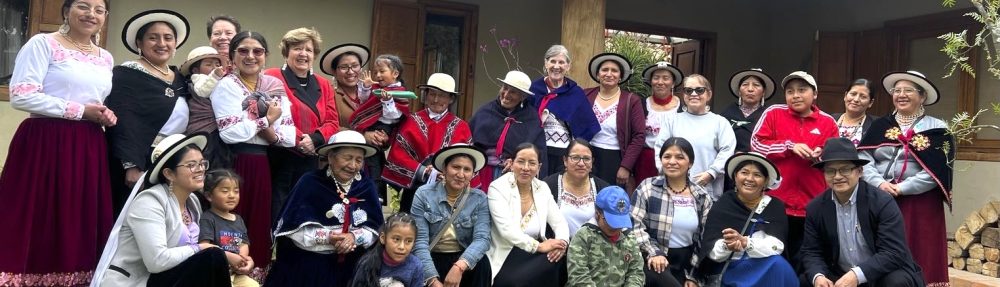
Dear Friends: I’m so pleased to report we now have twenty-one Cañari women university graduates, with professional degrees ranging from agronomy to veterinary medicine. Two of our alums have finished master’s and two are currently studying, one in Mexico and one in Ecuador. Our current scholars number twelve, and as they graduate we carefully review our pool of applicants and select new recipients. The scholarship is for five years, the usual time for an undergraduate degree in Ecuador.
Since 2005 our program has “lost” only two scholars; each suspended her studies for personal reasons. But we have a policy that they are welcome to return if we have a place. In other words, it’s almost impossible to fail in our program. Once a young woman is accepted as a scholarship holder, we make sure she succeeds by accommodating  pregnancy and childbirth, childcare, family crises and other problems – a policy that has paid off with our high success rate.This year we had two graduates, Vicenta Pichisaca in gastronomy and Mercedes Chumaina in accounting as a CPA. I add the photo of Mercedes receiving her diploma in her white hat because, as is usually the case, she was the only indigenous woman in her group (and maybe her class).
Mercedes was special in another way. Through a Christian organization in the U.S., Tom and Kathleen Easterday have sponsored her education since primary school. When I heard about Mercedes through her sister, Margarita, one of our scholars, I wrote to to ask the Easterdays if they would be willing to sponsor Mercedes through university. They were, and they did.
They  had hoped to attend her graduation in October, which was not possible, but they sent a generous gift and they are pictured here wearing embroidered shirts from Mercedes in thanks for supporting her education for over 15 years. In the photos below, Mercedes stands with her husband Noe and son on graduation day, and with her proud mother.

 So with two women graduating we welcome two “newbies.” Sara Duy is studying economy at the University of Chimborazo in Riobamba, and Lourdes Pichasaca in medicine at the University of Cuenca. Both have exceptional stories. Several years ago, Sara’s older sister had the rare chance (in Ecuador) for a kidney transplant after years of dialysis. Sara left her secondary studies to accompany her sister in dialysis and recovery from surgery, and they both lost two or three years of high school. Sara finally graduated this year and passed the exam to be admitted to university.
 Lourdes Pichasaca showed up with her mother at my studio several years ago. She had taken the entrance exam and passed high enough to get in to university, but not in the field she wanted: medicine. She decided to wait to apply for a scholarship and retake the exam. After that, whenever I ran into her mother in town, she would report that Lourdes was preparing to take the exam yet again. After three tries, she scored a place in the school of medicine at the University of Cuenca, one of the best!
Now for news of some older graduates.  Mercedes Guamán was one of our first scholars. She famously became a lawyer and a mother within hours (rushing from the podium with her diploma to the hospital to give birth) and since then has served her Cañari community with legal services and our program as president of the board. Under President Correa she was elected as an alternate to the National Assembly. After six years I think she’s a bit burned out on politics, but one perk was her invitation this year to the United Nations meeting on indigenous peoples in New York. In 2018 Mercedes also received an honorary degree in jurisprudence for her service to the indigenous community.
 Carmen Loja went in another direction. After graduating in economy at University of Cuenca, she had a stellar few years in finance, managing a credit union and ending up as comptroller for her hometown of Suscal. Then she left it all to create an organization promoting Andean culture through native agriculture, architecture, food and ancestral medicine. Kinti Wasi invites groups and individuals for stays long and short. (That’s Carmen- our favorite entrepreneur/ innovator – second from left.) Check out her website at: (https://www.facebook.com/kintiwasi.ec/
 Juana Chuma is our first to pursue a master’s degree outside the country, in Mexico, where she won a scholarship to UNAM in veterinary medicine. (We subsidize master’s studies at $1500/year for two years, or $3000 total). In the photo at left, Juana is in Puerto Montt, Chile with her research group. She writes that her thesis is focused on a cooperative of cattle producers in the south of Chile.
The Cañari Women’s Education Foundation is an official 501(c)3 nonprofit, which means your contributions are tax deductible. We have zero administrative costs other than this mailing, so every dollar goes to the women’s education. Please make checks to CWEF and send to Charlotte Rubin, 2147 NW Irving St., Portland, OR 97210 (some of you will receive this letter by snail mail with return envelopes), or you can contribute through PayPal with the secure “DONATE” button below.
A final note on this subject: A couple of weeks ago, CWEF treasurer Charlotte Rubin and I visited the Oregon Community Foundation (OCF) to talk about the idea of an endowment for our program. OCF has a plan for 501(c) 3 foundations such as ours that looks really good. It’s too soon to launch a campaign, but I would appreciate a note or call from any of you interested in discussing, or helping, with “succession planning.” I’m a novice!
Heartfelt thanks to all for your ongoing support, and don’t forget that you are invited to visit us in Cañar, any year between January and June. In a couple of months we will welcome two contributors from the Women’s Giving Circle of Bend, Oregon. And earlier this year we had a visit from Portland photographer Rick Rappaport, who took a bunch of beautiful photos during our annual all-scholarship meeting in April.


