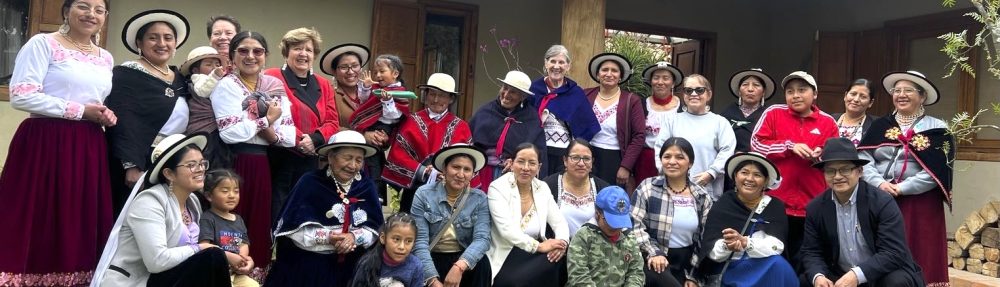
 Pawkar Raymi is the Quichua equivalent of Carnival, the celebration that marks the beginning of Lent in Catholic Church. In the indigenous cosmovision – world view, loosely translated – Pawkar Raymi marks the “flowering of the crops” planted earlier in the year and the promise of a good harvest ahead (with another fiesta at summer solstice called Inti Raymi). It’s all about abundance and sharing and my favorite fiesta of the year. Only in recent years have Cañari communities begun to recreate what they claim was a pre-Inca indigenous festival, co-opted first by the Inca invaders and then by the Spanish conquistadors and the Catholic Church. But as Pawkar Raymi always falls on the Monday before Ash Wednesday, and its name comes from the Inca language, I think it’s safe to say it’s a perfectly melded day of old and new traditions from far and wide.
 For me, it’s a long and arduous workday, beginning with a procession that starts early from a host community, usually deep in the country, picking up participants along the way as it winds through town and then out to a field prepared for a celebration that lasts far into the night of music, dancing, eating, and throwing cornstarch, water and canned foam on one another (more on that later). I usually take a break between morning and afternoon, come home for lunch to download my photos and charge the batteries. But my job is nothing compared to the work of the women who carry the cuynaña for hours and hours, a sort of cornucopia platform loaded fruits and vegetables, drinks and cooked cuys – guinea pigs, so important to Andean life. There’s one in the photo below, impaled next to a …chicken?
  Here’s the cuynaña from above in a moment when the women rested.
 When I first started photographing this fiesta, live cuys were dangled by their little feet around the platform, usually not surviving the day. After a few years, animal rights concerns put them in cages attached to the bottom of the platform, and now live animals seem to have disappeared altogether.
After lunch, it’s back to the field, where each community sets up a choza to offer food and drink to the carnavaleros. Over in one corner, women and men from the host community are cooking in huge pots on wood fires to feed about 1000 people. As I said, Pawkar Raymi is all about abundance and sharing.
 There I run into many familiar faces, and it’s one day where I’m allowed to photograph everyone without asking, In return, I give CDs of the photos to anyone who asks.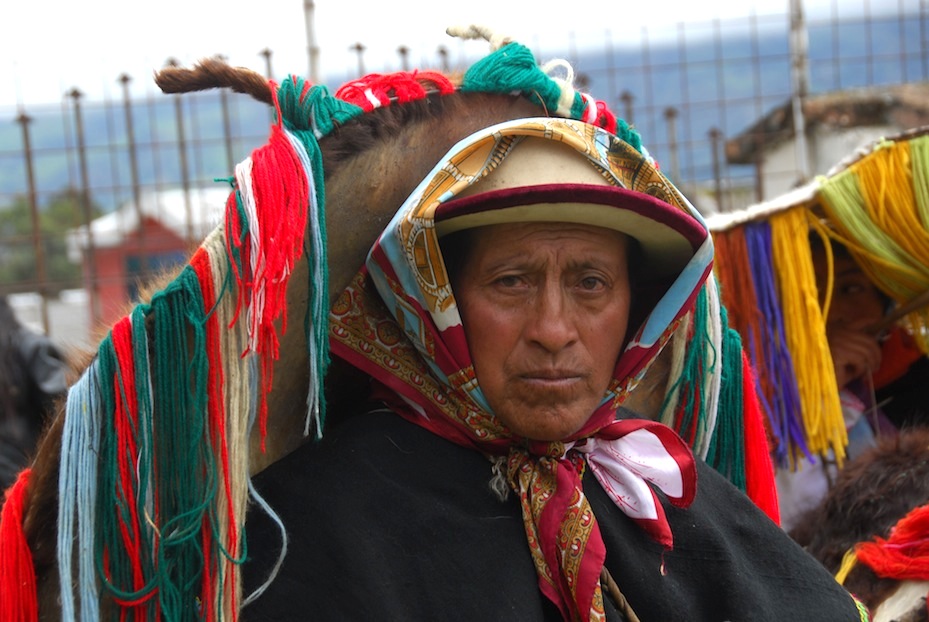
Families have spent weeks preparing for this day – the women making special clothing and the men fashioning flutes and drums and these amazing hats, made of cowhide stretched over a frame and decorated with everything from fresh flowers to cooked cuyes to deer heads and antlers.


Every year for over 20 years, my old friend Pedro Solano has brought out his Tayta Carnaval sombrero topped with a stuffed condor, each year more desiccated and missing more parts. 
By mid-afternoon it is raining hard, and I’ve finally had enough of trying to protect my gear while dodging cornstarch and foam sprayed from cans (called kareoke, for some strange reason), and I’m exhausted from shooting over 500 photos. I trudge home and say to Michael, “I’m not sure I can keep doing this every year.” But I know I’ll be back next year – walking backwards and stumbling along the road, trying to capture the procession as it heads toward me at a fast clip.


