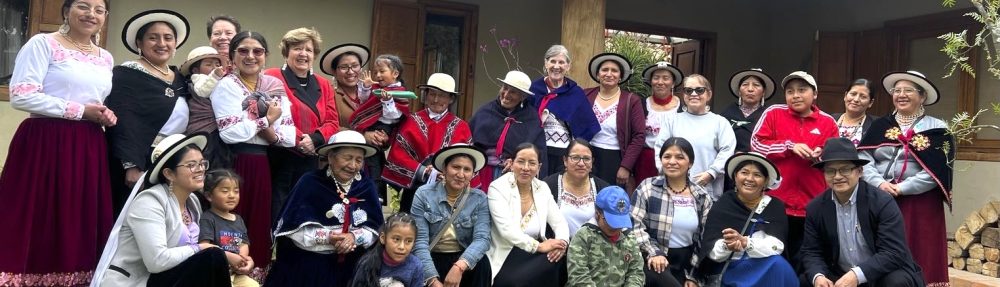
Goings on about Cañar

January is always a busy time here, what with the five-day Fiesta de San Antonio de Padua, held this month despite the fact his official saint’s day is June 13, when he died in Padua, Italy, in 1231. Then there’s the Fiestas de Cañar, an annual civic celebration lasting fifteen days, beginning with a cleaning of the city streets, ending with fireworks, and in between a handcrafts fair, lectures, soccer games, concerts, dances, a bull fight, and an long-long parade on January 26 to celebrate Cañar as the self-proclaimed archeological capital of Ecuador.Cañar capitalI gladly photograph it all, sometimes by invitation; and sometimes I get a call as the big parade is forming up: “Judicita, we’re hundreds of people from Quilloac getting ready to march. Come take some photos!”

foto 2Other times, I come upon things by accident, as today when I walked into town and stumbled on the finish line of the wooden car race, always held the last day of the civic fiesta, when hand-made wooden carts race down the Pan American from the high hill on the outskirts of town.wooden car wins

wooden car

But my favorite event is the Fiesta de San Antonio, held in the hamlet of Junducuchu high on the mountain, with its own saint – a tiny figure or “doll” found in a mountain crevice 100 years ago by a woman of the village, and venerated ever since. (Below: tiny San Antonio is behind glass…the figure alongside represents El Nîño, or baby Jesus.) tiny saint
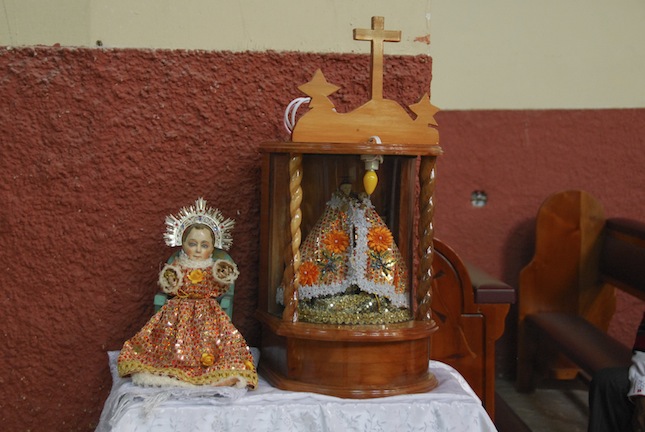
The tiny San Antonio lives with a host family that changes year to year, a transition marked by carrying the saint into town to the church to be blessed before being carried back up the mountain in the arms of the wife or daughters of the  prioste – the new guardian of the saint, who will also host the fiesta, including feeding hundreds of people several times in the course of five days.

two wm w saints

On a bright Saturday morning I joined up outside the church, where the vacas locas gather and dance while waiting for the saints and village leaders to emerge from the blessing. Men and boys prance around as huge “crazy cow” puppets, mooing and snorting, or pretending to poke onlookers, as a town band plays. These wonderful vaca locas are hand-made of cow hide stretched over a wooden form, with papier mâché heads, decorated in inventive ways, and a wooden bar across the front for the dancers to hang onto and maneuver for the hours they must be carried.

.dance of vacas locas vaca loca closeupMeanwhile, other figures join in, and onlookers gather, waiting for the taytas or community leaders to emerge from  the church

desfile de iglesia taytas in front of churchAfter a short march around the town we start up the mountain, the band playing nonstop. Meanwhile, another group has left the village to come down to meet us. This procession includes boys and girls, dancers, a man carrying a maypole, a trio of flutes and drum, accompanied by various other characters, such as the rukuyayas, or clowns, who make mischief as long as the fiesta lasts:

yucuyaya  rukuyays

And the bands:

band on hillside  flute + drums

And this wonderful old man, who appears every year in his mask and vaquero, or cowboy, gear, of rope and chaps. He dances for hours and hours, sleeps a bit sitting up, then dances some more. One year he grabbed onto me to dance, and insisting on calling me his warmi, “woman” in Quichua.

tayta con mascaraWell, this is only one day of the fiesta and I’m usually worn out by the third day. All this January activity wraps up in time to prepare for Carnaval, the biggest Cañari fiesta of the year, celebrated the Monday before Lent. This year it is mercifully late, on March 5.

We’ve had a month of brilliant weather – sunny and warm but so dry that the farmers around us badly need rain. They plow and plant in January anticipating the rainy season, which should have started before now.

One of the goings on I came across the other day was a minga, a cooperative work day that is part indigenous tradition, part hacienda custom, I suspect. Everyone in a comuna is called out to work, in this case on an irrigation project. The old way was to blow on a conch shell, called a quipo. Now they probably use cell phones.

boy w conche

Those who don’t work must pay a fine, or send a laborer for which they pay. I came across this scene the other day near our house – maybe two hundred people digging up old and broken concrete irrigation pipes, to be replaced with plastic ones. They live in a village far down the mountain, and no water has reached them during this drought. When I came by later in the day, the pipe was laid and the ditch covered. Irrigation is, and has always been, the life’s blood of agriculture, and of rural life. Next week there will be another minga near our house, and we were told we will be expected to colaborar – collaborate, meaning either work or make a contribution. Stay tuned!

minga


Breathless in Cañar

When I posted these photos on Facebook the other day, with the caption “Culebrillas Lake at 4000 meters,” I meant to add “breathless,” which is how Michael and I felt hiking around this spectacular landscape earlier this week with our friend, Lynn.Culebrillas  M. wi lake Paradones M & me culebrillas

It always takes us awhile to adapt to the altitude here (Cañar is at 3,100 mts. or 10,170 feet), but we normally wouldn’t attempt 4000 meters (13,123 feet) within ten days of arriving. However, the road to Lake Culebrillas is notoriously bad, and only during the dry season can a four-wheel-drive vehicle safely traverse the two hours of pot-holed, rocky, rugged, heart-stopping-drops, landslide-vulnerable track called a road. For days, we’d been watching the clear views of the high mountains from our north windows, the same you see at the top of this blog. The lake lies behind the highest ridge, in an intermontane valley, and is the site of the myth of origin of the Cañari people. When we called Lynn to suggest that we take the opportunity of good weather for a day trip, she agreed, driving up from Cuenca with her dog, Ariel, to spend the night so we could get an early start.

Michael and I haven’t been to this lake for years, but it played a part in our very earliest years here, when we organized an overnight camping trip with our first Cañari friends, my photography students and their spouses and siblings. We were a group of about ten. The truck we hired couldn’t make it all the way, so we ended up walking overland. The Cañaris (with their big lungs and oxygenated hearts) leaping over the páramo grass while carrying a large tarp, pots, food, our packs (mine with a heavy Hasselblad camera and gear) and even a bass drum, while Michael and I, carrying nothing, were on our knees every few yards, gasping to catch our breath. We slept by the lake, under the tarp, where our friends built a fire while playing music long into the night. The next morning, a bit sick from carbon monoxide, we walked around the lake and Michael and the boys tried their luck fishing.

It was a wonderful time – a significant moment then and an evocative one now. Antonio, one of my students, died last year, and his wife Edelina, died ten years ago, and the little girl in the photo below now works in a nail salon in New Jersey. Another couple is separated, and a young woman, unmarried but hopeful at the time, is now a “migrant widow” – one of many Cañari women left in marital limbo here, raising children, while their immigrant husbands in the U.S. make new lives, some with new families.

Antonio y Edelina  ME w lamb

Zoila y Rebecaat culebrillas

The bottom right photo is the only one I could find in my digital files from that original trip to Lake Culebrillas – the boys looking for fish with Michael’s net – although the other images were taken around the same year, 1992.


First Cañar Chronicle 2014

P1030362Dear Friends: Well, we are at home in Cañar, and Michael is already cutting wood, but we couldn’t have chosen a worse time to travel. Of course, when we bought our economy airline tickets six months ago, we didn’t give a thought to weather until the moment arrived. I did, however, wonder why we were routed through Washington DC; then JFK in New York, then an overnight flight to Guayaquil. With three different airlines.

Even the Alaska Airlines agent in Portland mentioned it was a long way round. She asked if we needed visas for Ecuador and recounted, rolling her eyes, that she’d recently checked through a guy traveling to Mexico with a “service kangaroo.”  Mexico refused him entry. She had also lately met several service parrots. Michael joked that he’d like to have a “service toad” to calm his nerves when he travels.

That was the easy part. I have written a long account of our travel travails, but to spare you the convoluted details I’ll just say it was a trip from hell that began on January 7 and ended 36 hours later, with a surprise twist, in Guayaquil. So: a series of delayed and missed flights, an unplanned expensive night at a hotel in New York, a fruitless search for our four large bags in DC and JFK (10 degrees F), where a broken water main had flooded the baggage area. This was truly a scene from Hades – thousands of bags without their owners; thousands of passengers milling around looking for their bags, the lost luggage offices jammed.

M. baggage(I think he’s screaming, not laughing)

Past midnight, after the American Airlines agent told us the only voucher hotel they could offer was on Long Island, 1.5 hours away, “and there’s no transportation,” we thought, for an awful hour or so, that we might have to join other lost souls sleeping on cots and in chairs in a cold lounge near the terminal exit. Courtesy phones to call hotels and Internet service and even charging stations were not working. As Michael sat calmly doing Sudoku, preparing to spend the night sitting up, I called my sister Sherry in Santa Fe and asked her to try to find us a hotel near the airport. And so she did – the heroine of our saga – a warm and outrageously overpriced room at Day’s Inn. We were lucky to get it.  Bad weather brings manna from heaven for some.

It could have been this:sleeping lounge

But instead was this:Day's End

Miraculously, 24 hours later, rerouted through Miami by an efficient agent who never cracked a smile or made small talk (while the guy next to us muttered, “five days, I’ve been five days trying to get out…”), we arrived in Guayaquil WITH OUR BAGS. We still can’t figure that one out.

Here comes the dramatic part: We had loaded our four suitcases onto the cart, grinning like fools and crowing, “All four bags! Amazing! How did that happen? How could we be so lucky?” Our luck continued as we got the green light at customs and the agent waved us through. Again, “We must be charmed!” Then, as we were literally yards from the exit, an officer in camouflage approached. “Your passport please. Do you speak Spanish? I am from the money-laundering police, and I’d like to know how much money you are carrying. Please step into this office and bring all your luggage.”

Michael was so stunned he numbly followed the guy into his office, leaving me to juggle the cart and roller bags. “The Señora too,” the guy peered out and gestured. Bring all your bags.”

Michael knows the law. In Ecuador, same as in the U.S., an individual is allowed to bring up to $10,000 cash into the country. And that’s just about what he had strapped in money belts and bags around his middle. But in the rush to leave we hadn’t counted what was in our wallets, and Michael had mentioned a couple of times he was worried we were over the limit. (No matter that I had also suggested a couple of times, “Why don’t we just wire the funds to our bank in Cañar?” But noooooooo. I had also offered to carry one of the money belts.)

And so we sat down with the money-laundering officer in a small dark room. No computer, no safe, just a desk, bookcase, and four black fake leather chairs. When I glanced at the dark light fixture on the ceiling, he said, “For security. So they don’t see we’re handling money in here.” Not exactly reassuring. Michael stripped off his money belts and the officer asked for his wallet and patted him down. He asked for my wallet and counted my cash: $70. On a chair between us, he laid out the pile of bills and began to carefully count each one, even those still in the bank wrappers. I got out my little notebook and noted his name: Jorge Aguirre. And for good measure but no particular reason, laid my business card from Cañar on the chair.

He tried to make small talk as he counted: “How long have you lived in Ecuador? That’s two thousand. What work do you do?  Six thousand. You know money laundering is a problem here that we have to control. Eight thousand.”

I asked why us, was it a random sort of thing? He said something not very convincing like, “Oh we check about one traveler in a thousand.”

We sat tense as Jorge Aguirre kept counting: “nine thousand eight hundred, nine thousand nine hundred…”, and then…with some loose bills still to count he made a “that’s it” gesture and dropped the last bills on the pile. “OK, you are good, but if it had been $10,000 you would have had to pay a thirty percent multa, a fine.  $3000 dollars!  “Next time divide your money with the Señora.”

Relieved but still in shock, as we gathered up wallets and bills, Michael strapping on money belts and we prepared to continue on with our lives, Jorge Aguirre asked in the nicest possible way, “And how was your Christmas?”

After a night our familiar Hostal Tangara in Guayaquil, we hired a car and driver to bring us, all our bags and our cash, to Cañar. A mere 3.5 hours later, on newly paved roads (finally!), we were at our gate. The house was just as we had left it in July.

house exterior

The patio plants on Michael’s side continue to take over:

patio

The view we love from our back porch the same, with the clouds coming in, quinoa newly planted in the field, and our neighbor Magdalena’s calf and pig flirting with one another.

view mountains

Michael uncovered our San Antonio, guardian of the house, while our compadre Jose Maria (the other guardian of the house), watched.

San Antonio 2

And, after a quick trip to the market, we had our first local-fare lunch in the patio: fried potatoes, green pepper, onions and tomatoes.

first lunch

Also on the domestic front, and very big news, is our new sewer service, a process that began with our neighbors in 2010 and continued with fits and starts until we left in July, still incomplete. But Michael was prepared, having last year laid a 4” pipe from house to road, and today he had the great pleasure of making the hookup at the house….sewer house

and in the road.

sewer street

Then a chat with our neighbor Magdalena about the problems with water service…and that’s all for now. I’ll try to send out chronicles every two weeks, but meantime I love hearing from everyone.

Magdalena